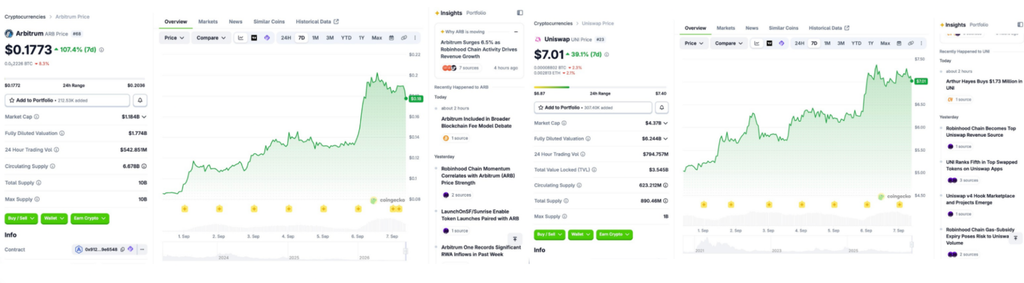
UNI price climbed 39.1% as Robinhood Chain activity drew attention to Uniswap and Arbitrum. ARB surged 107.4%, more than doubling during the week.
ARB reached its highest level since early January, while UNI returned to prices unseen since November.
TOTAL2ES, excluding Bitcoin and stablecoins, rose nearly 32% during the previous month. Zcash and legacy cryptocurrency Dash also posted double-digit weekly rallies.
Source: CoinGecko
Robinhood Chain Drives Record Crypto Revenue
Both token advances connect to Robinhood Chain, which launched about two months ago. The network has become crypto’s largest fee-generating blockchain. Its cumulative decentralized exchange volume has exceeded $40 billion.
Daily network revenue exceeds $4 million. That places Robinhood Chain ahead of Hyperliquid, Ethereum, BNB Chain, and Base. Uniswap and Arbitrum remain closest to the network’s growing revenue.
Uniswap Captures Robinhood Trading Activity
Uniswap serves as Robinhood Chain’s main decentralized exchange and handles nearly all trading activity there. It also collects more from each traded dollar than across its wider deployment.
Uniswap retains 0.465% of every dollar traded on Robinhood Chain. Across other networks, its comparable global rate stands at 0.214%. Tokenized stocks explain the difference because those assets trade through Uniswap’s most expensive fee tiers.
Tokenized stock pairs contributed almost nothing to Robinhood Chain’s volume during August. Their share has now increased to approximately 4.1%, strengthening fee collection.
Previously, liquidity providers received the fees while UNI remained outside that economic cycle. The UNIfication upgrade changed that structure by activating the fee switch. Collected fees now fund UNI purchases and burns, permanently reducing circulating supply.
Increased Robinhood usage creates more Uniswap trading volume and fee income. Those fees then support larger UNI purchases and permanent token burns.
Arbitrum Receives Contractual Revenue Share
ARB’s link to Robinhood Chain follows a different structure. The network uses Arbitrum technology and participates in the Arbitrum Expansion Program. Under that agreement, Robinhood Chain returns 10% of net protocol revenue.
The allocation sends 8% to the Arbitrum DAO treasury and 2% to the developer guild. By early September, the first 30 days had generated about $1.32 million through this arrangement.
That amount remained small beside the $78.73 million Uniswap collected from Robinhood Chain trading fees. Arbitrum’s allocation also enters a DAO-governed treasury instead of passing directly to ARB holders.
The revenue concentration creates a new dependency for Uniswap. Although it operates across dozens of blockchains, two-thirds of fee revenue comes from one network. Robinhood controls that chain while remaining accountable to shareholders and the SEC.
The concentration ties activity supporting UNI burns to Robinhood’s swap routing, fee structures, and regulatory conditions. Robinhood Chain continues setting volume records as burn activity rises and both tokens reflect stronger market demand.