
Robinhood rejected AMC Entertainment’s cease-and-desist demand over blockchain-linked tokens tied to AMC shares.
The clash raises questions about whether public companies can influence third-party tokenized products linked to their stock.
The issue affects issuers and retail investors because token buyers receive price exposure without becoming shareholders or gaining voting rights. Tokenized equities have expanded in 2026 while regulation, liquidity, and investor protections continue developing.
Robinhood Pushes Back Against AMC Demand
Robinhood legal chief Dan Gallagher responded to AMC CEO Adam Aron on X. Gallagher, a former SEC commissioner, said Robinhood knows “a little something about the U.S. securities laws and will not ‘DECIST.’” He added, “Send your lawyers, and we’ll educate them.”
CEO Vlad Tenev reshared Gallagher’s message and wrote, “We stand behind Stock Tokens.”
Aron argued Robinhood offered tokens connected to AMC and more than 190 companies without their consent or endorsement. He questioned whether the product complies with U.S. securities laws and raised concerns about protections for token buyers.
After Gallagher mocked “DECIST,” Aron said it intentionally combined “desist” and “de-cyst.” He questioned why Stock Tokens unavailable to U.S. residents appear on Robinhood’s U.S. website. Aron wrote, “If it’s not illegal, it should be,” and later accused Robinhood of “playing fast and loose with U.S. securities laws.”
What Robinhood Stock Token Buyers Own
Robinhood’s disclosures state Stock Tokens are not equivalent to purchasing shares. The company describes them as tokenized debt securities issued by Robinhood Assets Jersey Limited, providing economic exposure without legal or beneficial ownership.
Robinhood’s Classic Stock Tokens FAQ identifies the European product as a derivative contract. Customers receive no voting rights, and Robinhood warns they could lose their entire investment if the company becomes insolvent.
SEC Guidance Draws a Regulatory Distinction
On January 28, 2026, SEC staff issued a joint statement distinguishing issuer-tokenized securities from products created by unaffiliated third parties. Robinhood’s model falls within the second category.
The statement says securities offerings must be registered unless an exemption applies. However, it creates no legal obligations because it is a staff statement rather than an SEC rule.
Robinhood has faced similar issuer objections before. OpenAI previously rejected Robinhood tokens carrying its name, while Tenev said issuer consent was unnecessary.
Tokenized equities grew from $2.5 billion at the start of 2026 to $13.4 billion by September 1. CoinGecko reported $15.1 billion in first-quarter tokenized-stock spot volume.
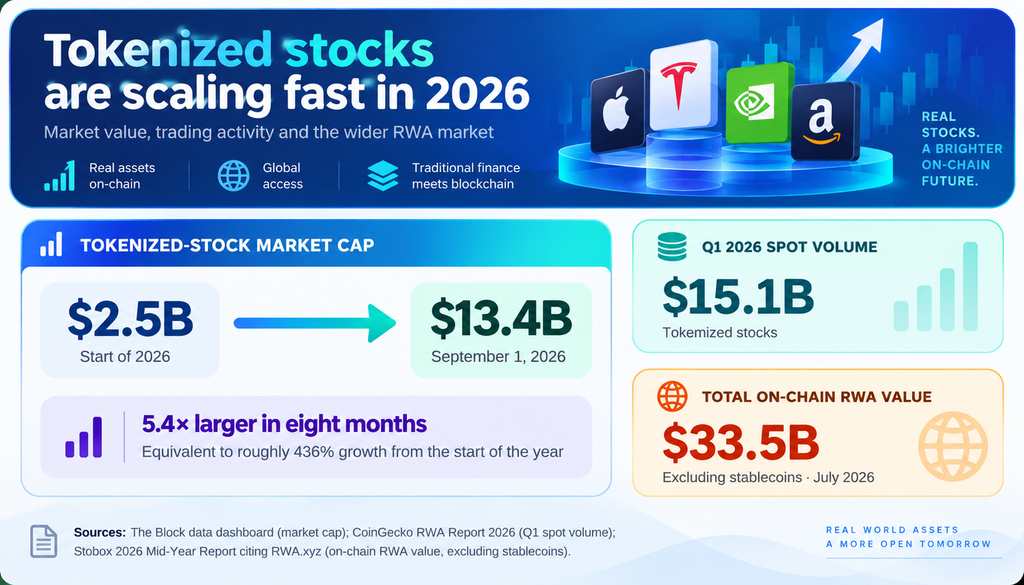
Robinhood lists more than 190 Stock Tokens. RWA.xyz found that its custom contracts can be misread by systems expecting standard ERC-20 behavior and may face DeFi compatibility issues. Stobox reported $33.5 billion in onchain RWA value excluding stablecoins in July. AMC shares rose nearly 21% overnight to $3.07 after Aron’s posts.