
Tokenized stocks are gaining traction across decentralized finance as investors increasingly use blockchain-based equities for trading, lending, and yield strategies.
The growth shows a wider shift toward bringing traditional assets into crypto markets. Data from Token Terminal shows that tokenized stocks used within DeFi protocols have expanded sharply since the start of the year. The increase highlights rising activity around tokenized equities beyond simple wallet holdings.
Token Terminal reported that tokenized stocks deposited into DeFi protocols reached $262.4 million, up from $14.66 million in January. The figure represents around 1,690% year-to-date growth, or nearly an 18-fold increase.
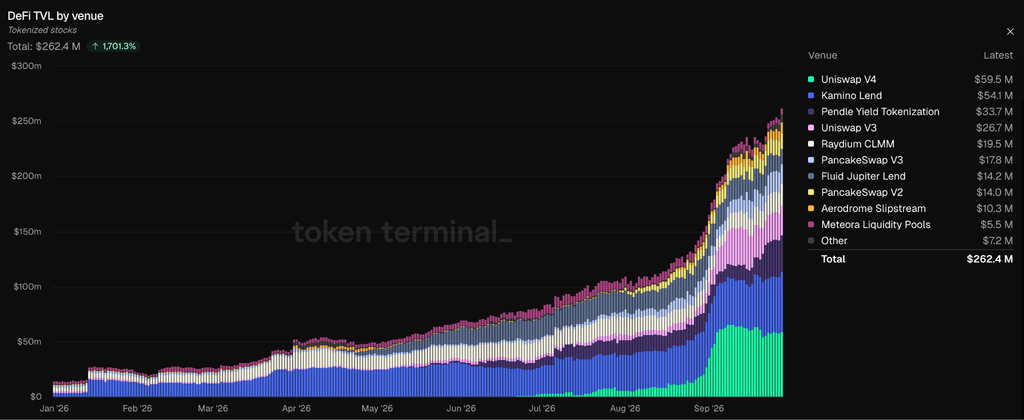
The data only tracks tokenized equities actively used inside DeFi platforms. It excludes assets sitting unused in wallets, such as a tokenized Nvidia share held without liquidity, lending, or yield activity.
Tokenized stocks in DeFi now include assets supplied to liquidity pools, used as collateral for loans, or deployed in yield strategies. The growth shows that investors are moving beyond ownership and applying tokenized equities across decentralized financial applications.
DEX pools hold majority of tokenized stock activity
Decentralized exchanges account for the largest share of tokenized stocks in DeFi, according to Token Terminal data. Around 58% of the $262.4 million total sits in DEX liquidity pools, allowing tokenized equities to trade continuously.
Uniswap V4 leads the market with $59.5 million, representing 22.7% of the total value. Uniswap V3 follows with $26.7 million, while Raydium, PancakeSwap, Aerodrome, and Meteora also contribute significant liquidity.
Lending protocols represent the second-largest category, holding about 26% of tokenized stock value. Kamino Lend leads lending activity with $54.1 million in collateral, while Fluid Jupiter Lend accounts for another $14.2 million.
The rise of tokenized stocks as loan collateral reflects increased reliance on pricing, liquidation, and redemption systems. Tokenized equities used in lending have grown from below $15 million in January to more than $68 million currently.
Pendle yield strategies represent another portion of the market, holding $33.7 million or nearly 13% of tokenized stock DeFi activity. These platforms allow users to apply tokenized equities in additional financial strategies.
Solana leads tokenized stocks with treasury assets driving growth
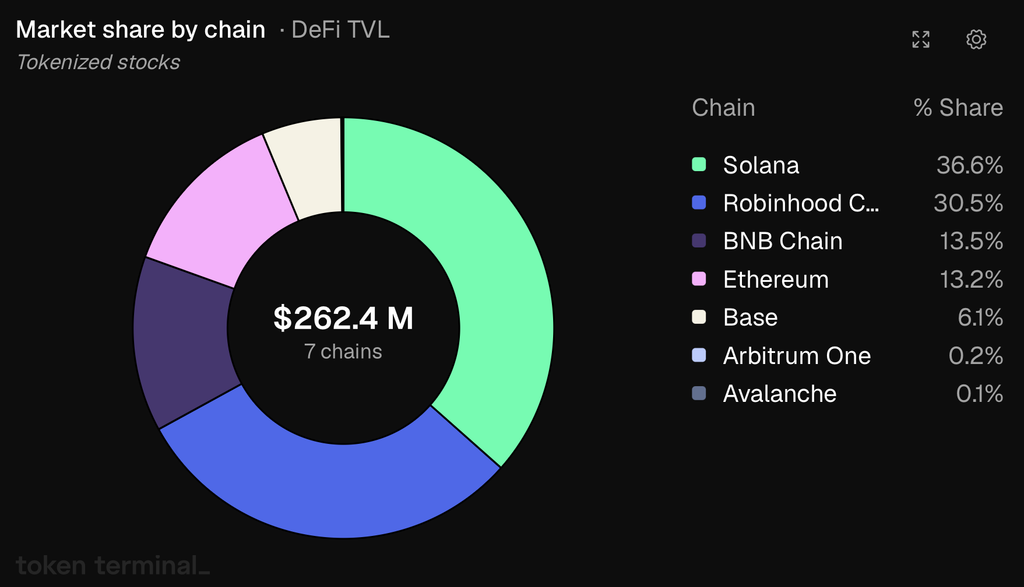
Solana remains the largest blockchain network for tokenized stocks in DeFi, holding $95.9 million or 36.6% of the total market. Robinhood Chain follows closely with $79.9 million, representing 30.5% of activity.
Almost all Robinhood Chain growth occurred in September, according to Token Terminal data. Meanwhile, BNB Chain and Ethereum hold $35.3 million and $34.7 million respectively, each accounting for around 13%. Base trails with $16 million.
Tokenized stock activity has also shifted across platforms during the year. Kamino and Solana-based decentralized exchanges supported much of the early growth, while Uniswap V4 gained momentum in September. Its total value locked roughly doubled during the month.
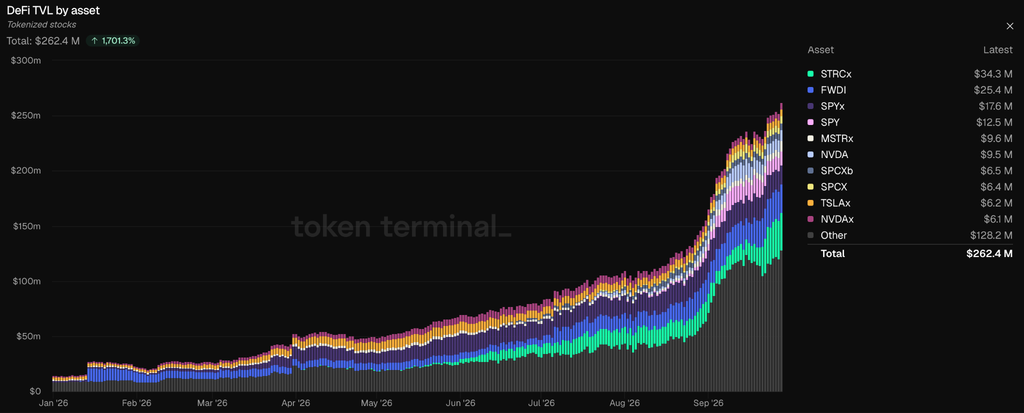
Crypto treasury-related stocks remain the largest category among tokenized equities. Strategy’s STRC preferred stock leads with $34.3 million deployed in DeFi. Forward Industries’ FWDI token follows with $25.4 million, while tokenized Strategy common stock MSTRx holds $9.6 million.
These crypto treasury stocks represent about one-quarter of all tokenized equity value locked in DeFi. Token Terminal reported that investors holding blockchain-related treasury exposure have increasingly used these assets for lending and other DeFi applications.
Traditional equity exposure is also expanding. S&P 500 tracking tokens SPYx and SPY hold a combined $30.1 million, while Nvidia tokenized shares across two issuers account for $15.6 million. Tesla’s TSLAx holds $6.2 million.
Token Terminal tracks 1,495 tokenized stock assets across DeFi platforms. Assets outside the top 10 represent 48.9% of total value, showing that activity remains distributed across a broad range of tokenized equities.