Aave has expanded its lending market by allowing selected Coinbase tokenized stocks to serve as collateral for USDC loans.
The move connects traditional equities with decentralized lending as demand for on-chain liquidity continues to grow.
Aave introduced the dedicated lending vault through its V4 hub on Base. The launch also comes as Ethereum recovers and tokenized asset activity attracts fresh capital.
The vault accepts tokenized shares representing Apple, Amazon, Alphabet, Meta, Microsoft, Nvidia, and Tesla. These companies make up the widely followed Magnificent Seven technology group.
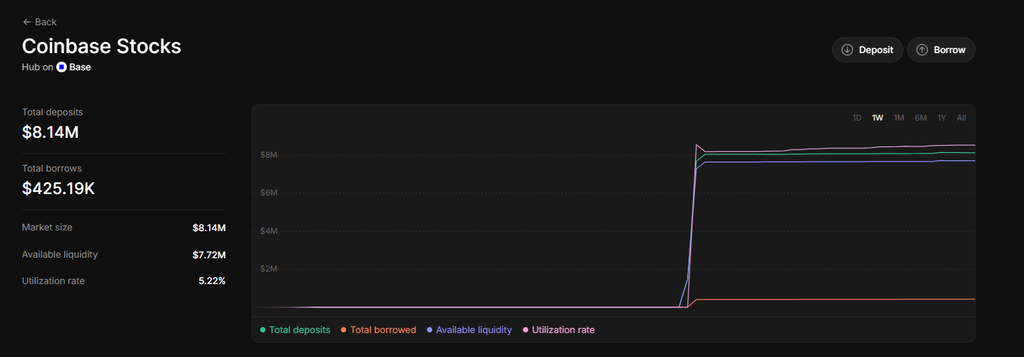
The Aave V4 vault based on tokenized Magnificent 7 tech equities immediately attracted collateral, but lending remained at a relatively low utilization rate. | Source: Aave
Users can deposit the Coinbase tokenized stocks as collateral and borrow USDC against their positions. Borrowers can then use that liquidity across DeFi markets or other trading strategies.
Aave’s V4 infrastructure seeks to connect traditional financial assets with blockchain lending markets. Tokenized equities have become another area where DeFi protocols are testing new collateral models.
Morpho also supports Coinbase tokenized equities through curated lending vaults. Steakhouse and Chipwork manage those markets, which provide variable-rate USDC loans.
Aave vault attracts $8.14 million in tokenized stocks
The Aave vault holds about $8.14 million based on current Coinbase tokenized stock valuations. However, borrowing activity remains relatively limited during the early stages.
Utilization stands near 5%, while borrowers have taken approximately $495,000 in loans. Aave aims to simplify access to loans backed by equities through blockchain-based infrastructure.
Traditional equity-backed loans often involve more steps and longer processing periods. DeFi markets can instead execute lending transactions directly through smart contracts.
The launch comes after most Magnificent Seven stocks recorded double-digit monthly gains. Amazon remained the exception during the period.
U.S. equities have also strengthened, pushing the S&P 500 toward record territory. That market recovery has increased attention around tokenized versions of traditional securities.
However, tokenized stocks present pricing challenges that differ from cryptocurrencies. Coinbase token prices depend on official equity market prices.
Chainlink oracles also stop updating stock prices during weekends. Consequently, protocols cannot value tokenized equity collateral continuously like crypto assets.
Aave founder Stani Kulechov said the protocol evaluates volatility before setting liquidation thresholds. Aave also adjusts liquidation bonuses to encourage timely settlement of risky positions.
The system seeks to prevent bad debt before prices move beyond available safety margins. This approach could reduce liquidation risks when negative stock news emerges during weekends.
Aave lending activity grows alongside DeFi recovery
Alpaca Securities LLC holds the underlying shares backing Coinbase tokenized equities. The regulated broker-dealer does not lend or transfer those underlying securities.
Instead, the shares remain reserved to support the tokenized products. Dividends are reinvested rather than distributed directly to token holders.
Aave’s broader lending business has also strengthened alongside Ethereum’s recovery. Rising tokenized asset activity has supported demand for borrowing and liquidity.
Aave’s total value locked has recovered above $19 billion. That represents its highest level since the Kelp DAO hack.
The protocol also generates more than $5 million in monthly earnings. Meanwhile, Aave carries over $13 billion in tokenized loans.
Ethereum remains the primary collateral behind most Aave borrowing positions. USDT and USDC account for most loan denominations.
AAVE traded near $148.08 as the protocol expanded its collateral offerings. Daily trading volume stood near $255 million.
Open interest hovered around $233 million following a recent 9% decline linked to liquidations. The token remains close to its three-month peak and upper 2026 trading range.