
Crypto economic activity reached a new high in Q3 2026 as blockchain applications generated stronger fee revenue and attracted more users.
The growth showed expanding demand for on-chain services beyond traditional trading activity. New launchpad models, decentralized exchanges, and prediction markets contributed to the increase.
The rise came as Web3 applications focused more on revenue generation and fee-sharing mechanisms. According to CryptoRank data, September alone produced $1.44 billion in fees from revenue-generating apps, highlighting stronger usage across multiple networks.
Fee Sharing Model Drives Web3 Activity Growth
Crypto economic activity recorded $3.3 billion in fees during Q3, marking a new quarterly peak. The increase reflected broader adoption of applications that generate revenue through direct user activity rather than short-term incentives.
Earlier Web3 activity relied heavily on airdrop farming, where users interacted with protocols to qualify for future token distributions. However, new fee-sharing models gained traction over the past year.
These models connected token holders with application revenue through mechanisms such as reflection tokens and tokenized asset products. The amount of fees generated depends on actual application usage, while each protocol applies different fee structures.
Crypto influencers also helped spread the fee-sharing model, particularly around reflection meme tokens. Some influencers received unsolicited fee-sharing offers through social platforms to increase attention around specific tokens.
However, blockchain data showed that only a limited number of meme projects generated meaningful fee-sharing revenue. Data also revealed that some recent meme launches were linked to rug pulls involving repeated launch teams.
Solana and Robinhood Lead Token Launch Activity
Crypto economic activity also expanded through new token launch platforms, with Solana and Robinhood Chain emerging among the strongest performers. The growth came from increased retail participation, liquidity availability, and demand for new token launches.
According to CryptoRank data, Robinhood Chain generated $368 million in fees during September, placing it among the highest fee-producing chains during the month. The early surge came from meme token launches through its ecosystem.
Later, the Pons launchpad became Robinhood Chain’s main fee contributor. The platform focused on reflection tokens connected to tokenized equities, cryptocurrencies, and precious metals.
Pons reached its highest daily fee production on September 5, generating $11.42 million. By the end of September, daily fees had stabilized near $2 million.
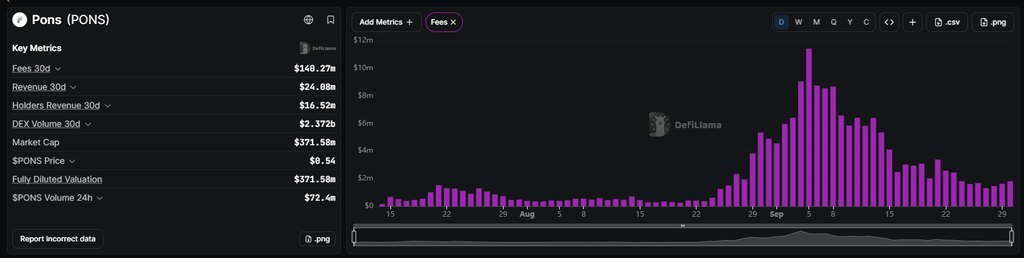
Pons activity peaked in September, making a major contribution to overall fees and revenues on Robinhood chain. | Source: DeFi Llama
Launchpads were not the only drivers of crypto economic activity. Decentralized trading platforms and prediction markets continued producing significant revenue across the industry.
Uniswap remained one of the leading decentralized exchanges by fee generation. The platform benefited from improved sentiment around altcoins and expanded activity through its Robinhood integration.
Meanwhile, Hyperliquid and Polymarket maintained strong positions among the top fee-producing applications. Hyperliquid generated more than $73 million in September fees, while Polymarket exceeded $87 million.
Prediction markets also reached a new milestone, surpassing $20 billion in weekly trading volume for the first time. The growth reflected increased participation across different types of on-chain financial applications.
Q3 showed that crypto economic activity continued moving toward applications with direct revenue generation. More chains recorded higher usage as new applications, trading platforms, and token launches expanded across the ecosystem.