The tokenized ETF market has recorded substantial growth in 2026, with market capitalization tripling as investor participation accelerates.
Onchain investment products have attracted more wallet holders, particularly through platforms offering exposure to traditional stock indices.
Meanwhile, differences between market value and holder distribution highlight contrasting participation patterns across major issuers. Ethereum continues to lead in asset value, while Binance-linked products dominate wallet adoption.
Tokenized ETF market value triples as investor adoption soars in 2026
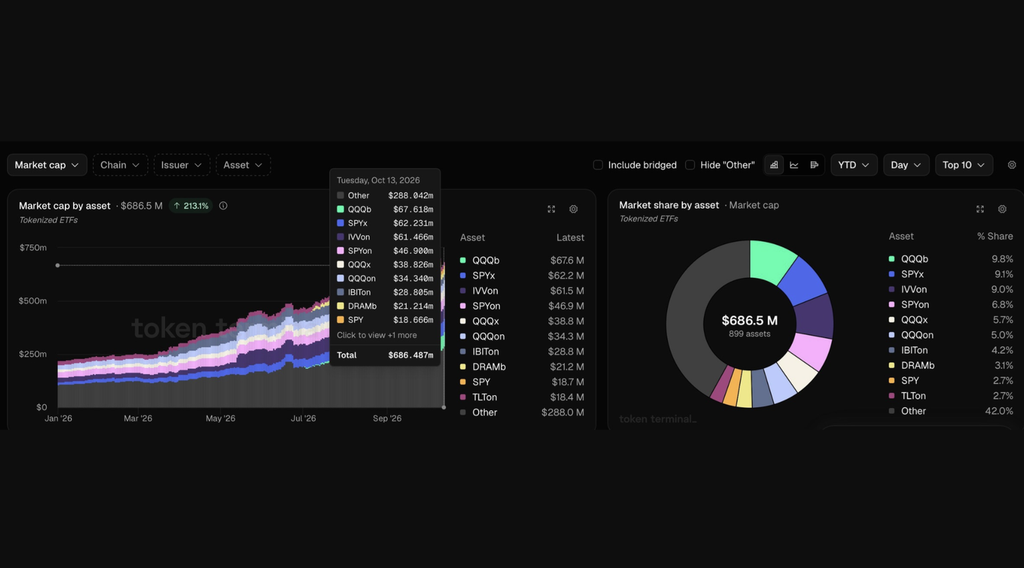
According to data from Token Terminal, the tokenized ETF market capitalization increased 213% year-to-date, reaching $686.5 million. The sector started January 1 with a combined valuation of $219.2 million before recording sustained growth throughout 2026.
However, holder growth has significantly outpaced the increase in market capitalization. Wallets holding tokenized ETFs jumped from approximately 17,500 to 897,700, representing a 51-fold increase.
During the same period, individual tokenized stock holders increased approximately 26.6 times. This means tokenized ETF adoption expanded at nearly twice the rate of individual tokenized equities.
Token Terminal data indicates that most holder growth occurred during the past two months. Adoption increased gradually through July before accelerating sharply in late August following Binance bStocks’ expansion.
The development comes as tokenized equities attract growing attention across the cryptocurrency industry. Jesse Pollack, head of Base, previously described tokenized equities as the next crypto supercycle.
Binance bStocks leads holder growth while ondo controls market value
Binance bStocks accounts for approximately half of all tokenized ETF holders, with 448,400 wallets. However, its $160.1 million market capitalization represents just 23.3% of the sector’s total value.
Robinhood shows a similar distribution, controlling 13.1% of holders against 5.4% of market capitalization. These figures suggest both platforms attract investors holding relatively smaller positions.
Conversely, Ondo Finance dominates the sector by asset value despite having fewer holders. The issuer controls $325.7 million, representing 47.4% of tokenized ETF market capitalization.
Nevertheless, Ondo accounts for only 20.3% of holders. This concentration suggests larger average holdings, although wallet data alone cannot confirm institutional participation.
Binance’s Nasdaq-100 product, QQQb, leads individual tokenized ETFs by market capitalization and holder count. The product holds $67.6 million across 314,500 wallets, representing approximately 35% of all sector holders.
SPYx follows with $62.2 million, while Ondo’s IVVon ranks closely behind at $61.5 million.
Meanwhile, S&P 500 and Nasdaq-100 products dominate the largest tokenized ETF offerings. Their combined value across the top ten products approaches $330 million, nearly half the overall market.
Several issuers offer similar index exposure through separate tokens on different blockchain networks.
Ethereum dominates tokenized ETF value as BNB Chain expands
Ethereum remains the largest blockchain network for tokenized ETFs, hosting approximately $303 million in assets. According to Token Terminal, this represents 44.1% of the sector’s market capitalization.
BNB Chain follows with $192.1 million, accounting for 28% of total market value. Its position closely reflects Binance’s growing presence in tokenized ETF issuance.
Solana holds another 13.3% of the sector. Meanwhile, Arbitrum One, Robinhood Chain, and X Layer each account for less than 5%.
The latest figures show that tokenized ETF wallet adoption has expanded considerably faster than invested capital since August. Binance leads in holder numbers, while Ondo maintains the largest share of market value.