Bitcoin has weathered several major security breaches throughout its history, but large crypto thefts have not always triggered lasting market declines.
Historical price data suggests investors often distinguish between exchange security failures and problems with Bitcoin itself.
Bitwise Chief Investment Officer Matt Hougan says the latest record-breaking Binance hack fits that pattern. His analysis shows Bitcoin gained ground after half of the industry’s 10 biggest hacks.
Bitcoin posted gains after half of the biggest crypto hacks
In a November 4 memo, Hougan examined Bitcoin’s performance during the 30 days following the 10 largest crypto thefts. The results showed five periods of gains and five periods of losses.
His former colleague David Lawant, now head of research at Anchorage Digital, helped develop the analytical approach.
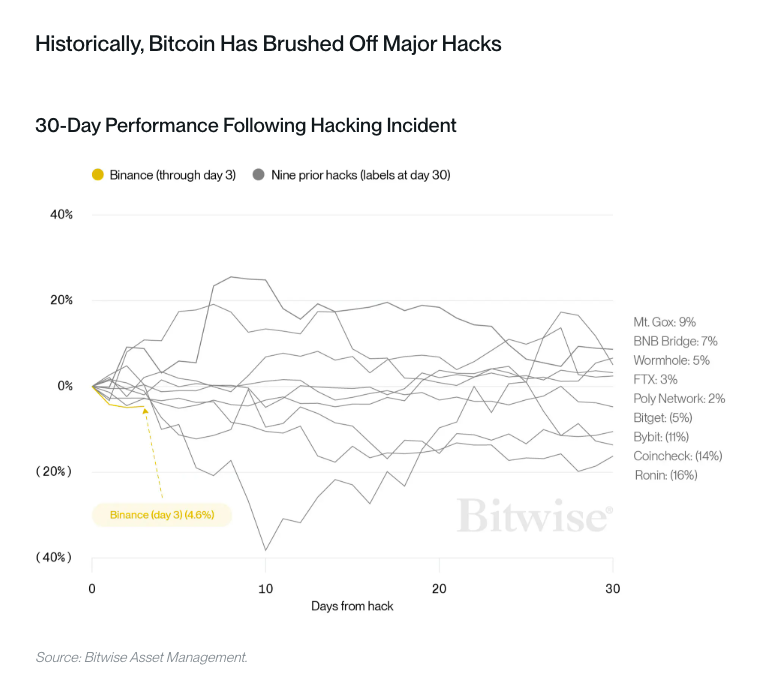
Hougan argued that the latest $6.3 billion Binance hack would probably have little lasting impact on Bitcoin’s market performance. The October 29 incident became the largest cyber theft in history by dollar value, roughly four times larger than the previous record.
Bitcoin fell approximately 4% over the following day. However, the decline closely tracked broader technology stocks, with the Nasdaq-100 dropping around 3% on October 30.
BTC then traded mostly sideways through November 3, suggesting the hack had not triggered sustained selling pressure.
Hougan maintained that crypto thefts do not damage Bitcoin’s underlying network. Its supply remains capped at 21 million coins, its blockchain continues operating, and major institutions still hold the asset.
He also noted that nobody has stolen Bitcoin by hacking its blockchain during the network’s 17-year history. “Bitcoin wasn’t hacked last week. Binance was,” Hougan wrote.
Binance hack highlights exchange security risks
The stolen funds came from Binance’s online hot wallets, which exchanges use to process deposits and withdrawals quickly. These wallets offer convenience but provide less protection than offline storage.
Attackers reportedly gained access through an employee’s laptop, exposing weaknesses in the exchange’s security infrastructure.
On November 4, Binance said it had restored approximately 98% of the affected assets using its reserves. The exchange also said it was purchasing the remaining amount through regular and over-the-counter markets.
Hougan urged investors to consider institutional custodians, personal cold storage and spot Bitcoin exchange-traded funds (ETFs) as alternative custody options.
He particularly highlighted ETFs because qualified custodians hold their Bitcoin offline. At Bitwise, transfers from cold storage require approval from multiple people.
The firm also restricts transfers to a limited number of preapproved market-maker addresses. Furthermore, ETF-related Bitcoin typically moves only once daily.
Hougan presented these safeguards as an option for long-term Bitcoin holders seeking stronger custody protections.
TD Cowen analyst Lance Vitanza similarly argued that the incident exposed weaknesses in Binance’s security rather than Bitcoin’s underlying technology. He compared the situation to bank robberies, which do not undermine confidence in the dollar.
Bitcoin rebounds as investors watch ETF demand
Bitcoin and other crypto-related assets recovered on November 4. BTC gained approximately 4% to close at $80,405, while Ether (ETH) climbed around 7% to $2,422.
The rally followed the November 3 US midterm elections, which gave Democrats control of both chambers of Congress.
Meanwhile, Strategy shares rose approximately 5%, while Coinbase gained around 4%.
21Shares crypto research strategist Matt Mena said the record-breaking theft produced a less severe market reaction than previous crises.
Mena is monitoring whether Bitcoin maintains support between $76,000 and $78,000. He is also watching for a potential recovery in spot Bitcoin ETF inflows.
Ultimately, Hougan’s longer-term bullish outlook rests on continued institutional demand. He believes stronger custody arrangements can reduce security concerns without undermining Bitcoin’s investment case.