
Kalshi faces another legal challenge as US states intensify their scrutiny of prediction markets. Arkansas Attorney General Tim Griffin has taken action against the platform over its sports and entertainment betting contracts.
The lawsuit raises questions about whether federal oversight protects prediction markets from state gambling laws. Meanwhile, Kalshi CEO Tarek Mansour is highlighting the platform’s election forecasting performance following the US midterm elections.
Arkansas Attorney General sues Kalshi over illegal gambling
Arkansas Attorney General Tim Griffin filed a lawsuit against KalshiEX LLC and Kalshi Inc. in Independence County on Wednesday. He accused the prediction market operator of offering illegal gambling services to Arkansas residents.
Griffin said the state seeks restitution, penalties, taxes, and injunctive relief. He also described Kalshi as a “pocket-sized bookie” operating without the licenses required under Arkansas law.
The attorney general argued that Kalshi accepts real-money wagers on sports and entertainment outcomes without obtaining the necessary gambling licenses. He also raised concerns about the platform allowing residents as young as 18 to participate.
Furthermore, Griffin cited Kalshi’s deposit limits, gambling-addiction resources, and self-exclusion tools as evidence of its gambling operations. He argued that these features contradict the company’s description of itself as a prediction market.
In his statement, Griffin said the platform’s activities mattered more than the terminology it used. He added that wagering money on whether the Arkansas Razorbacks win or lose clearly constitutes gambling.
The lawsuit follows earlier scrutiny from Griffin’s office in October 2025. At the time, his office argued that Kalshi and similar platforms would violate Arkansas law without the required gaming licenses.
That position followed an opinion requested by state Senator Bryan King. The opinion concluded that prediction market operators could not avoid state gambling regulations simply by labeling their products as prediction markets.
Kalshi CEO highlights 98% midterm election accuracy
The Arkansas lawsuit arrived as Kalshi CEO Tarek Mansour promoted the platform’s performance during the US midterm elections.
Mansour said Kalshi correctly forecast the winners in 98% of the races listed on its platform. He shared the results on X, challenging criticism from established institutions that questioned prediction markets’ forecasting accuracy.
He also wrote that “the power to decide what America sees changed hands.” His comments followed the election results, which supported Kalshi’s forecasts of a Democratic sweep.
Americans wagered more than $1.3 billion through Kalshi on the midterm elections. On Tuesday, the platform also operated as a live election hub, incorporating results data from the Associated Press.
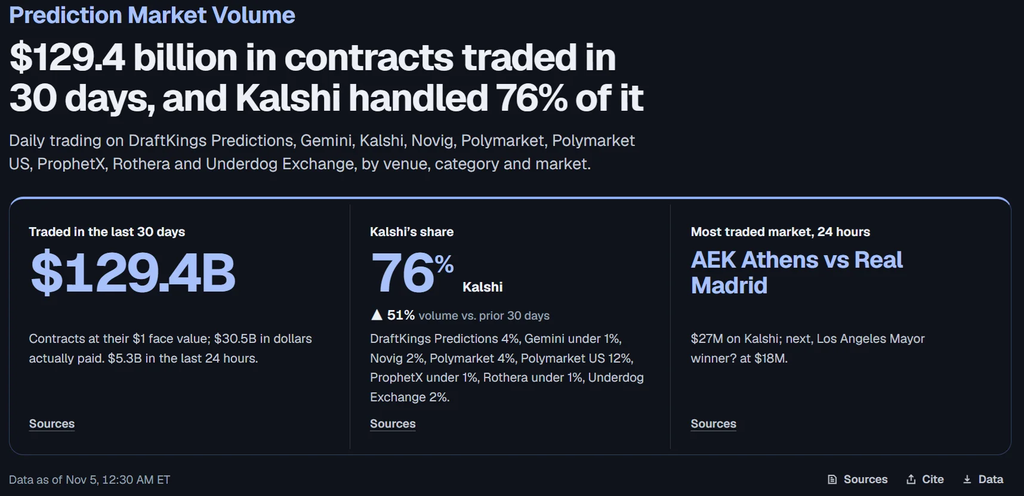
Kalshi ranks as the world’s largest prediction market by trading volume. The company recently raised approximately $1 billion at a $40 billion valuation.
However, sports contracts remain central to its business. Roughly 80% of Kalshi’s trading activity comes from sports markets, the same category attracting lawsuits from multiple states.
Kalshi faces legal battles across 20 states
Arkansas joins a growing list of states challenging Kalshi’s operations under local gambling laws. The platform already faces legal disputes involving Utah, Arizona, Nevada, and Ohio, among others.
Utah escalated its action on October 28 by pursuing Kalshi and co-founders Tarek Mansour and Luana Lopes Lara. The state brought 13 felony charges and one misdemeanor against them.
Kalshi maintains that federal law protects its event contracts from state gambling restrictions. The company argues that the Commodity Futures Trading Commission (CFTC) regulates these products as financial derivatives.
However, federal courts have delivered conflicting decisions. The Third Circuit sided with Kalshi, while the Sixth and Ninth Circuits supported state authorities.
Meanwhile, New Jersey asked the Supreme Court in September to resolve the dispute over federal and state jurisdiction.
The CFTC has also sued several states to defend federal oversight of prediction markets. The resulting litigation now involves approximately 20 states, leaving Kalshi’s regulatory position contested across the country.