Robinhood has added Bitcoin to its corporate balance sheet as the brokerage expands deeper into digital assets.
The move gives the company direct exposure to Bitcoin alongside its larger crypto operations. However, the purchase remains small compared with Robinhood’s overall valuation and customer-held assets.
The company continues to focus most of its crypto investment on trading products, tokenization, and blockchain infrastructure.
Robinhood now holds $25 million worth of Bitcoin on its own balance sheet, marking its first corporate BTC purchase. Johann Kerbrat, Robinhood’s crypto and international chief, disclosed the investment during an interview with The Block.
Kerbrat announced the purchase while attending Token2049 in Singapore. He said Robinhood wanted to align its corporate strategy more closely with the broader cryptocurrency community.
However, Kerbrat played down the financial impact of the Bitcoin purchase. Robinhood carries a market capitalization of roughly $100 billion, making the investment relatively small.
Robinhood’s Bitcoin holding represents a small share of company value
Robinhood shares closed Tuesday at $112, placing the company’s market value near $100 billion. Therefore, the $25 million Bitcoin holding represents around 0.025% of Robinhood’s market capitalization.
The position also remains smaller than recent Bitcoin purchases by major corporate holder Strategy. Michael Saylor’s company bought 334 BTC for approximately $28.7 million between September 28 and October 4.
That acquisition increased Strategy’s total holdings to 848,000 BTC. Robinhood, meanwhile, manages substantially more Bitcoin through its customer custody operations than it owns directly.
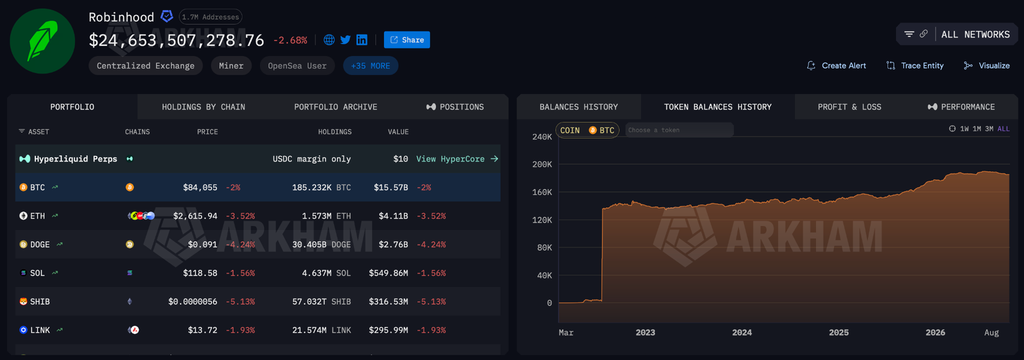
Arkham data shows Robinhood holds about 185,232 BTC for customers, valued at approximately $15.57 billion. That custody position significantly exceeds the Bitcoin now sitting on Robinhood’s corporate balance sheet.
Kerbrat said the $25 million position would not materially change Robinhood’s current business trajectory. The company has not announced a scheduled Bitcoin accumulation strategy or recurring purchase policy.
Such a policy would place Robinhood closer to companies that actively use Bitcoin as a treasury asset. For now, the purchase remains separate from its larger crypto product strategy.
Robinhood expands perpetual futures, Blockchain and tokenized stocks
Robinhood continues to direct larger resources toward crypto trading products and blockchain infrastructure. The company recently announced plans to introduce perpetual futures trading for eligible U.S. customers.
The planned offering will support BTC, ETH, SOL, XRP, DOGE, ADA, LINK, and HYPE. Users will gain the ability to take long or short positions through perpetual contracts.
CEO Vlad Tenev described the initiative as a new phase for U.S. derivatives trading. Robinhood expects to introduce the products in the coming months.
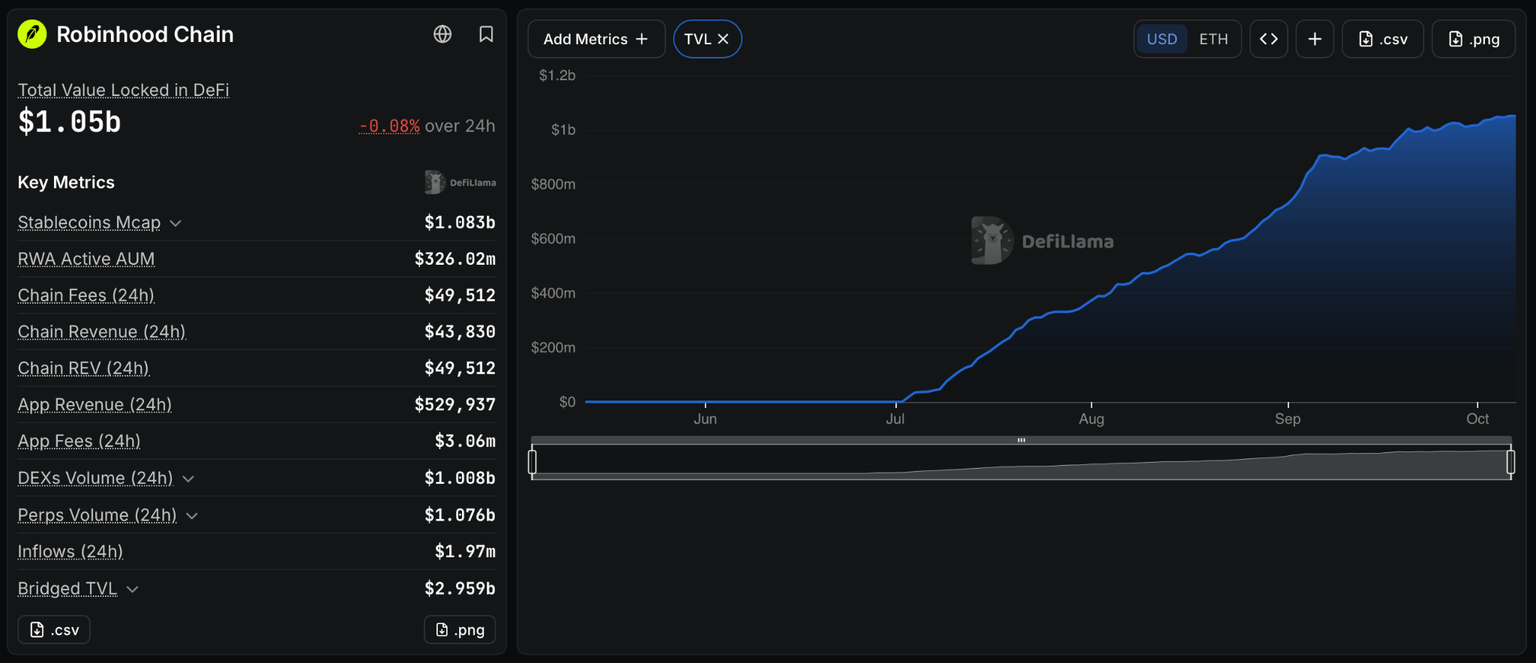
Meanwhile, Robinhood Chain launched its mainnet in July using technology from the Arbitrum stack. DefiLlama reported $1.05 billion in total value locked as of Tuesday.
Kerbrat has highlighted Robinhood’s 28 million funded accounts as a potential distribution advantage for the blockchain. Around 27 million of those accounts belong to U.S. customers.
Robinhood has also expanded its tokenized stock products as demand continues to grow. Kerbrat recently said trading volumes were approaching limits under the SEC innovation exemption covering tokenized U.S. equities.
The Bitcoin purchase also comes during renewed pressure across cryptocurrency markets. Bitcoin briefly dropped below $84,000 on October 6 as crypto long liquidations reached about $487 million.
Bitcoin currently trades near $84,000 following the market decline. Robinhood’s $25 million purchase remains too small to materially influence Bitcoin liquidity or overall market direction.
Future purchases could provide clearer evidence of a broader Robinhood Bitcoin treasury strategy. For now, its custody operations, derivatives expansion, blockchain network, and tokenized assets represent much larger crypto commitments.