
AEREDIUM has opened LOVEH, its ownerless lending protocol, on a public testnet. The Layer 1 blockchain is offering an AERX bug bounty to encourage researchers to scrutinize the contracts.
The rollout marks AEREDIUM’s first move into consumer DeFi after focusing on institutional clients. The public test gives researchers time to identify flaws before lenders and borrowers commit real funds.
LOVEH bug bounty targets flaws that put funds at risk
The AEREDIUM Foundation advertises 10,000 AERX for each qualifying flaw it confirms and credits rewards as airdrop points. The general airdrop program converts 10 points into one AERX at listing. The LOVEH announcement leaves the exact number of points per award unclear.
Bugs qualify if they let someone access funds without permission, trap lenders’ or borrowers’ assets, or break a documented rule. A market that fails to balance its books qualifies, as does one that liquidates a loan within its borrowing limit. The program excludes complaints about style, wording, or costs. The earliest qualifying submission earns the reward when several researchers report the same flaw.
Researchers can file reports privately through GitHub. AEREDIUM says it will publish each report and its outcome. Uniswap Labs took a similar approach ahead of its v4 launch in 2024. It offered up to $15.5 million and described the bounty as the largest in history at the time.
LOVEH market rules lock at deployment
LOVEH contracts have no owner, admin keys, or governance body. Even the developers who wrote the code cannot pause, patch, or upgrade a live market. Liquity’s Kolten Bergeron outlined a similar governance-free approach for its Ethereum protocol in 2021. Morpho Blue also uses isolated markets with rules that stay fixed after deployment.
Anyone can create a market by choosing the loan token, collateral asset, price source, borrowing limit, and interest rate formula. Lenders collect borrower interest after the contracts deduct a hard-coded 10% fee. The AEREDIUM Foundation receives that fee in the loan token. AEREDIUM says each market contains its own losses.
Fixed gas fees and borrowing rates tied to demand
AEREDIUM charges $60 per megabyte of transaction data, keeping ordinary transfers below one cent even during market swings. Sell-offs can drive up network fees as borrowers add collateral, lenders withdraw, and liquidators close troubled loans.
In March 2020, Ethereum congestion and higher gas fees contributed to zero-bid collateral auctions during MakerDAO’s Black Thursday. LOVEH still allows anyone to repay a loan and claim discounted collateral when its value falls below the required threshold.
At deployment on November 15, AEREDIUM anchored LOVEH’s rate curve to Ethereum’s three largest USDC lending pools. It averaged borrowing rates from their contracts after two independent sources agreed on the figures.
Annual borrowing rates start at 0.5% when nobody borrows and reach 5.5% at 92.33% utilization.
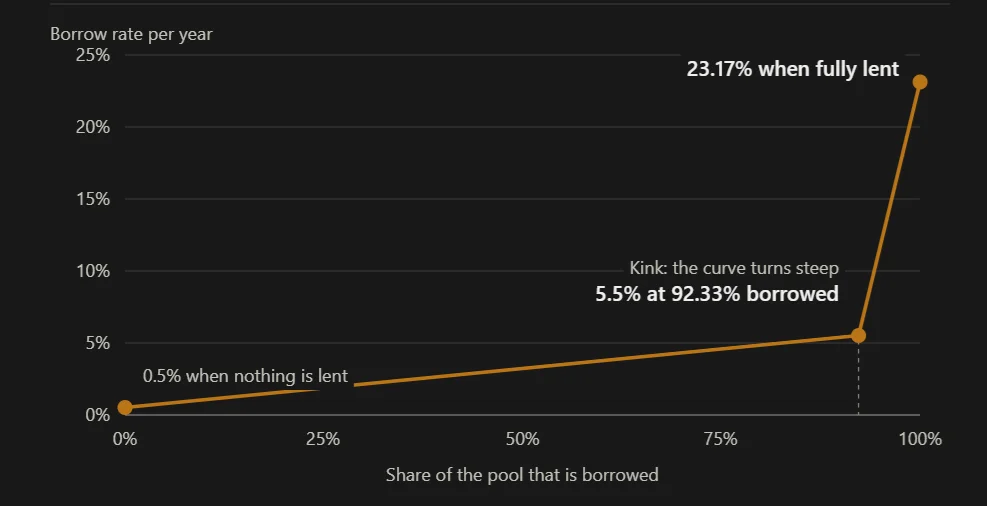
They climb to 23.17% when borrowers use the entire pool. LOVEH extends AEREDIUM’s work beyond institutional settlement, which CEO Albert Dadon has described as supporting different payment methods.