Bitcoin could outperform traditional investments over the next decade, according to JPMorgan’s first long-term cryptocurrency forecast.
The bank expects Bitcoin to deliver stronger annualized returns than U.S. stocks, gold, and real estate investment trusts.
However, its outlook also highlights substantial volatility and risks that could affect long-term performance. The forecast marks a new step in how JPMorgan evaluates Bitcoin alongside established asset classes.
JPMorgan forecasts 10% annual Bitcoin returns over the next decade
J.P. Morgan Asset Management projected a 10% compounded annual return for Bitcoin in its 2027 Long-Term Capital Market Assumptions.
The bank released its 31st annual report on October 19, introducing Bitcoin projections for the first time. The analysis covers more than 200 asset classes and compares Bitcoin with 12 conventional investments.
According to JPMorgan, U.S. large-cap stocks could deliver annual returns of 7.5%, while small-cap stocks could generate 7.7%. Meanwhile, real estate investment trusts carry an 8.2% forecast, compared with 5.5% for gold.
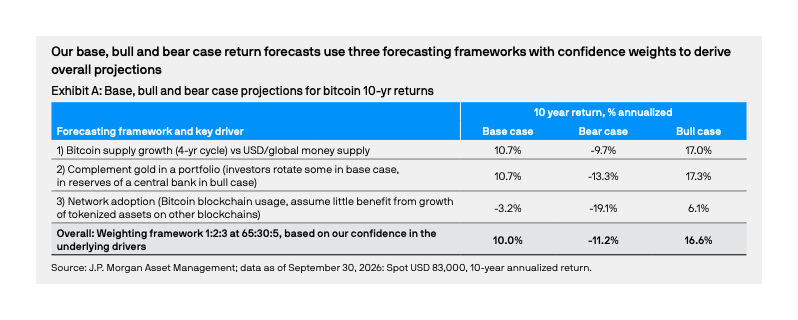
Base, bear and bull case projections for bitcoin’s 10-year returns, with data as of September 30, 2026, in J.P. Morgan Asset Management’s 2027 Long-Term Capital Market Assumptions report.
Bitcoin’s projected return exceeds large-cap equities by 2.5 percentage points and gold by 4.5 percentage points.
However, JPMorgan outlined sharply different outcomes depending on market conditions. Its bearish scenario projects an annualized loss of 11.2%, while its bullish scenario forecasts 16.6% yearly gains.
The projections use Bitcoin’s September 30 spot price of $83,000.
JPMorgan assigned a 65% weighting to Bitcoin supply growth relative to money supply. The gold-complement scenario received 30%, while network adoption accounted for the remaining 5%.
Meanwhile, the bank projected 7% annualized returns for a traditional 60/40 stock-bond portfolio. It attributed this outlook to AI-driven productivity improvements, corporate profitability, and higher bond yields.
Bitcoin’s 55% volatility keeps it outside core investment models
Despite its leading return forecast, JPMorgan identified Bitcoin’s volatility as a major portfolio risk.
The bank estimated Bitcoin’s annualized volatility at 55%, compared with 17.2% for gold and 18% for large-cap stocks.
Consequently, JPMorgan excluded Bitcoin from its main covariance matrices, which measure relationships between asset price movements.
Instead, analysts developed a separate model comparing Bitcoin against selected investments.
The bank also calculated Bitcoin’s arithmetic average annual return at 20.9%, substantially exceeding its 10% compounded projection. Compounding accounts for losses and subsequent recoveries, making volatility especially important when evaluating long-term returns.
JPMorgan indicated that greater market stability could eventually support Bitcoin’s inclusion in its primary models. However, that would require more consistent correlations, deeper liquidity, clearer regulation, and reduced volatility.
Report authors Dr. Sheena Shah and Dennis Cristallo described Bitcoin as the cryptocurrency ecosystem’s anchor. They highlighted its liquidity, longevity, and improving regulatory clarity.
Bitcoin ETF inflows strengthen institutional interest
Institutional Bitcoin demand also attracted attention following JPMorgan’s long-term forecast.
BlackRock’s IBIT recorded $665.16 million in inflows on October 19, its strongest daily figure since October 2025. Meanwhile, U.S. spot Bitcoin ETFs collectively attracted $526.6 million as Bitcoin traded between $82,000 and $83,000.
Bitwise Chief Investment Officer Matt Hougan welcomed JPMorgan’s decision to include Bitcoin in its long-term assumptions.
However, Hougan challenged the bank’s 55% volatility estimate, citing declining Bitcoin price fluctuations over the past 15 years. He also argued that different economic outcomes could support Bitcoin’s long-term investment case.
Strategy Chairman Michael Saylor similarly acknowledged Wall Street’s growing attention to Bitcoin’s investment potential.
Nevertheless, JPMorgan urged investors to examine Bitcoin allocations carefully and stress-test portfolios against its bullish and bearish scenarios.