Cardano has introduced a compliance framework that gives regulated token issuers greater control over assets moving across its blockchain.
The framework supports stablecoins, tokenized funds, bonds, and other regulated financial instruments. Issuers can embed identity checks, sanctions screening, transfer restrictions, and asset recovery rules directly into their tokens.
The launch comes while Cardano’s stablecoin market remains relatively small compared with larger blockchain networks.
Cardano CIP-0113 adds freeze and seize controls
The Cardano Foundation launched CIP-0113 on mainnet after announcing the standard at the TOKEN2049 conference. The Swiss-based nonprofit introduced the framework without requiring a Cardano hard fork.
CIP-0113 allows issuers to create compliance rules that follow tokens across applications, wallets, and services. The Cardano ledger checks those rules whenever users transfer, mint, or burn affected tokens.
Transactions proceed only when they meet conditions defined by the issuer. Otherwise, the ledger rejects them before completing the transaction.
Issuers can introduce identity verification, anti-money laundering checks, sanctions screening, and transfer restrictions. They can also activate optional freeze-and-seize functions where regulations or product structures require them.
The framework includes pre-built rule sets called modules. However, issuers can develop custom rules and replace existing requirements when regulations change.
Cardano Foundation chief executive Frederik Gregaard said the rules should travel with assets whenever they move. The approach aims to keep compliance controls attached to tokens instead of individual applications.
Freeze-and-seize controls can also give issuers authority to recover tokens without the holder’s approval. However, issuers must specifically enable those capabilities within their asset rules.
The Aiken implementation describes Freeze & Seize as an optional regulatory compliance feature. Therefore, CIP-0113 does not automatically make every Cardano token subject to confiscation.
The technical specification also warns lending platforms about accepting assets carrying issuer-controlled recovery powers. Services may need to review those controls before accepting such tokens as collateral.
Cardano targets tokenized finance despite small stablecoin market
Cardano introduced the framework while its stablecoin market remains considerably smaller than competing networks. DeFiLlama data cited in the announcement places Cardano stablecoins at roughly $67.5 million.
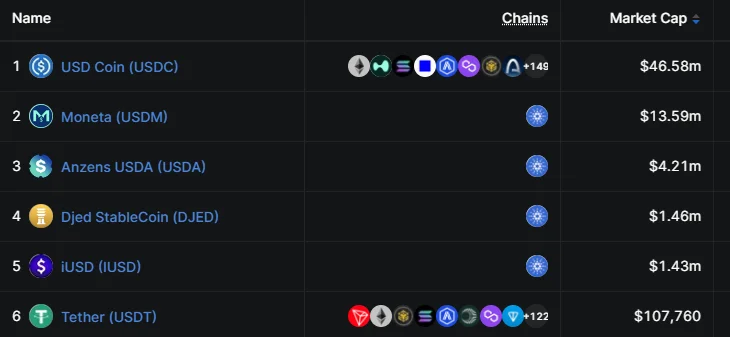
Top stablecoins on Cardano. Source: DeFiLlama.
Ethereum, Solana, and XRP Ledger already support versions of transfer controls for regulated assets. Cardano has therefore entered an area where competing networks already offer compliance-focused infrastructure.
The network also added ADA support for Coinbase’s x402 payment standard in September. That integration expanded Cardano’s payment infrastructure shortly before the CIP-0113 mainnet launch.
CIP-0113 also responds to growing institutional demand for programmable financial assets. The BIS and IMF have highlighted programmability as an important feature for expanding tokenized finance.
Programmability allows issuers to embed regulatory conditions directly into financial assets. These conditions can then remain enforceable as assets move between supported platforms.
The Swiss Capital Markets and Technology Association has also recognized CIP-0113 Programmable Asset Tokens. It views the standard as a smart-contract equivalent to its CMTAT framework.
That recognition supports potential use involving ledger-based equity securities under Swiss standards. Meanwhile, the Cardano Foundation continues developing a dedicated securities module for regulated financial instruments.
The technology predates this week’s mainnet announcement. CIP-0113 builds on CIP-143, an earlier reference design developed by Phil DiSarro and the IOG team.
Developers later migrated the implementation to the Aiken programming language. Cardano founder Charles Hoskinson also discussed freeze-and-seize capabilities in January 2025.
Hoskinson said similar controls could support asset recalls, identity updates, and dividend payments. Those functions extend the framework beyond sanctions enforcement and stablecoin restrictions.