
Fluidkey has blamed vulnerabilities in a third-party logging tool for a wallet exploit that drained more than $1.58 million.
The privacy wallet provider said attackers manipulated transaction processes without directly accessing users’ private keys.
The incident affected accounts across several blockchain networks and prompted an emergency shutdown of its services. Fluidkey has since introduced security changes to prevent similar unauthorized transfers.
Fluidkey Identifies Logging Tool Vulnerabilities Behind Wallet Exploit
In a November 20 statement on X, Fluidkey explained how attackers exploited weaknesses in an external logging tool. The vulnerabilities exposed session data, allowing attackers to prepare unauthorized transactions through the company’s servers.
These transactions received signatures when users opened the application. However, Fluidkey maintained that users’ private keys never left their devices.
The company released version 1.79.22 to block the transaction preparation method attackers exploited. The update also introduced additional safeguards across its web, iOS, and Android applications.
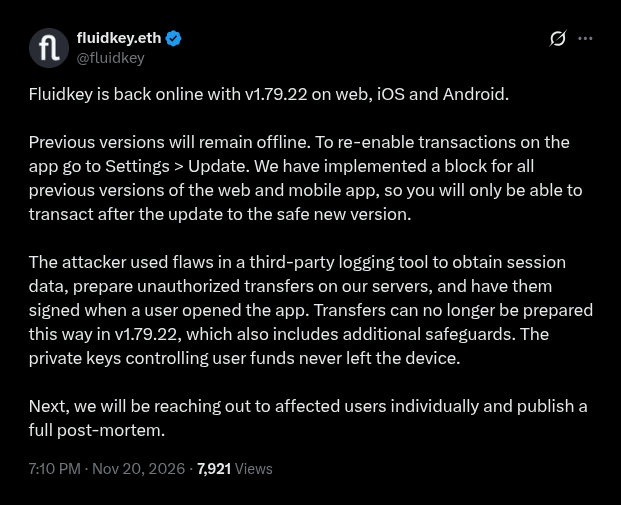
Fluidkey restored its applications while blocking older versions from sending funds. Users must update through Settings before making further transfers.
The company operates a privacy-focused wallet system that assigns each user a unique name. Incoming payments generate fresh stealth addresses, preventing outsiders from easily calculating users’ total holdings.
Each address functions as a Safe smart contract wallet. Users generate their spending keys locally through their browsers.
Because new addresses lack ETH for gas fees, Fluidkey processes transactions through relayers. The platform operates one relayer wallet per supported blockchain.
Bitquery Tracks $1.58 Million Across Six Blockchain Networks
Blockchain analytics firm Bitquery traced at least $1.58 million to attacker-controlled wallets across six networks.
The affected chains included Ethereum, Base, BNB Chain, Optimism, Arbitrum, and Polygon.
According to Bitquery, the exploit lasted 36 minutes, beginning at 17:28 UTC and ending at 18:04 UTC on November 19.
Approximately half the funds reached attacker wallets within five minutes.
Base recorded the largest losses at approximately $837,000. Ethereum followed with $660,000.
The largest individual transfer involved $415,783 in USDT from two Ethereum accounts.
Meanwhile, one user transferred $277,000 to a wallet they had used since 2024 during the incident.
An independent GitHub tracker estimated losses near $1.63 million. Bitquery placed the total between $1.58 million and $1.64 million.
Attackers Move Stolen Funds Through Tornado Cash
Fluidkey warned users against accessing its website and applications at 18:20 UTC on November 19.
The company later confirmed that services had gone offline at 18:05 UTC. It reported no further unauthorized transactions after the shutdown.
Fluidkey also said blockchain security group SEAL 911 had joined efforts to trace the stolen funds.
However, blockchain records showed that six wallets transferred 881.6 ETH into Tornado Cash between 20:05 and 21:29 UTC.
The deposits represented approximately $1.57 million at the time. Earlier transactions showed the attacker’s wallets had received initial ETH funding from Tornado Cash hours before the exploit.
Fluidkey said it would contact affected users individually and publish a detailed post-mortem explaining the incident.
The breach follows another third-party security incident involving prediction platform Predict.fun. In October, Predict.fun promised refunds after attributing a separate wallet drain to a third-party website.