Ethereum core developers will weigh changes to the network’s gas rules on Thursday. The proposals aim to make room for more transactions under the upcoming Glamsterdam upgrade.
Auditors found that the new rules could disrupt smart contracts that depend on today’s gas costs. Developers must weigh those risks against the prospect of delaying the upgrade.
Glamsterdam gas proposals put deployed contracts at risk
Ethereum Foundation developer Marius van der Wijden estimated the changes could affect 10,000 to 15,000 of roughly 90 million contracts.
He put the value at risk at a few hundred thousand dollars. Thursday’s 90-minute execution-layer call, ACDE #249, starts at 14:00 UTC with Glamsterdam first on the agenda.
Foundation developer Rahul Kothari is expected to discuss feedback on the specifications and share updates from affected teams.
EIP-8037 raises the cost of creating on-chain state, while EIP-8038 raises costs for certain operations that access it.
The changes aim to curb node storage growth as Glamsterdam enables a block gas limit increase from 60 million to 200 million.
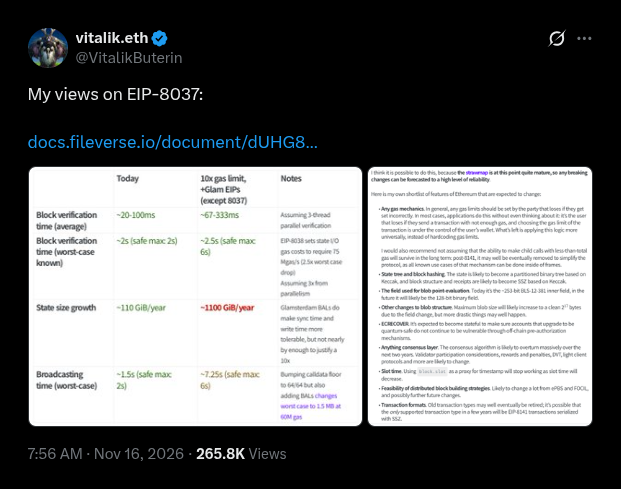
In a November 16 post on X, Vitalik Buterin backed EIP-8037 and warned that fixed-gas bridges could break. He estimated that a tenfold gas limit would mean annual state growth of roughly 1,100 GiB versus 110 GiB with repricing.
Audits find roughly 200 contract compatibility issues
ChainSecurity first flagged vulnerable contracts in October, prompting developers to pause the Hoodi testnet fork.
On Monday’s testing call, the auditor reported 152 findings, including 76 that overlapped with the foundation’s review. Together, the two reviews yielded roughly 200 findings.
Dedaub separately flagged 70 medium- to high-risk findings across about 25,000 contracts with complex gas usage. It identified 22 contracts the foundation had missed.
ChainSecurity traced most findings to higher operation costs, including failures involving hardcoded gas limits. Few stemmed from EIP-8037’s new gas reservoir for state creation.
The auditor said teams could readily address most issues, though some contracts would need upgrades or redeployment. Kothari’s outreach identified three high-severity issues and at least 25 medium-severity issues. Most affected teams are working on fixes.
Ethereum developers weigh three options for Glamsterdam
Juicebox builder Jango said Sepolia simulations showed a caller could skip a payment to another contract under Glamsterdam’s rules.
The simulations showed the issue at gas limits between 182,000 and 294,000. Jango said Juicebox’s live versions cannot receive an in-place fix.
A Uniswap developer urged a review of EIP-8037. Security researcher pcaversaccio said consensus compatibility alone cannot guarantee that applications keep working.
Developers could keep the specifications, revise gas accounting, or drop EIP-8037 from Glamsterdam.
The foundation urged developers to wait for public audit findings and planned to present possible revisions on Thursday.
Some developers warned on Monday that a rollback could delay Glamsterdam by four to six months and push back post-quantum work. Developers have yet to set a new date for the Hoodi testnet fork.