
Bitcoin needs trillions in new capital to sustain another major rally, according to CryptoQuant CEO Ki Young Ju, who argues that significantly larger institutional allocations are required for meaningful price appreciation in the current market cycle.
Bitcoin continues facing pressure as institutional demand remains subdued and capital increasingly shifts toward artificial intelligence infrastructure.
Ju shared on-chain analysis on July 1 showing that every Bitcoin market cycle has required substantially larger inflows to generate comparable returns.
His data indicated that $2.7 billion in net inflows fueled a 55,436% gain during 2011, while the current cycle transformed $697 billion into a 689% increase.
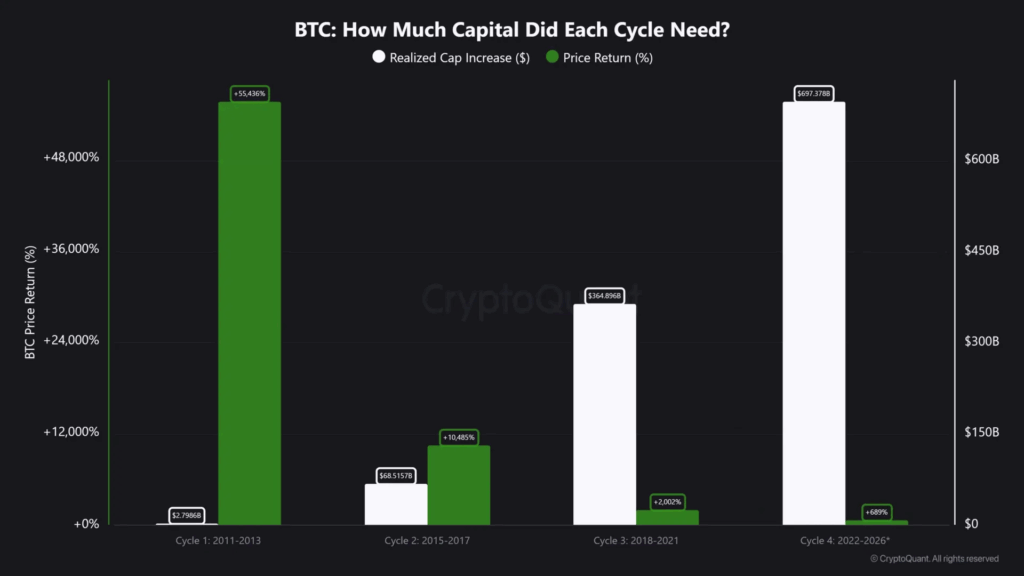
Bitcoin needs exponentially more capital to replicate past rallies. Source: CryptoQuant
The analysis also showed Bitcoin now requires approximately $101 billion in net inflows to double in value, compared with just $5 million during 2011.
Bitcoin requires larger institutional allocations
Ju said the next major rally depends on Bitcoin becoming a core macro asset rather than remaining primarily an exchange-traded fund investment.
He stated, “The next parabolic bull cycle likely requires deeper institutional portfolio allocation and Bitcoin becoming a core macro asset, not just an ETF trade.”
According to Ju, another parabolic advance remains possible if Bitcoin attracts more than $1 trillion in additional realized capitalization. He also noted that gold currently holds a market capitalization of approximately $27 trillion.
Meanwhile, institutional capital has largely favored artificial intelligence investments instead of digital assets.
Recent market movements showed gold, silver, and Bitcoin declining together as hedge positions unwound, while funds flowed into AI-related stocks.
Several Bitcoin mining companies have also redirected computing resources toward AI hosting because contracted payments provide steadier revenue than mining operations.
Bitcoin traded near $58,800 after falling more than 45% from its October peak above $120,000. U.S. spot Bitcoin exchange-traded funds also experienced continued withdrawals.
SoSoValue reported total net outflows of $222.64 million on June 30, including $212.45 million from BlackRock’s IBIT fund.
On-chain data highlights stronger selling pressure
On-chain analyst Axel Adler Jr. reported that Bitcoin exchange inflows measured by a 30-day moving average reached 122,000 BTC on July 1.
That figure stands about 52% above February levels near 80,000 BTC and approaches the upper yearly deviation band around 131,000 BTC.
Adler also observed that Bitcoin’s Spent Output Profit Ratio remained below the breakeven level of 1.0 for 37 of the previous 61 days.
He noted that February displayed similar loss realization, although exchange inflows were considerably lower. Current conditions therefore combine heavier selling volume with sustained loss-taking activity.
Wealth transfers could expand future demand
Grayscale Head of Research Zach Pandl identified two long-term sources of institutional demand.
He said wealth transfers from older generations who hold approximately $110 trillion could eventually benefit crypto markets.
Pandl estimated that allocating 2% of those assets would generate $2.2 trillion in crypto demand.
He also highlighted corporate treasuries beyond crypto-native firms, citing SpaceX’s 18,712 Bitcoin holdings worth roughly $1.4 billion.