Bitcoin BIP-110 is again dividing the community as the proposal approaches its planned activation at block height 961,632 in early August.
The proposal seeks to introduce a soft fork that would block transactions considered spam, including ordinals, runes, and NFTs.
Supporters argue that Bitcoin should remain focused on payments, while opponents continue using the network for additional on-chain data.
Bitcoin BIP-110 Targets Ordinals and Other On-Chain Data
The proposal has intensified an ongoing disagreement between Bitcoin maximalists and users who rely on inscriptions for digital assets and messaging. BIP-110 supporters maintain that Bitcoin functions best as a payment network and describe non-payment data as unnecessary spam.
The proposal is scheduled to activate in early August at block height 961,632. As that milestone approaches, discussion around the update has increased because it could divide network participants if consensus is not achieved.
According to current network activity, ordinals and runes account for more than 67% of Bitcoin transactions.
The network continues processing these transactions while operating with very low fees, making it practical for users to publish content on-chain.
Bitcoin currently generates about $2.3 million in daily transaction fees while processing more than 621,000 transactions every day.
More than 91% of blocks remain full, indicating that network capacity continues to be heavily utilized despite low transaction costs.
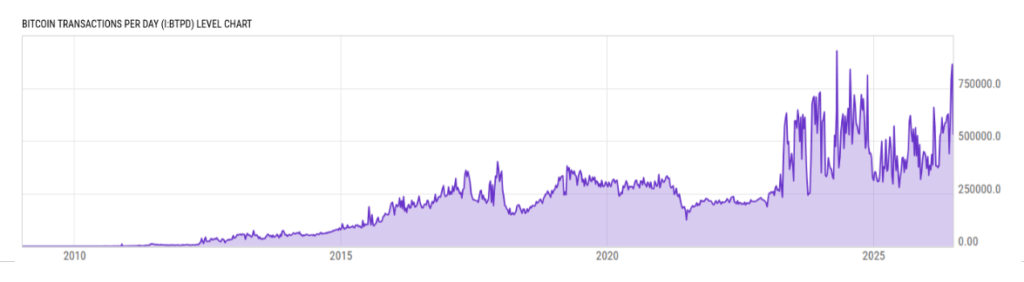
The Bitcoin network carries over 621K transactions daily, while the mempool is currently not overwhelmed by ordinals and runes transactions. | Source: Ycharts
Supporters Continue Campaign Against Network Spam
Supporters of BIP-110 argue that ordinals, runes, and NFTs place unnecessary data on the blockchain. Blockstream’s Adam Back has stated that the network should not carry spam transactions.
The debate also extends to previous methods of embedding information. Earlier uses of the OP_RETURN feature have been criticized because some users employed it to claim ownership of inactive wallets. Even if BIP-110 becomes active, other methods of attaching messages or content to Bitcoin blocks would still remain available.
Limited Support Raises Questions Over Network Consensus
Current signaling for BIP-110 has remained limited, suggesting that only a small number of miners and nodes currently support the proposal.
If activation occurs without broader participation, miners may continue producing regular blocks while supporters validate blocks under the proposed rules.
Such a situation would create separate versions of the Bitcoin network, with one continuing to process ordinals and related transactions.
The dispute has drawn comparisons to the period that produced Bitcoin Cash after competing chains failed to maintain a shared consensus.
The proposal may continue operating with backing from a limited group of miners and nodes even without widespread agreement. Around the activation period, some Bitcoin wallets could experience compatibility issues.
The Bitcoin Knots wallet included with the proposal could also become unusable, making certain coins unspendable if problems occur. The proposal could also stop producing blocks if sufficient activity does not continue.