
Bitcoin’s Supply in Loss has risen above 50%, showing that over half of the circulating BTC now sits below its cost basis.
CryptoQuant data shows the reading at 51.6%, up from 34% about a month ago. The shift has left Bitcoin supply almost evenly split between coins in profit and coins in loss.
Bitcoin Cost Basis Shows Holder Pressure
Supply in loss tracks the share of Bitcoin whose on-chain cost basis stands above the current market price. A coin’s cost basis reflects the price at which it last moved on-chain. When the metric rises, more holders are sitting on unrealized losses.
The move from roughly one-third of supply in loss to more than half marks a sharp decline in market positioning. It also shows that recent buyers have faced pressure as Bitcoin moved below their acquisition levels. The metric differs from sentiment surveys because it follows actual coin movement and realized price levels.
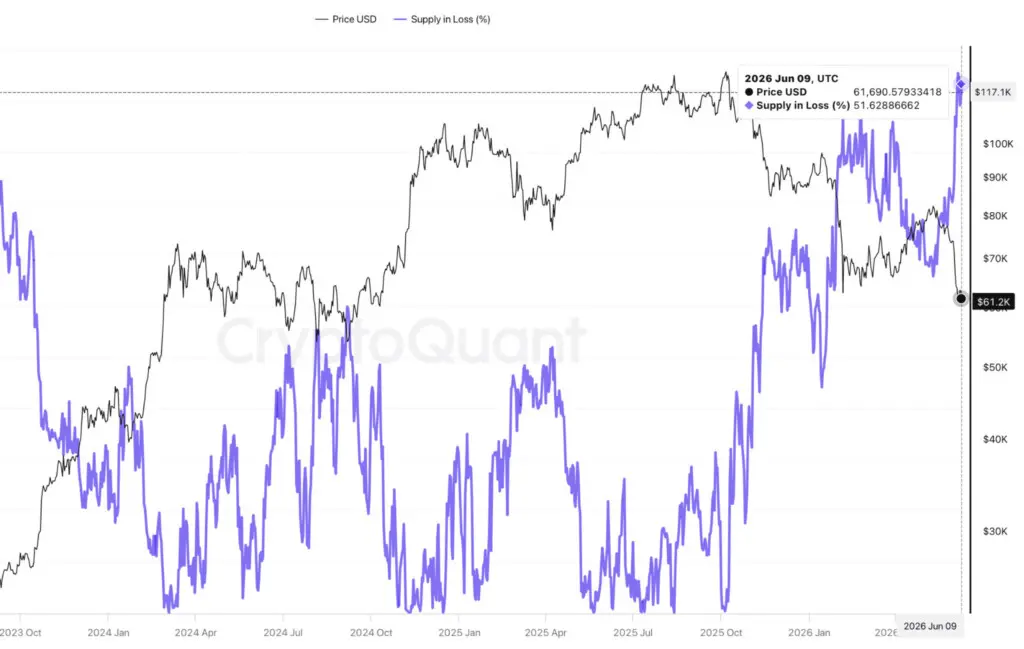
For market observers, the increase shows how much stress remains across the network. Holders can sell into weakness or hold through the drawdown. The data does not show which path they will choose, but it measures the scale of losses embedded in the market.
Rare Bitcoin Supply Split Near Cycle Lows
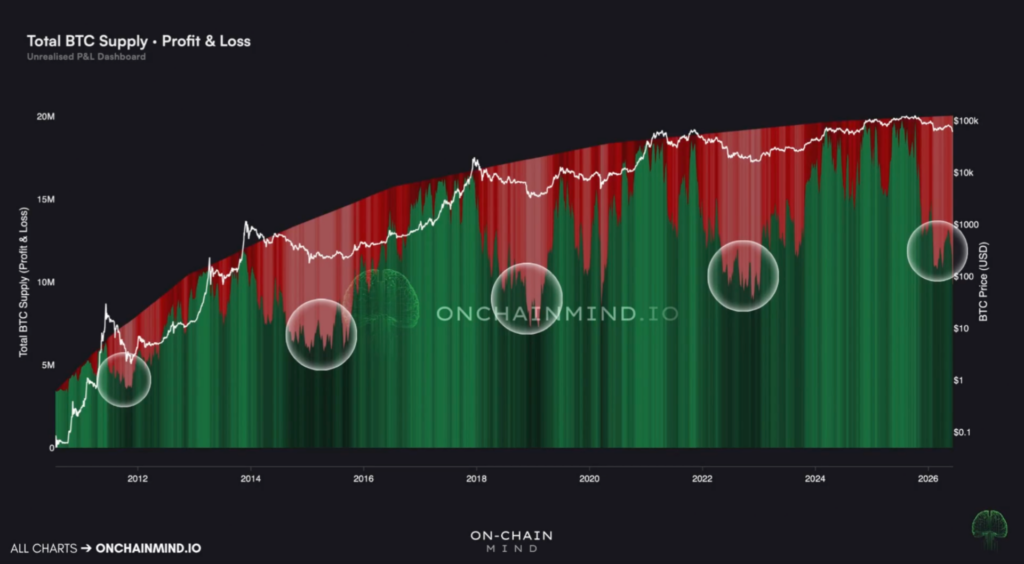
Bitcoin has reliable price data going back to 2010. During that period, BTC has spent about 93 percent of its history with more than half of its supply in profit, according to onchainmind.io. That makes the current supply split rare in Bitcoin’s history.
Source: Onchainmind
Past examples have appeared close to major bear market lows. Similar readings emerged near the 2015 bottom, during the 2018 capitulation, and again in 2022 after the FTX collapse pushed BTC to that cycle’s lows. The current reading is the first such signal since then.
The pattern does not confirm an exact bottom. It does, however, place Bitcoin in a zone seen near major turning points.
Bitcoin Bottom Process May Take Time
Historical behavior shows that Bitcoin has not usually rebounded sharply after supply loss reached this area. Instead, price has often moved sideways while the market absorbed losses. Ownership shifted during those phases as weaker holders exited and stronger holders accumulated.
That points to a slow capitulation process rather than one defined by a sudden low. The market may continue to trade unevenly as sellers test conviction and buyers wait for clearer strength.
The latest data shows Bitcoin in an uncommon position, with loss and profit levels nearly balanced across supply. It does not call a bottom by itself, but it shows conditions that resemble earlier periods when the market moved closer to a floor than a top.