
A Tron wallet transferred millions in USDT after Tether publicly proposed freezing the address. The transfer was the largest of its kind in a yearlong review by wallet-risk project FreezeCheck.
The study found that some wallets continued sending USDT while Tether’s freeze proposals awaited confirmation. Researchers said the timing alone could not establish whether any sender had seen a proposal.
Tron wallet moves 15.2 million USDT in one transfer
Tether’s proposal appeared on Tron at 13:05 UTC on September 20, 2026. Five minutes later, the wallet with an address beginning TT5KQg sent 15.2 million USDT in a single transaction. The freeze took effect at 14:14 UTC, 64 minutes after the transfer.
FreezeCheck found no outgoing transfers from the address during an equally long period before the proposal.
The project, which runs a Telegram wallet-checking bot, said some addresses in the study were already active.
A few large wallets accounted for much of the total that moved during the waiting period. It compared each wallet’s transfers during the wait with its activity over the same length of time immediately beforehand.
About 30% of Tether freezes took more than an hour
A multisignature wallet controls Tether’s USDT contract on Tron and requires approval from two of its three owners.
One owner submits an on-chain proposal containing the addBlackList(address) call, which immediately makes the target address public.
The contract blocks outgoing USDT only after a second owner confirms the transaction. FreezeCheck matched freeze transactions to proposals for 4,199 addresses from November 4, 2025, through November 7, 2026.
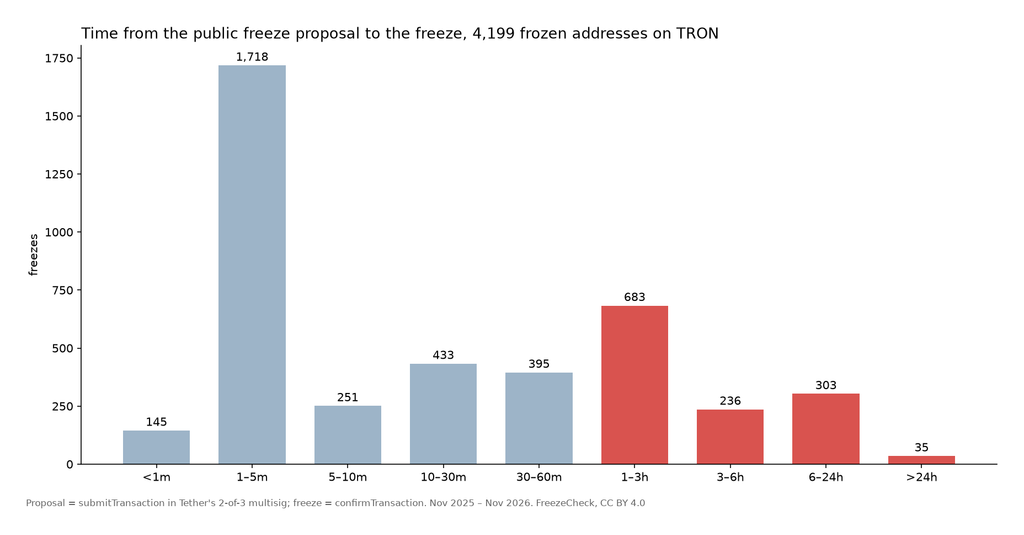
The study recorded 4,221 freeze events because Tether froze some addresses more than once. Half took effect within 9.7 minutes. However, 1,257 took more than an hour, including 338 that took more than six hours. Thirty-five took longer than a day, with the longest delay reaching 167 hours.
Targeted wallets sent 65.4 million USDT before freezes
Of the 3,476 addresses still frozen on November 8, 219 sent 65.4 million USDT before their freezes took effect.
In the matching periods before the proposals, 177 addresses sent 27.9 million USDT. Outflows during the wait were 2.3 times as high.
Among 1,150 addresses with waits of at least an hour, 165 sent 53.3 million USDT, versus 23.6 million beforehand. Wallets without exchange, service or scam labels received 94.5% of those outflows.
FreezeCheck said these were typically new wallets and based its classifications on a database of 71 million labels. Exchange deposit addresses received 130,000 USDT in total. Another 3.2 million USDT went to addresses Tether later froze.
In August, Cryptopolitan reported that a separate analysis of 2,955 Tether freezes on Ethereum and Tron measured the same gap.
The average was two hours and 16 minutes. In July, sanctioned Iran-linked wallets held more than $165 million. Roughly $34 million moved out before Tether’s freeze took effect.
Frozen addresses can still receive USDT. During the study period, 1,945 senders transferred 104.2 million USDT to 982 addresses after Tether froze them.
FreezeCheck counted 3,033 incoming transfers of at least one USDT, including 280 within an hour of a freeze. Exchanges accounted for 3.7 million USDT. FreezeCheck published a downloadable CSV with the proposal and freeze transaction hashes on Zenodo.