
Ondo Finance says existing U.S. securities laws can accommodate perpetual contracts tied to individual stocks without requiring new regulations.
In an August 24 comment letter, Ondo Finance and broker-dealer affiliate Oasis Pro Markets urged the SEC and CFTC to apply the current security-futures framework.
The filing responds to the agencies’ June request under File No. S7-2026-21 concerning definitions for swaps and security-based swaps. Ondo argues under current federal law that cash-settled perpetual contracts linked to single stocks can qualify as security futures under the Commodity Futures Modernization Act of 2000.
Ondo Finance Presses Existing Security Futures Framework
Ondo’s position centers on how security futures are defined. The company argues that the statute focuses on the underlying security and settlement structure rather than requiring a fixed expiration date.
Under that interpretation, a perpetual resembles a traditional futures product without maturity. Funding payments and mark-to-market settlements replace scheduled expiration while preserving the contract’s function.
The framework also provides joint SEC-CFTC oversight and a notice-registration process. It allows firms registered with one regulator to register with the other without creating a separate entity.
Ondo says regulators can assess individual filings under current law instead of waiting for broader rulemaking. The proposal would bring offshore activity into U.S. markets with domestic supervision, clearing, margin, surveillance, position limits, and trading-halt requirements.
Offshore Trading Strengthens Ondo Finance Case
Ondo Global Panama Inc., an Ondo subsidiary, offers stablecoin-settled perpetual futures on U.S.-listed stocks to non-U.S. customers. Ondo said platform trading exceeded $8 billion during the six weeks following its launch by August 14.
The company also says it has about $4 billion in tokenized assets on its ledger and leads the tokenized equities market. Messari analysis cited by Ondo shows billions of dollars in equity-perpetual activity on newer offshore platforms.
In a September 2 blog post, Ondo linked three comment letters covering product definitions, portfolio margining, and data reporting. It said there is “something backwards about perps on U.S.-listed stocks trading entirely offshore” and urged regulators to prioritize U.S. trading.
Regulatory Debate Continues Over Perpetual Classification
The Blockchain Association also submitted an August 24 letter supporting the security-futures framework for equity perpetuals. It warned offshore liquidity could become harder to recover as trading habits and market depth become established abroad.
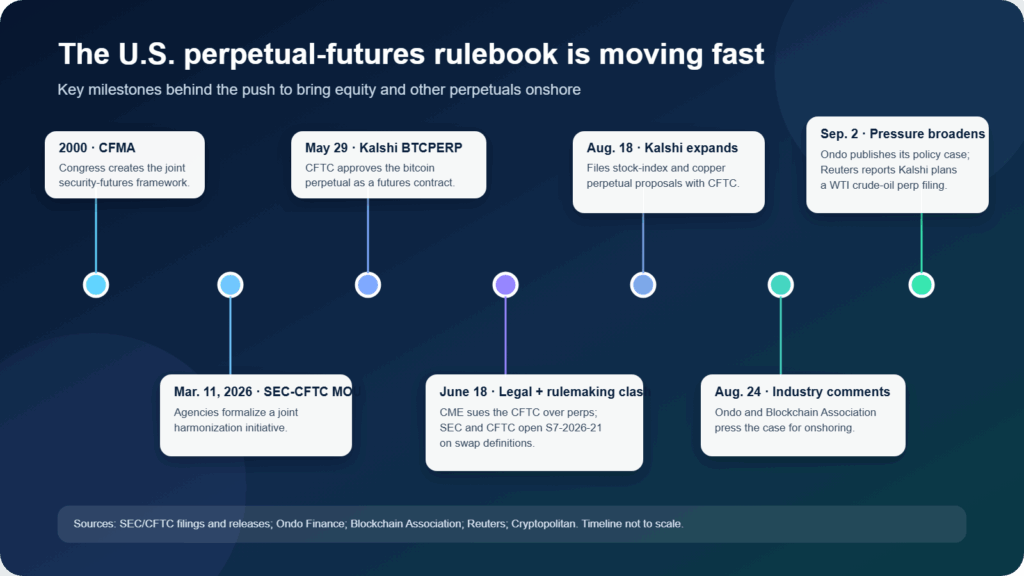
The debate follows the SEC-CFTC harmonization effort launched in March 2026. The CFTC approved Kalshi’s BTCPERP on May 29 as futures contracts and said additional perpetual products would be reviewed individually.
Kalshi later filed for perpetual contracts tied to a U.S. stock index and copper. Reports on September 2 said it was preparing a filing linked to West Texas Intermediate crude oil.
CME Group disputes this approach. Its June lawsuit against the CFTC argues perpetual contracts should be treated as swaps, not futures. The dispute could determine whether individual-stock perpetuals can operate under existing U.S. security-futures rules.