
Solana Transaction V1 activated on testnet at epoch 1025 on September 1, completing the final rehearsal before the planned September 9 mainnet activation. Anza began local V1 testing August 24, and confirmed the mainnet date of August 29.
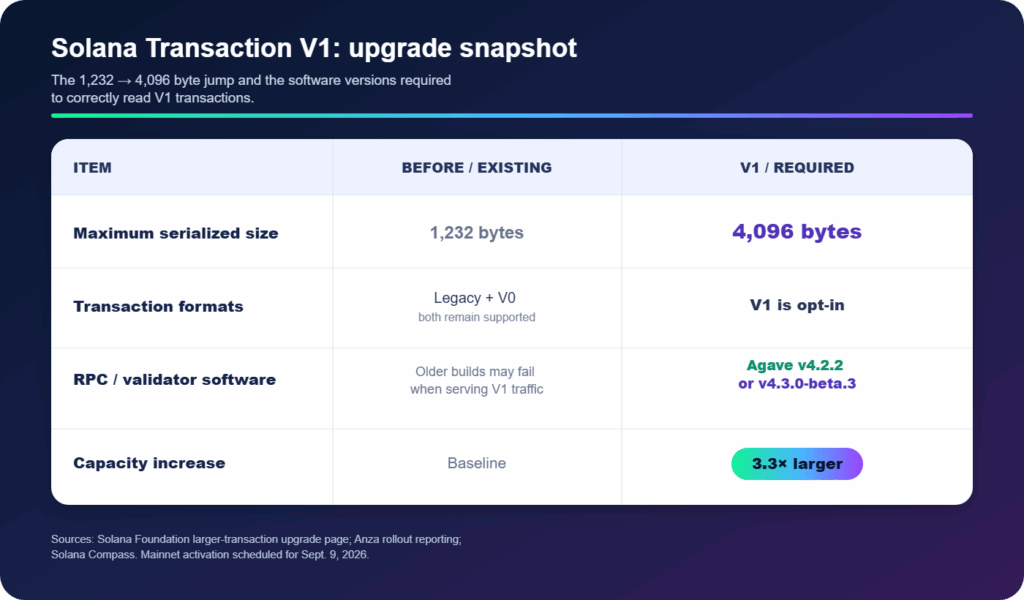
The upgrade raises Solana’s maximum serialized transaction size from 1,232 bytes to 4,096 bytes, roughly 3.3 times larger. It lets cryptographic, multisig, confidential-transfer, and DeFi operations previously requiring several transactions fit within one native atomic transaction.
Larger Solana Transactions Expand DeFi Capacity
Solana Foundation materials say the format can accommodate zero-knowledge proofs, BLS signatures, large multisig setups, confidential transactions, and other constrained workloads. Combining them can reduce separate signature requirements and avoid waiting through a sequence of confirmations.
SIMD-0296 raises the transaction limit to 4,096 bytes. SIMD-0385 defines V1 messaging and moves transaction configuration into the message.
Less than a day after activation, Anza CEO Brennan Watt highlighted a large testnet transaction on X, writing, “ATTENTION: large transactions have hit the testnet.”
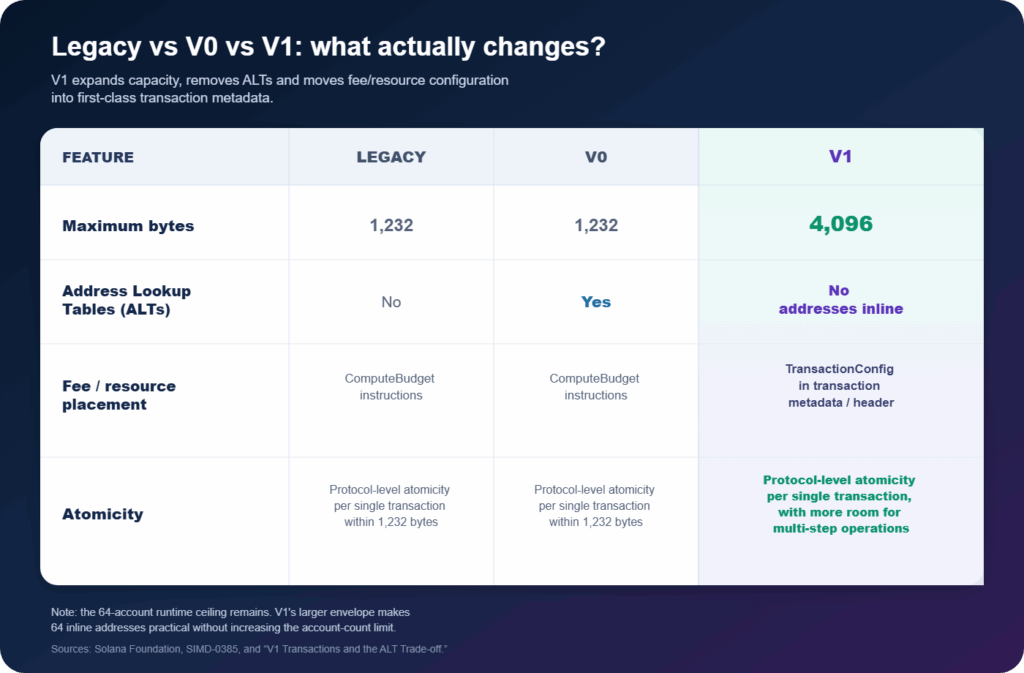
V1 also changes resource handling. Legacy and V0 use ComputeBudget instructions for priority fees and resource requests, while V1 places those settings inside transaction configurations.
Native Atomicity Reduces Reliance on Bundles
Developers used Jito bundles to bypass Solana’s size ceiling. Jito documentation says bundles can contain five transactions, processed sequentially on an all-or-nothing basis through its block engine, while competing through validator tips.
SIMD-0296 says bundles lack protocol-level atomicity equivalent to one native transaction. V1 carries Solana’s transaction-level guarantee, letting qualifying swap routes, proofs, and other multistep DeFi operations succeed or revert together.
V1 removes Address Lookup Tables used by V0 to shorten account addresses. Addresses instead sit inline, simplifying validator input while consuming more bytes in account-heavy applications. Solana’s 64-account maximum remains unchanged, leaving account-intensive applications constrained.
The rollout coincides with Agave 4.2. Cryptopolitan reported a cost-reduction plan targeting roughly 90% savings and processing reductions from 500 milliseconds to 200 milliseconds, benefiting stablecoin issuers, wallets, and payment systems.
Infrastructure Prepares for September 9 Launch
Galaxy’s Q2 2026 Solana report highlighted rising stablecoin, tokenized equity, and real-world asset activity. It said future utility depends increasingly on lending, collateralization, margin, and yield, beyond issuance or trading. DeFiLlama data also indicates a substantial DeFi presence on Solana.
V1 remains opt-in, so Legacy and V0 transactions will continue working. The immediate issue is whether infrastructure reading V1 traffic is compatible.
Anza has asked RPC providers to upgrade to Agave v4.2.2 or v4.3.0-beta.3. Helius guidance warns RPC consumers that do not declare V1 support could encounter failures, including getBlock errors when V1 transactions appear.
The testnet phase gives RPC providers, indexers, wallets, SDKs, and analytics platforms their preparation window before the scheduled September 9 mainnet activation.