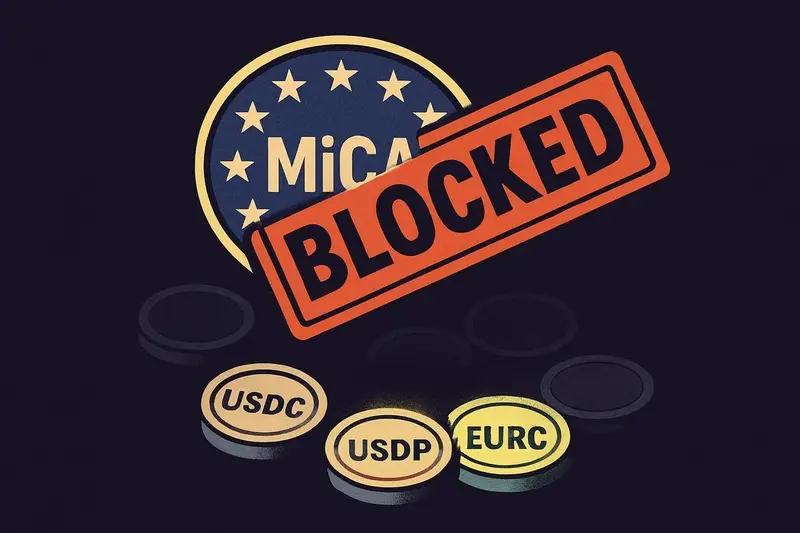
MiCA has positioned USDC as the only top-10 stablecoin currently compliant with the European Union’s Markets in Crypto-Assets regulation, according to Circle.
The company said its dollar-backed USDC and euro-backed EURC are the only two Circle-issued tokens approved under the new framework.
As a result, most leading dollar-pegged stablecoins, including Tether’s USDT, are no longer available through regulated crypto platforms serving the European Union’s approximately 450 million residents.
Circle stated that both USDC and EURC remain fully redeemable in fiat currency, with reserves managed under regulatory standards and disclosed publicly.
The company also released its latest reserve report on August 3. Under MiCA, issuers must separate reserve assets, provide regular attestations, guarantee redemption rights, and meet governance requirements before exchanges can legally offer their stablecoins to European customers.
Reserve requirements drove Tether from the EU market
The transition period for MiCA concluded on July 1, after which the European Securities and Markets Authority instructed unauthorized crypto firms to cease operations. It also reminded consumers that only licensed crypto-asset service providers could legally operate throughout the European Union and European Economic Area.
A major challenge for large stablecoin issuers is MiCA’s reserve requirement. Stablecoins classified as significant must hold at least 60% of their reserves in bank deposits within the European Union. USDT satisfies the quantitative conditions for that designation.
Rather than meeting those requirements, Tether withdrew from the regulated European market and discontinued its euro-backed stablecoin, EURT. The company stated, “After careful consideration, we have made the decision to discontinue support for EURT’s.”
Tether added that the move reflected its strategic direction while regulatory frameworks continue evolving.
Chief Executive Officer Paolo Ardoino also argued that shifting reserves from short-term US Treasury assets into commercial bank deposits could weaken stablecoin resilience during financial stress.
He said MiCA “poses a systemic risk to European banking stability” and explained that Tether preferred protecting existing users.
Trading activity remained resilient despite exchange delistings
Following MiCA implementation, Binance, Coinbase, Kraken, and OKX removed USDT trading pairs for European users to comply with the regulation.
However, research published in July 2026 by Nicola Borri of LUISS and Kirill Shakhnov of the University of Surrey found that overall stablecoin market shares changed very little.
European USDC trading gained roughly six percentage points mainly because USDT trading volumes declined by around 20% after delistings rather than because of stronger demand.
DefiLlama data showed MiCA-compliant euro stablecoins approached $900 million in value during mid-2026. ESMA has approved 19 e-money token issuers across 11 member states, while policy analyst Patrick Hansen estimated about 35 regulated e-money tokens from 21 companies by late July.
A consortium including BBVA, ING, and UniCredit also plans to introduce a MiCA-compliant euro stablecoin, although dollar-backed stablecoins continue leading global crypto trading, payments, and liquidity.