
Liquid staking stayed one of the steadiest major crypto sectors in Q2, with protocols recording only minor ETH withdrawals despite broader market pressure across crypto.
The sector contracted by 1.3% from its all-time high, showing that long-term Ethereum holders still used staking products while other parts of the market saw deeper declines.
CryptoQuant data shows liquid staking protocols held 14.5 million ETH, down from a peak of 14.7 million ETH. The sector has still expanded sharply over a longer period, with deposits rising from 8.6 million ETH to 14.5 million ETH in three years, a net increase of 68%.
Liquid Staking Holds Core DeFi Role
Liquid staking stays central to Ethereum’s DeFi structure, supplying reserves for lending, trading, and other on-chain activity. Its limited Q2 decline highlights its role as infrastructure rather than a purely speculative sector.
Ethereum staking also grew across the quarter. In June, overall staking added another 1 million ETH, while 2.7 million ETH waited in the validator queue. More than 40.3 million ETH, equal to around 33% of total supply, is now held in the Beacon Chain and supports the creation of liquid staking tokens.
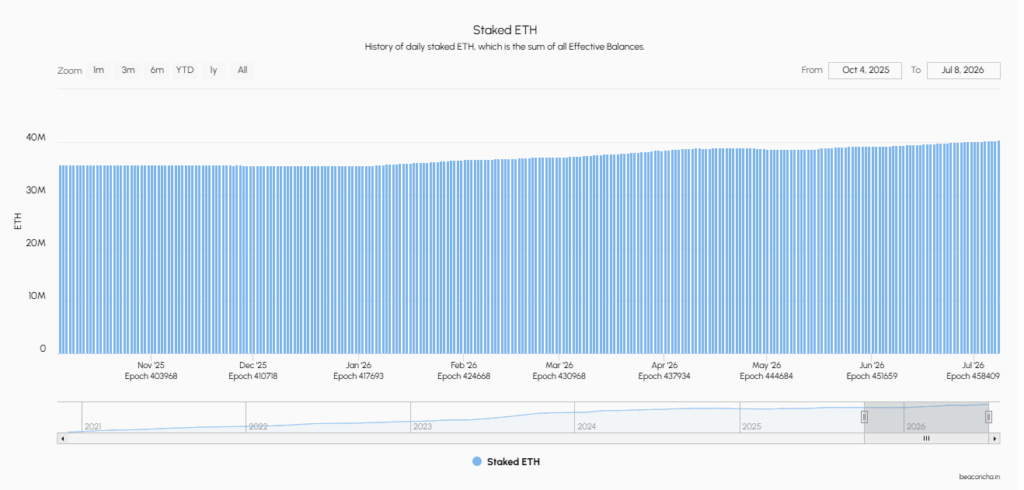
ETH staking expanded in the past months, adding around 1M ETH to the Beacon Chain in June. | Source: Etherscan
The wider liquid staking token market is valued above $54 billion. Similar staking incentives have also spread beyond Ethereum, with Ethereum anchoring the sector’s largest liquid staking activity.
Lido Leads Fee-Producing Protocols
Liquid staking protocols rank among the crypto economy’s steadier fee generators. Lido DAO leads the sector with more than $16 billion in value locked, representing almost 50% of all liquid staking liquidity.
The protocol records $1.99 million in monthly earnings. Across the sector, liquid staking protocols generate more than $20 million in fees while also helping secure the Ethereum network.
These protocols also support ETH treasury companies by making some holdings productive rather than leaving them idle in wallets. That role has become more relevant as holders seek yield from existing ETH positions.
ETH Moves Toward Staking Income
ETH traded around the $1,700 range while liquid staking activity persisted. Open interest stood near $10.5 billion, reflecting slower speculative activity compared with earlier trading conditions.
Exchange reserves also sat near multi-year lows, with around 15 million ETH held across markets. Binance held about 3.86 million ETH, with both inflows and outflows. The exchange showed capitulation selling near $1,500 and whale withdrawals as leverage cooled.
Binance ETH outflows reached $1.23 billion, the highest level in three years. Some withdrawals moved into liquid staking and Ethereum DeFi. On-chain data showed one whale moving 4,491 ETH to Lido after withdrawing 34,557 ETH from Binance.
Even amid the Iran conflict, which still drove market reactions and occasional panic selling, liquid staking data showed much of Ethereum liquidity stayed tied to the DeFi space in Q2.