
Ethereum exchange supply has fallen to a record low of 14.5 million ETH, according to CryptoQuant data, marking the thinnest exchange balance ever recorded for the network.
The decline became sharper around July 2025, when corporate ETH treasury strategies began moving from experiments into a wider accumulation trend.
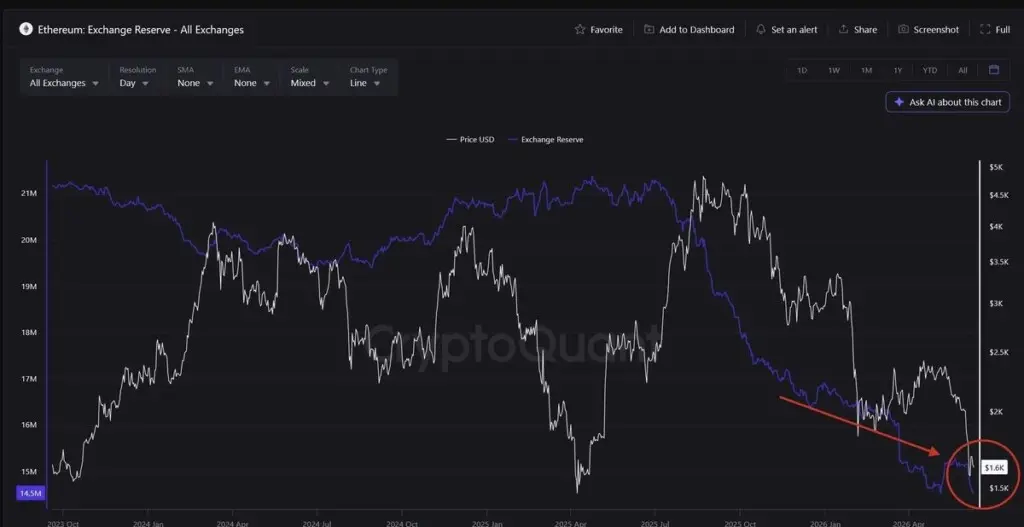
Exchange balances are closely watched because they show how much ETH may be available for immediate sale on trading venues such as Binance or Coinbase.
When coins remain on exchanges, they can reach order books quickly. When they move into treasury wallets or staking contracts, that supply becomes less available for short-term trading.
Record low supply meets weak price action
The supply drain is unfolding while ETH trades near $1,650, down about 44% year to date. Market sentiment also remains in extreme fear, adding pressure to a weak price backdrop.
May closed with an 11.07% decline, while spot Ethereum ETFs recorded their second-largest monthly outflow since launch at $540.88 million.
The contrast is notable because Ethereum is facing its tightest exchange supply conditions on record during one of its weakest price periods of the cycle.
A lower exchange balance does not automatically lift prices, but it reduces the amount of ETH available if demand returns.
Treasury buying accelerated after July 2025
CryptoQuant data shows ETH exchange reserves held near 20 million for much of 2024 before breaking lower in July 2025.
That timing aligned with a major shift in corporate treasury activity. BitMine began its ETH treasury pivot in June 2025 after raising $250 million and has continued accumulating.
BitMine now holds more than 5.5 million ETH valued at $9.21 billion, making it the second-largest crypto treasury after Strategy.
SharpLink follows as one of the largest ETH treasury holders, with 868,699 ETH at the time of writing. Much of the ETH held by these firms is staked, placing those coins away from order books.
The exchange reserve indicator only tracks coins leaving or entering exchanges. It does not identify the destination of those assets.
However, the sharp reserve decline occurred during the same period when large treasury holders began locking ETH into longer-term balance sheets.
Thin float changes market structure
A shrinking float does not guarantee a price bottom. ETH can remain weak while sentiment stays negative and treasury holders sit on unrealized losses.
The current setup shows that fewer coins are available on exchanges than at any previous point.
That condition matters because a thinner float can amplify market moves. When demand is low, a reduced supply may have little impact.
But if buyers return in size, fewer exchange-held coins could make each new bid move through a smaller available supply base.