
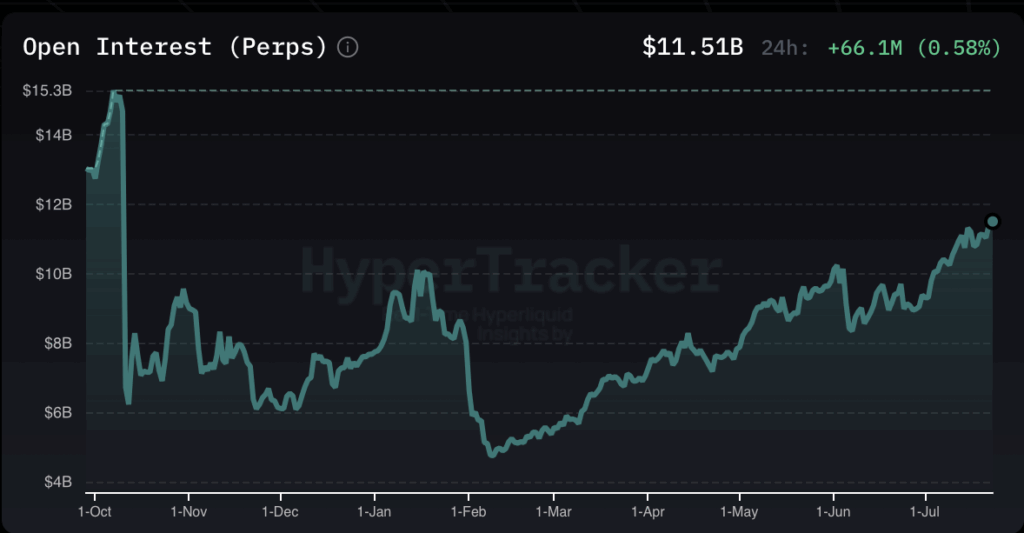
Hyperliquid open interest has reached $11.51 billion, its highest level since the October 10 liquidation crash.
It is also the platform’s strongest reading this year, even as the wider cryptocurrency market continues to recover from the severe deleveraging event.
Bitcoin and the broader market remain under pressure after the crash. Total cryptocurrency market capitalization is still roughly 45% below its previous level. HYPE, meanwhile, has gained about 34% over the same period, showing stronger performance than the wider market.
Bitcoin currently trades near $65,000, compared with approximately $100,000 around the October 10 crash. Coinglass data places total crypto open interest at $116.66 billion, down 47% from that period.
Source: HyperTracker
Hyperliquid is therefore expanding while the broader derivatives market remains substantially smaller. That divergence highlights the platform’s faster rebound within a market still shaped by reduced leverage and lower trading activity.
RWA Perpetuals Lead Hyperliquid Growth
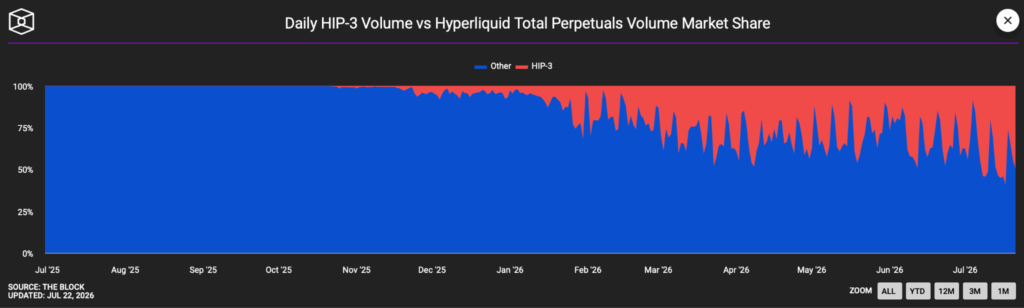
Real-world asset perpetuals are driving much of Hyperliquid’s open interest recovery. HIP-3 builder markets now hold $3.61 billion in daily open interest, making RWA perpetuals the platform’s largest single segment. They now exceed Bitcoin, HYPE, and other layer-one tokens.
HIP-3 launched on October 13, 2025. The framework allows any builder to stake 500,000 HYPE and deploy a perpetual market without approval from Hyperliquid’s core team.
Source: The Block
HIP-3 markets now generate half of daily perpetual volume, matching core markets at a 50-50 split. At the start of the year, core perpetuals accounted for 97% of platform volume.
Hyperliquid Reaches Record Exchange Share
Source: Hypeflows
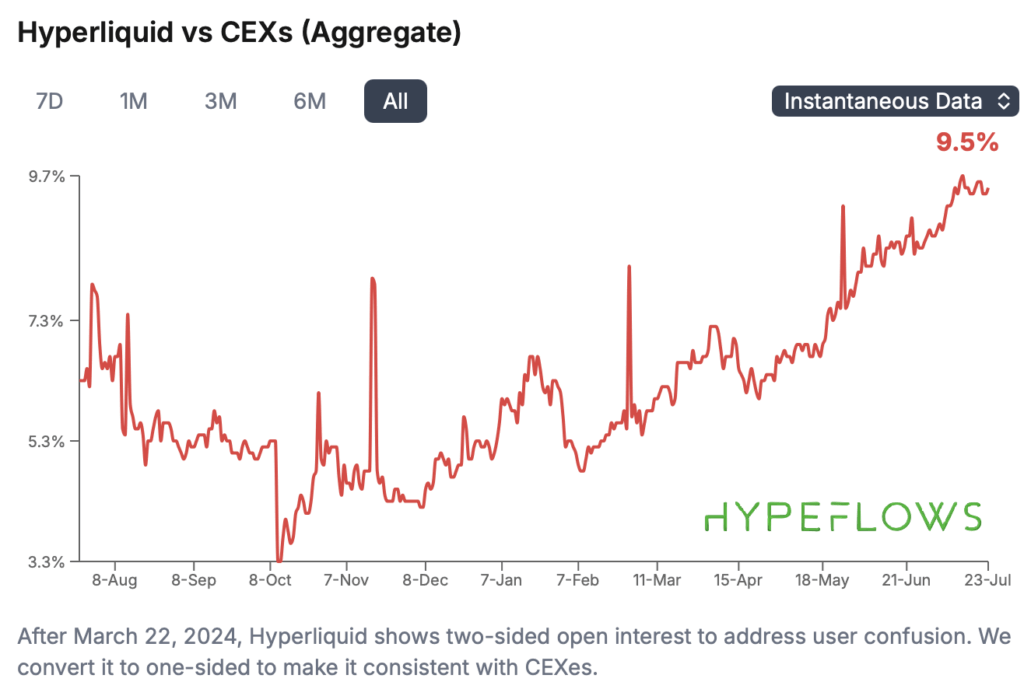
Hyperliquid’s share of perpetual open interest against major centralized exchanges has reached a record 9.5%, according to Hypeflows data. The figure has risen from 6.9% in late May.
That increase requires context. Hyperliquid’s open interest remains about 23% below its October 2025 peak near $15 billion. Binance, Bybit, and Gate.io contracted more sharply during the post-crash deleveraging period.
Consequently, Hyperliquid gained market share mainly by declining less than its competitors. Available figures do not establish that traders moved directly from centralized exchanges to the platform.
TradeXYZ Controls Most HIP-3 Activity
TradeXYZ, built by Hyperliquid’s tokenization arm Hyperunit, holds more than 90% of HIP-3 open interest. One builder therefore supports almost one-third of the platform’s total open interest.
HIP-3 markets operate outside Hyperliquid’s native liquidity pool. Oracle quality, margin settings, and liquidity provision depend entirely on each deployer, placing significant activity under TradeXYZ’s operational framework.
Centralized exchanges are also entering the category. Binance launched pre-IPO perpetuals with a SpaceX contract on May 21. It added seven United States equity and exchange-traded fund perpetuals on July 9, offering leverage of up to 25 times.
Those launches bring centralized exchange liquidity into products previously associated closely with Hyperliquid. They also increase competition across tokenized equity, ETF, and pre-IPO perpetual markets.