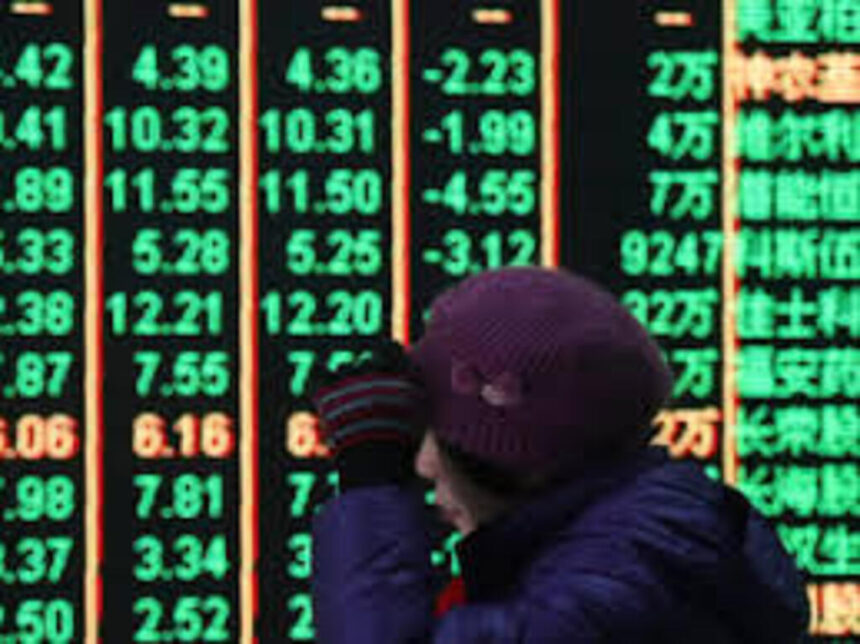
Other traditional investments are failing, prompting retail investors in China to revert to the stock market.
In a low-saving environment, bad bonds, and a slow property market, stocks are emerging as an investment choice for most households.
Limited Returns from Other Assets
The banking sector of China is providing one of the lowest rates of savings in many years. The fixed savings account is now only 1.3 in five-year terms, a fall compared to 2.75 in 2020. Even the demand deposits offer a low rate of 0.05 per annum. Money-market funds that once had greater returns are now paying off poorly, with Tianhong YuE Bao paying 1.1, which is half of what it was paying out.
Bonds, too, are not performing well. Although the yields are maintained at a high level, the current Chinese government bond of 10 years is at 1.80, which is lower than the 5-year average of 2.58. Moreover, the return of the taxes on bond interest has deterred a large number of investors in government debt.
Real Estate Loses Its Appeal
In China, property was a very good investment option, though the industry has been experiencing a long slump. Developers are also finding it hard to finish projects, and not all of them can buy another home anymore since many families already have several homes. President Xi Jinping’s policies have strengthened the belief that houses are meant to be inhabited and not speculated on. Consequently, the percentage of household wealth invested in real estate has fallen since 2021 (74 to 58%).
Wealth Management Products and Foreign Investments Stagnate
Wealth management products (WMPs) are not faring well either, with average returns as low as below 3%, dropping for the second consecutive year. The returns on life insurance policies, including those of Ping An Insurance, have also fallen to 2.5% as against 4.3%.
Though there have been investor considerations to invest overseas, tight capital controls restrict the sum of money that can be exchanged to in the currency as a foreign one to $50,000 in a year. Although there is an option of investing in other countries, it is accompanied by huge taxes that may reach up to 20%% of profits. The foreign investments have become less attractive as a result of these limitations.
Stocks as the Only Viable Option
Retail investors are concentrating on the Chinese stocks; this is due to a lack of options. The CSI 300 Index has been on a 25-plus percentage upswing since April due to AI excitement and a better global outlook. Institutional investors and foreign funds have fueled the rally, but analysts believe that retail investors will soon control the retreat. JPMorgan chase predicts that the household savings could be up to 350 billion which will be invested in the Chinese stock market by 2026.