The markets remain mostly bearish, but short-lived euphoric phases have been evident in altcoins.
Although tokens such as UNI, ZRO, and BERA experienced significant gains in February, these gains were soon erased, and most traders are wondering about the effectiveness of such short-term pumps.
The altcoin market is still unstable, and some of the assets have managed to increase and then further decrease subsequent to the initial surge.
KITE surges to all-time highs amid market weakness
KITE is one of the altcoins that have been performing exceptionally, with the strongest record of reaching an all-time low of $0.26.
The token has also been resilient, and it has rallied amid the broader market decline. KITE, which was only launched six months ago, has been able to ride the AI agent story and the release of its product, which has drawn attention to the product in a period where most projects are battling to survive.
It was also able to maintain its growth, as opposed to other tokens that collapsed after incurring short-term rallies, because of good liquidity in the market and being listed on Binance.
Nevertheless, even being successful, the long-term sustainability of KITE is not guaranteed because AI agents and blockchain infrastructure are still observed as having too many players in the market.
February’s Altcoin rallies: A mixed bag
Unless listed in the bearish market trend, in February, altcoins like UNI, ZRO, and BERA rose, showing a huge price increase.
UNI, which began the month at $5, tumbled drastically to $3.42, its extreme low.
ZRO also shot to $2.50 and fell back to $1.49, indicating the volatility in the altcoin market.
Leapfrog-BERA, which had been a poor performer of late, briefly recovered to $0.74 and went back to $0.59.
This volatility was in part contributed to by various token unlocks whereby the market was pressured by selling off approximately 257K per day.
The market of altcoins has turned highly volatile. Although they do not occur frequently, pumps are brief, and price mishaps are corrected almost instantly.
Such movements tend to be market maker-led and localized transactions, and they can lead to spikes in local prices without any underlying fundamental basis.
To traders, the market is a tough place to operate in, as the altcoins tend to increase, followed by severe corrections.
Altcoins face overbought conditions
Due to the fact that some of the altcoins have reached their overbought range, their sustainability is increasingly in question.
KITE is an example of the overbought tokens currently, although it has only been in the market for a few months.
Some of these coins that surged back in February are now in a zone of neutrality on the Relative Strength Index (RSI), which shows that they have cooled off after the initial excitement.
Selling pressure is present in most of the altcoins, and yet, there are also tokens that are doing better to be considered an outlier in an otherwise bearish market.
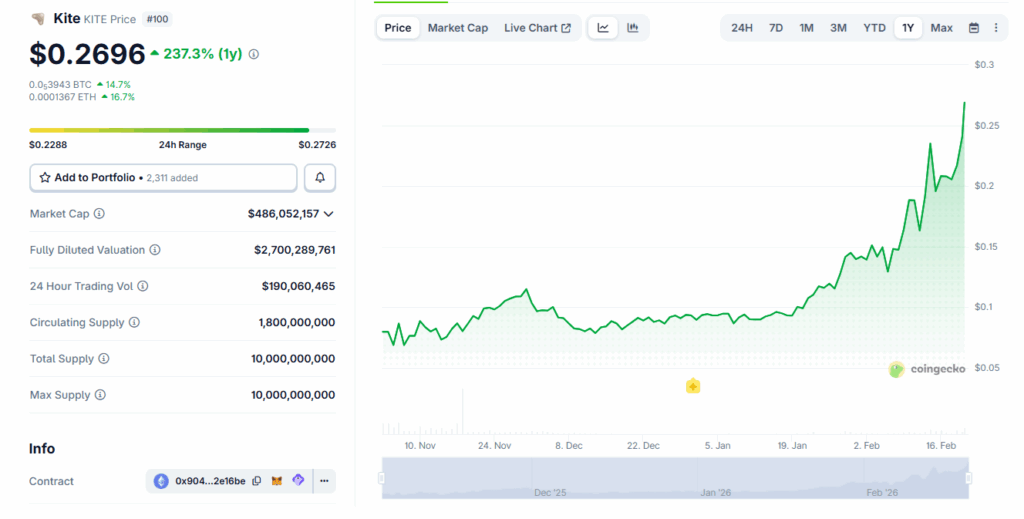
KITE is among the newly pumping altcoins, showing there is still energy to drive new projects, but not lift all assets. | Source: Coingecko
Although the market condition has slightly dwindled, the liquidity of the altcoin market has enabled slight growth, yet such profits are not turning into sustainability.
There is still apprehension among traders, where even liquidations and volatility are destabilizing more comprehensive market recovery strategies.
Altcoin Pumps Show Limited Sustainability
The trend of altcoin pumps continues to occur, but its credibility is getting doubtful.
The short-lived rallies observed in such tokens as UNI, ZRO, and BERA indicate that such pumps are accompanied by subsequent, more profound corrections, though the market can respond to such trading changes in the short run.
Although KITE is an outlier, showing growth in the opposite direction, its long-term perspectives are not clear.
The altcoin market is unpredictable, and traders should always be ready since these short-term gains are always followed by corrections.