USDT supply has contracted across Ethereum and TRON after Tether burned $2.5 billion in tokens on Ethereum, marking its largest supply reduction since February.
The burn reflects a broader liquidity pullback across stablecoin markets, while USDT continues to hold its central role in crypto transfers.
Tether’s treasury destroyed the tokens on July 7. The move followed a larger $3.5 billion burn on February 10, when the issuer removed tokens during a period of weaker trading activity and reduced exposure to legacy networks. After the latest burn, Tether retained a total USDT supply of $189.6 billion, with Ethereum and TRON remaining its main transfer networks.
USDT Burn Tracks Stablecoin Liquidity Decline
USDT supply changes are closely followed as a liquidity signal across digital assets. The token is also watched for the effect of Euro Area regulations on stablecoin activity. The latest contraction came as stablecoin usage weakened across several key measures.
According to Artemis data cited in the report, active stablecoin addresses declined by 36.2% over the past 30 days. Average daily stablecoin volume also fell by 47.5%. USDT and Circle’s USDC both recorded larger-than-average liquidity outflows in the past month.
The decline in stablecoin supply has affected broader market conditions across the crypto market. The report stated that many crypto rallies are now driven by short squeezes rather than wider liquidity expansion. A recovery in stablecoin activity would mark a shift toward stronger marketwide participation.
TRON-Based USDT Liquidity Falls On Binance
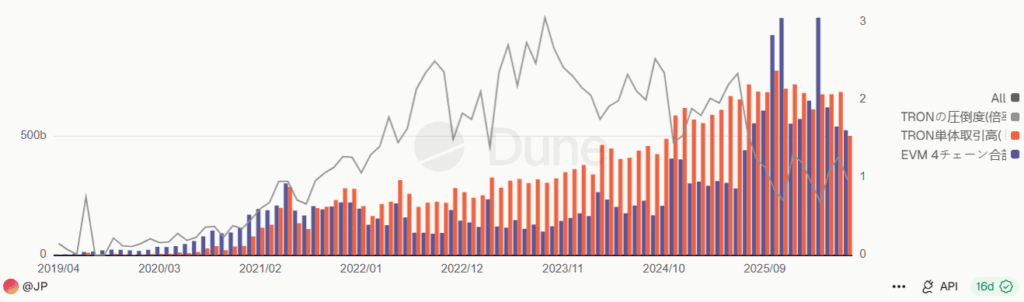
USDT transfers slowed down on both the TRON and Ethereum networks, reflecting the worsening crypto sentiment in the past two months. | Source: Dune Analytics
The contraction also appeared on TRON, one of the main networks used for USDT transfers. Binance’s TRON-based USDT liquidity dropped to $806 million, down from more than $1 billion earlier.
Transfers between Binance and TRON are often used as a gauge of trading activity, particularly for Asian and global users. USDT transfer activity slowed in May and June on both Ethereum and TRON, adding to signs of lower crypto liquidity.
Binance still holds about $39 billion in stablecoin reserves, and that overall supply remained relatively unchanged during the past month. The decline on TRON therefore points to a more specific liquidity adjustment rather than a broad exchange-wide stablecoin drawdown.
USDT Keeps Lead As USDC Gains In DeFi
The $2.5 billion burn remains a limited contraction relative to USDT’s total size. Tether still has about $99.98 billion of USDT on Ethereum and more than $89 billion on TRON.
USDT remains widely used for commercial transactions and peer-to-peer transfers. At the same time, USDC has gained ground in DeFi, supported by perpetual futures activity and the Base network ecosystem.
Revolut’s decision to wind down exposure added to recent setbacks for USDT. Still, stablecoin supply remains near an all-time peak, after only a 1% monthly contraction.