Uniswap has strengthened its position as the leading decentralized venue for tokenized asset trading.
The exchange now anchors growing spot activity across real-world assets and tokenized equities.
New integrations and broader network support have expanded its role beyond conventional token swaps. The shift also shows how permissionless markets are gaining ground across the RWA sector.
Uniswap captures majority of decentralized RWA trading
Uniswap handled more than 50% of DEX-based real-world asset volume, while its share recently reached 60%. The protocol processed more than $743 million in RWA volume during peak trading by September 4.
Daily RWA volume later eased toward roughly $300 million. Uniswap first took control of decentralized RWA spot trading in August and retained its influence in September.
Uniswap emerged as the leading venue for RWA trading in the past month, with recent volume records as of September 7 | Source: Dune Analytics.
HIP-3 remained the main venue for RWA perpetual futures. However, Uniswap became the leading decentralized platform for RWA spot trading.
Uniswap V4 and third-party deployments now support specialized markets, while Unichain continues expanding as a trading venue. The protocol also captures activity across Ethereum, Solana, Base, and other major networks.
RWA activity accelerated after reflection tokens linked to tokenized stocks entered the market. That trend lifted volumes across established tokenization platforms.
Uniswap also benefited from Robinhood Chain connections and its presence within the wider Robinhood ecosystem. The supplied report said this growth could support RWA trading moving from Binance toward other markets.
RealityFi rStocks expand Uniswap tokenized asset market
Uniswap already offered tokenized stocks from Ondo Finance and XStocks before adding RealityFi’s rStocks. RealityFi has also expanded to Arbitrum, Morph Network, and Bitget Wallet.
Bitget Wallet provides another retail gateway that may increase access to Uniswap. The rStocks integration adds more than 1,700 assets.
The offering covers about 95% of major US equities. Those equities rank among popular assets for spot trading, perpetual swaps, and reflection meme tokens.
FINRA-registered custodians back rStocks, while the products operate under El Salvador’s jurisdiction. US persons cannot directly trade the stocks, although the permissionless DEX remains accessible.
UNI also rallied alongside stronger RWA activity. The token climbed from about $3.24 one month earlier to $6.28 on September 16.
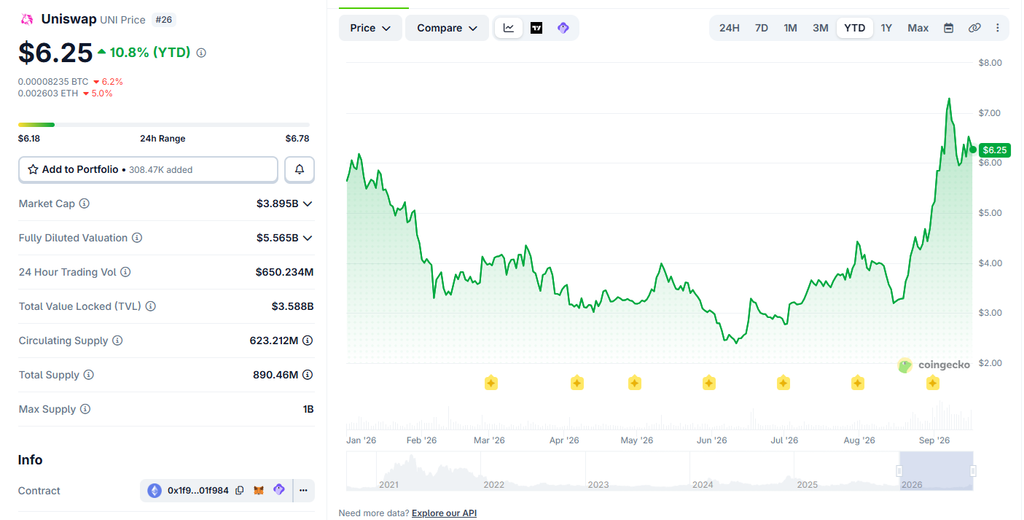
UNI traded close to its higher range for 2026, after getting a boost from Robinhood activity and accelerating RWA trading. | Source: Coingecko.
UNI reached $7.29 on September 7, leaving it up 10.9% during 2026. However, around 1,400 wallets hold most of the UNI supply.
That concentration weakens the narrative of widespread retail ownership and exposes the recovery to large-holder selling pressure. Stronger trading and fees have nevertheless supported renewed activity.
The rebound follows years of underperformance and slower trading. Uniswap has since expanded through new networks, financial infrastructure, and tokenization markets.
By September 16, Uniswap V3 on Robinhood Chain recorded more than $743 million in trading volume. Ethereum V3 carried about $640 million, while Robinhood V4 reached $278 million.
DeFi Llama data showed daily Uniswap volume rising during the previous 30 days toward its 2026 high during September. Uniswap holds $3.59 billion in value locked.
The protocol also produces about $14.9 million in monthly revenue and has generated more than $182 million in fees.