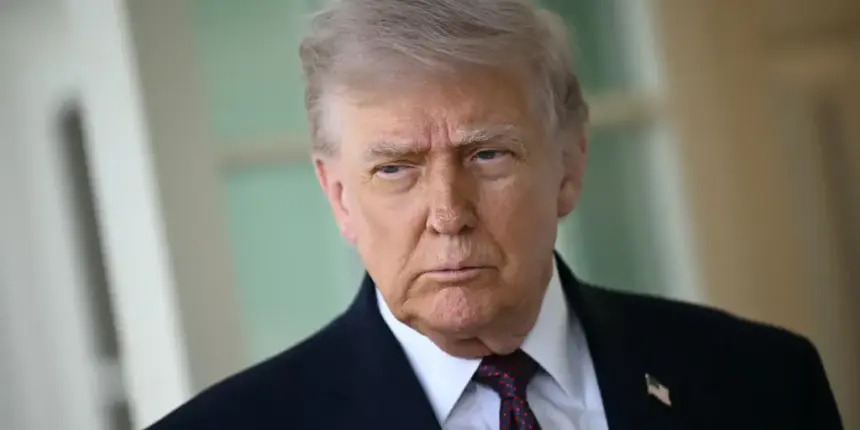
Trump backs CFTC control over prediction markets as a growing legal fight puts federal derivatives law against state gambling rules.
The president said the Commodity Futures Trading Commission should keep exclusive authority over platforms such as Kalshi, Polymarket, Robinhood, and Crypto.com.
His statement adds political weight to a dispute already moving through courts, state capitals, and federal oversight channels.
Federal Position Strengthens
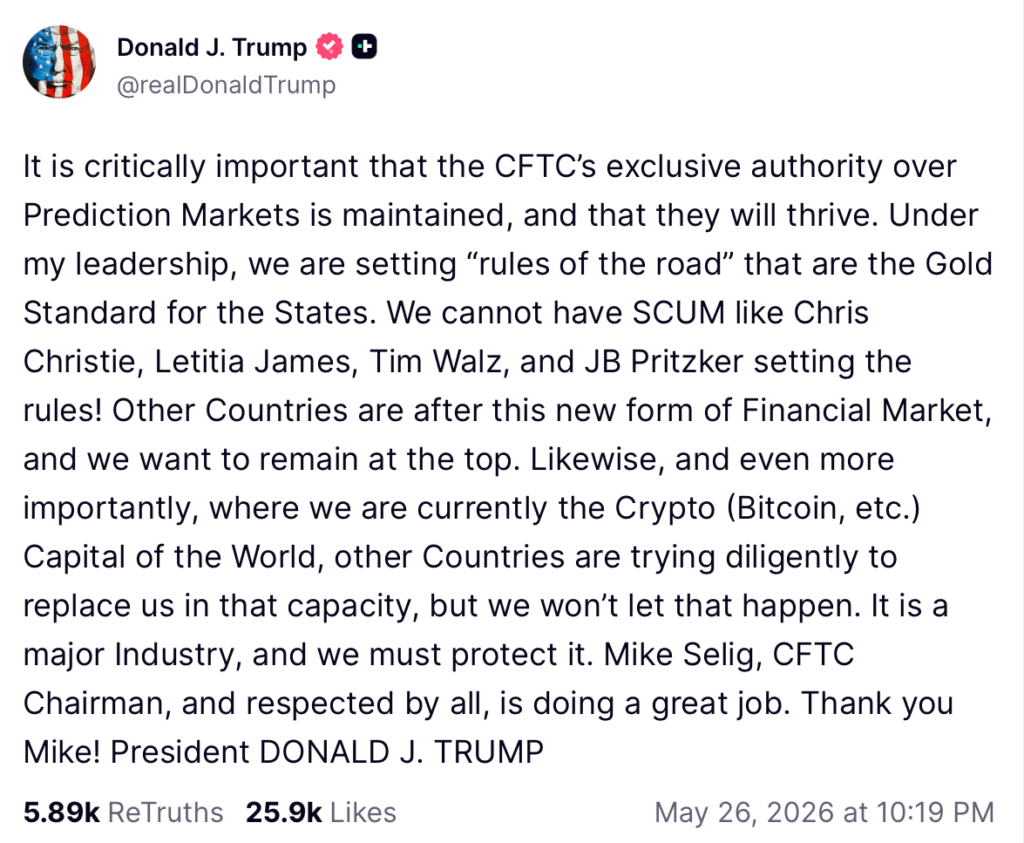
Trump used a Truth Social post to support CFTC Chair Michael Selig, who is currently leading the agency with a reduced commission. He described federal control as critical and argued that other countries are competing for leadership in this new financial market.
The post also named Chris Christie, Letitia James, Tim Walz, and JB Pritzker as officials resisting the federal framework. Trump’s comments came as the CFTC continues to argue that event contracts listed on registered derivatives markets fall under the Commodity Exchange Act.
The issue has become more sensitive because Trump Media has also entered the prediction market sector. Its Truth Predict product was announced through an arrangement with Crypto.com Derivatives North America, a CFTC-registered exchange.
States Push Back
The CFTC is suing Wisconsin, Illinois, Arizona, Connecticut, and New York after those states moved against prediction market platforms under gambling laws. The agency argues that states cannot block contracts traded on designated contract markets.
State officials have answered with their own legal pressure. A coalition of 39 attorneys general, led by Nevada Attorney General Aaron Ford and Ohio Attorney General Dave Yost, backed Massachusetts in its case against Kalshi sports contracts.
They argue that Congress did not clearly remove state authority over gambling when it wrote the Commodity Exchange Act. The coalition also cited heavy sports trading activity on Kalshi, where more than $1 billion was wagered across 3.4 million sports bets between January and June 2025.
Minnesota has taken the strongest state action so far. Governor Tim Walz signed a law that criminalizes prediction markets and creates felony penalties for operators.
Supreme Court Fight Looms
The central legal question is whether sports and entertainment outcome contracts are federally regulated derivatives or state-regulated gambling products. That distinction will shape how prediction market platforms operate across the United States.
Court watchers now expect the dispute to reach the Supreme Court within 12 to 18 months. Until then, platforms may keep operating in many states under federal cover while some states continue enforcement.
Congress is also watching the sector more closely. The House Oversight Committee has opened an inquiry into Kalshi and Polymarket over insider trading concerns. Trump’s endorsement strengthens the federal position, but courts must still determine the legal boundaries for this fast-growing sector.