Starknet’s STRK token has recorded strong weekly gains as the network considers a major change to its blockchain infrastructure.
The potential shift would allow Starknet to strengthen its defenses against emerging quantum computing threats. However, the proposal raises questions about Ethereum’s security roadmap and Starknet’s long-term independence. Investors are watching whether the network will move forward with the proposed transition.
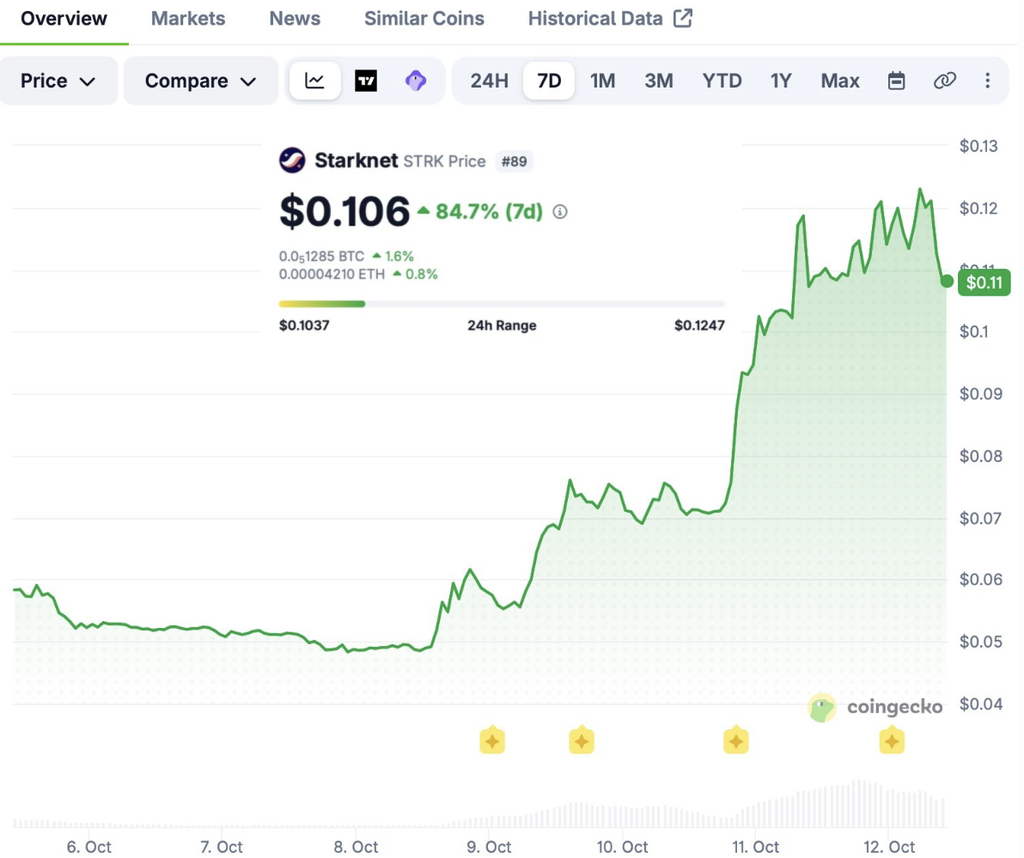
STRK surged more than 80% over seven days, becoming the best-performing cryptocurrency among the 100 largest tokens. The token reached $0.126 on Sunday, its highest level since December 2025.
The rally followed Starknet’s October 8 announcement that it was actively considering becoming an independent layer-1 blockchain. The network aims to achieve full quantum resistance by 2027, ahead of Ethereum’s targeted 2029 timeline.
Starknet considers L1 transition to address quantum security risks
StarkWare CEO Eli Ben-Sasson raised the possibility of Starknet leaving Ethereum to strengthen its post-quantum security capabilities. He asked followers whether becoming an independent L1 for greater quantum security flexibility represented a practical approach.
Ben-Sasson explained that Starknet currently relies on Ethereum for security because it operates as a layer-2 network. Consequently, Starknet cannot achieve stronger overall quantum protection than its underlying blockchain.
He urged Ethereum developers to accelerate their security upgrades, warning that Starknet could pursue independence if progress remains slow.
An independent blockchain would allow Starknet to introduce security improvements without relying on Ethereum’s development schedule.
Starknet already uses hash-based cryptographic proofs, which researchers generally consider resistant to known quantum attacks. However, the network still needs to replace cryptographic components that depend on elliptic-curve technology.
StarkWare outlined those changes in its June 30 roadmap, identifying steps toward comprehensive quantum-resistant infrastructure.
The discussion followed warnings from Ethereum Foundation researcher Justin Drake on October 7 about emerging cryptographic risks.
Drake urged the cryptocurrency industry to begin preparing for what he described as “bunker mode.” He warned that advances in artificial intelligence could potentially threaten ECDSA signatures before quantum computers become capable of breaking them.
Under his worst-case scenario, such risks could emerge within months rather than years. Drake discussed transferring funds to addresses with unexposed public keys while cautioning against rushed action.
Ben-Sasson echoed those concerns the following day, linking advances in AI and quantum computing to the need for stronger defenses.
STRK rally continues as Starknet weighs governance and security challenges
Starknet’s potential transition comes as other Ethereum layer-2 networks face operational difficulties.
Blast announced on October 2 that it would shut down because operating expenses exceeded revenue. The network instructed users to withdraw funds to Ethereum mainnet before October 26.
Abstract, which has links to Pudgy Penguins, also announced plans to discontinue operations in early October.
Meanwhile, Starknet holds approximately $168 million in total value locked, distinguishing its proposed transition from those closures.
Despite STRK’s weekly rally, Starknet has not submitted a formal L1 governance proposal or scheduled a vote.
StarkWare’s roadmap requires governance approval for protocol-level changes, and developers have not announced a decision timeline.
Furthermore, independence would require Starknet to assume responsibility for its security rather than relying on Ethereum. STRK has already retreated from its latest 24-hour peak as investors await further details.