
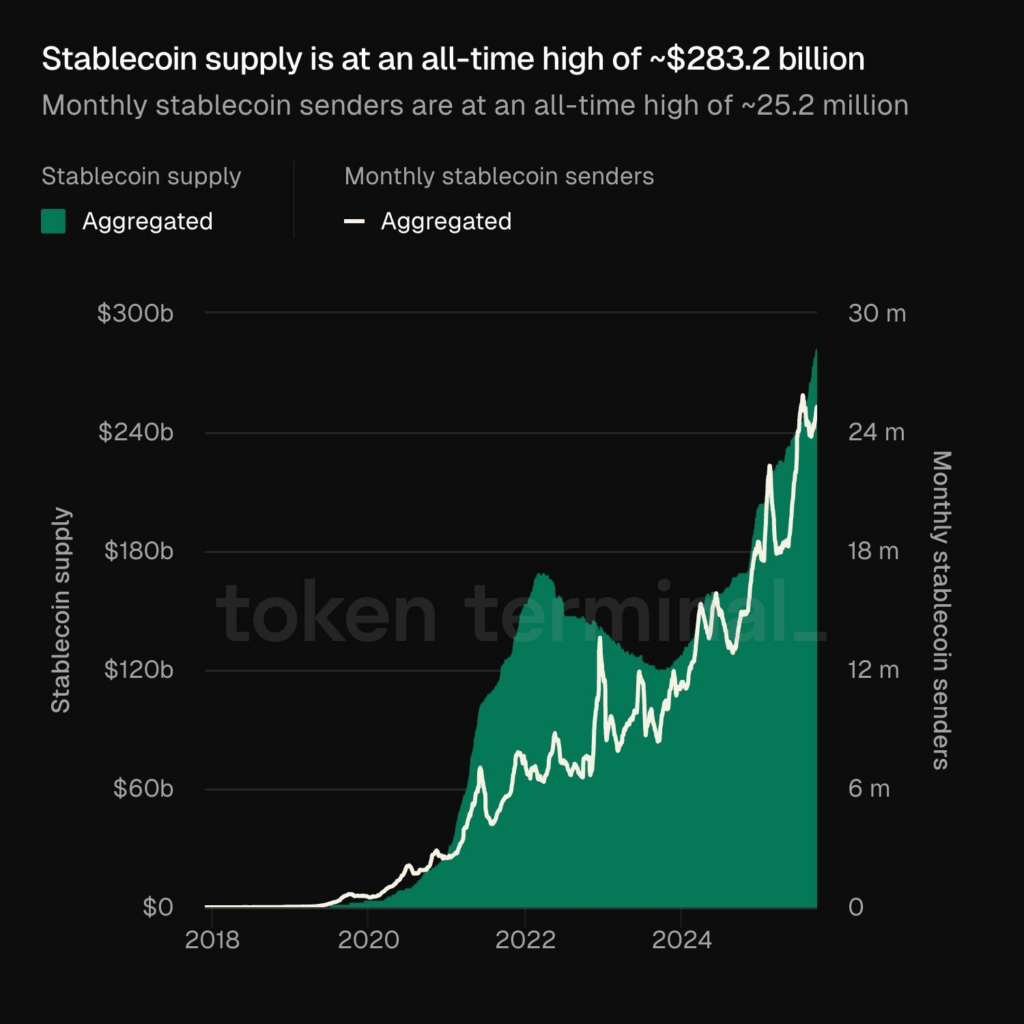
The aggregate supply of stablecoins has already reached a new high of 283.2 billion, a milestone in the cryptocurrency scene’s history.
With this explosion, monthly stablecoin senders have also reached a new high of 25.2 million, according to information from Token Terminal.
Stablecoin Industry Sees Explosive Growth in Funding
By 2025, stablecoin companies will have raised enormous sums of 621.81 million dollars, seven times the amount of 84 million raised in 2024. The biggest one was achieved with OSL Group, the company based in Hong Kong that received $300 million in July. The capital will be used to expand their operations in international markets.
Source: Token Terminal
This rise in funding is after the signing of the GENIUS Act by former President Donald Trump. The law brought greatly-welcomed regulatory certainty to the sector, and executives such as Ron Tarter, the CEO of MNEE, have dubbed it a green light to corporate America. Therefore, Wall Street is currently more engaged in ventures related to stablecoins. USDC is a project by Circle, which is one of the companies that has recently raised over $1 billion in an IPO. Through this support, the stablecoin companies are currently worth more than $297 billion.
Traditional Finance’s Shift Toward Stablecoins
Conventional financial institutions are not being left behind in the stablecoin race. Companies such as Stripe, Citigroup, Wells Fargo, and Bank of America are developing their own stablecoins. In the meantime, JPMorgan has affirmed the launch of its JPMD coin, which is based on the Base blockchain. Societe Generale has introduced USDCV, a crypto-market stablecoin.
It is a change of direction in traditional finance as the global stablecoin market continues to grow in popularity. The new competition has, however, concerned the banks. They claim that stablecoin firms, in contrast to traditional banks, are able to provide interest-like benefits without corresponding limitations, and they may attract $6 trillion of bank deposits.
Competition and Tensions Between Crypto and Banks
Banks and the crypto industry have become more aggressive towards each other. As an example, Coinbase is paying a 4.1% interest on USDC assets, which is much higher than what banks charge on savings. This has prompted the banking lobby groups to advocate stricter regulation of the growth of stablecoins. The CEO of coinbase, Brian Armstrong, has been fighting back, claiming that banks have to play on a level playing field.
The space still gives rise to new undertakings. Plasma, one of the projects supported by Bitfinex, introduced Plasma One, a neobank that targets stablecoin users. The app also has zero-fee USDT transfer, integrated rewards, and immediate virtual card issuance. Even with the development, analysts point out that user interfaces need enhancement to promote mass adoption.
The future of the stablecoin market is auspicious, as there is a lot of growth in terms of new projects and investment, as well as regulated support. Nevertheless, the industry still has to overcome issues connected with user experience and regulatory matters.