
Senator Edward Markey is challenging Google’s plans to tie artificial intelligence features to Search access in American schools.
The dispute centers on whether educators can restrict AI tools without losing a widely used learning resource.
School administrators face growing pressure to manage students’ exposure to generative AI while maintaining access to digital services. Meanwhile, Google’s approach has raised questions about school choice, student safety, and the company’s influence over education technology.
Markey Demands Separate Controls for Google Search and AI
On November 9, Markey sent Alphabet CEO Sundar Pichai a letter requesting changes to Google’s planned school access policy.
The Massachusetts Democrat wants schools to disable AI Overviews, Gemini, and Guided Learning without restricting traditional Google Search. He requested a response by November 30.
Markey also questioned whether Google could technically provide Search results without generative AI tools or chatbot features.
The senator argued that schools should retain essential educational resources while deciding which AI products students can access.
He accused Google of using its position in education technology to pressure schools into accepting AI features.
Google Classroom serves approximately 150 million students and teachers, giving the company’s education policies considerable reach.
Markey also requested Google’s research, testing results, and risk assessments concerning AI’s effects on student safety, mental health, and learning.
His inquiry specifically covers K-12 students, including children younger than 13.
Additionally, he asked how many schools and districts currently use Google products to restrict chatbot access outside Search.
Google Says AI Overviews Cannot Be Removed From Search
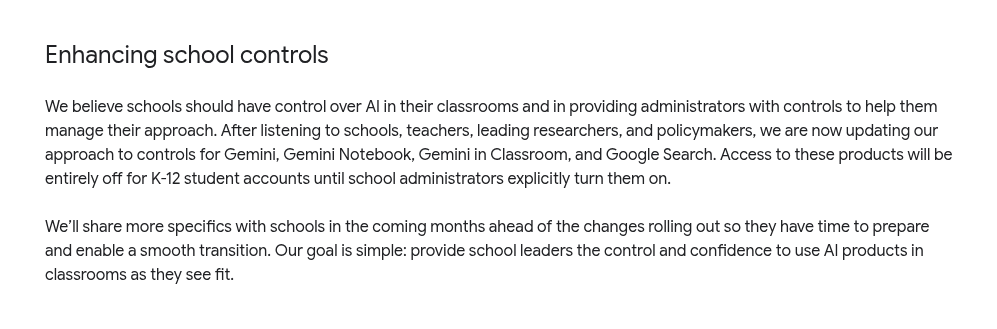
Google announced revised controls for school accounts on November 3, allowing administrators to manage access to several services.
The changes cover Gemini, Gemini Notebook, Gemini in Classroom, and Google Search. Administrators must enable each product individually before students can access it.
However, Google’s documentation identifies AI Overviews as a core Search feature that administrators cannot disable separately.
Consequently, schools seeking to block AI Overviews must also restrict Google Search. Students affected by that decision receive an access notice.
A Google spokesperson said AI functionality has become too integrated with Search to separate the services.
Chris Phillips, Google’s education vice president, maintained that schools should control how they introduce AI into classrooms.
Google also plans to pilot Guided Learning through Search with selected American schools later in November.
The feature guides students through homework problems using a step-by-step approach.
School Access Debate Draws Political and Industry Responses
The disagreement has attracted criticism beyond Washington as schools assess Google’s proposed restrictions.
New York City Mayor Zohran Mamdani accused Google of using its search dominance to push AI into public education.
Meanwhile, DuckDuckGo CEO Gabriel Weinberg offered to help schools make his company’s search engine their classroom default.
Weinberg made the offer on November 4, following Google’s announcement.
October figures placed Google’s worldwide search market share at 91.05%, compared with DuckDuckGo’s 0.64%.
The figures highlight Google’s market position as educators consider alternative search services.
For now, Markey’s November 30 deadline puts attention on Google’s response and whether schools will receive independent AI controls.
The article uses an inverted-pyramid structure, three subheadings, and short, factual sentences. It also incorporates the supplied details and avoids direct copying. Independent AI-detection or plagiarism scores cannot be guaranteed.
The central dispute and Markey’s November 9 letter are corroborated by contemporary reporting.