
Polymarket continues to lead political prediction markets as election-related trading attracts more activity.
The US midterm elections have strengthened demand for political contracts across prediction platforms. Meanwhile, competitors such as Kalshi continue to draw most of their trading activity from sports. The latest market trends highlight growing differences between platforms competing for political prediction volumes.
Political prediction volumes climb as Polymarket maintains lead
Political prediction markets recorded $396 million in trading volume during November’s first week, marking a 34.2% weekly increase. Trading activity has nearly tripled since early October, largely reflecting interest surrounding the US midterm elections.
Polymarket captured most political trading volumes, maintaining its lead over rival Kalshi across major election-related markets.
According to market data, Polymarket’s political trading volumes exceeded Kalshi’s by 300% to 900%, depending on the category.
Politics and election contracts account for approximately 12% of Polymarket’s trading activity, ranking as its third-largest category.
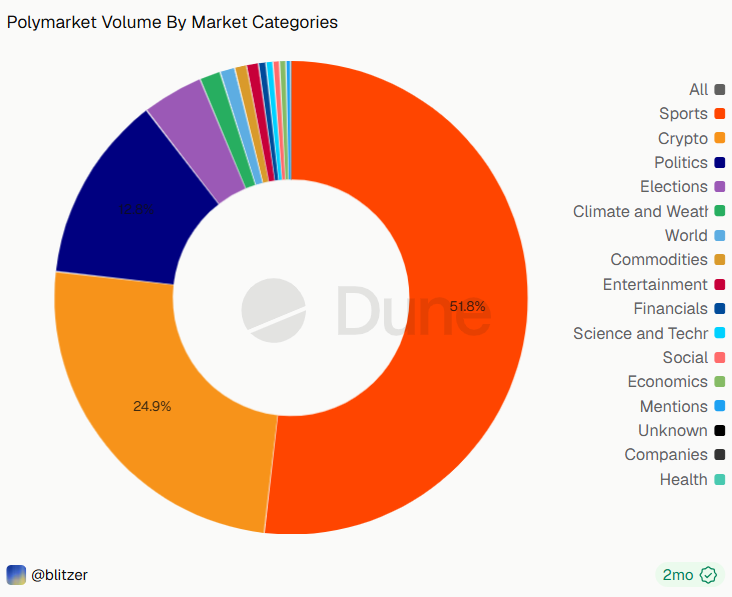
In contrast, political predictions represent just 1.5% of Kalshi’s total volumes, despite heightened interest during the midterms.
Sports remain Kalshi’s largest segment, generating 85.2% of its trading activity. Similarly, sports account for 95.4% of volumes on Polymarket US.
These differences show how the platforms attract traders across different event categories.
Polymarket liquidity and open interest reach new highs
Polymarket’s trading momentum has also supported stronger liquidity across its prediction markets.
According to DeFiLlama data, the platform’s total value locked briefly exceeded $400 million in late October.
Its decentralized exchange trading volumes also increased roughly 30% compared with the quieter summer months.
Meanwhile, Polymarket’s open interest reached a record $762.65 million in early November, reflecting increased outstanding positions.
Although presidential elections typically attract the most political trading activity, smaller elections also generate short-term volume increases.
Beyond elections, Polymarket continues to offer contracts covering numerous real-world events, supporting activity across smaller markets.
However, the platform recently experienced a front-end exploit that resulted in funds leaving affected user wallets.
Despite the security incident, traders returned during the midterm election results. Polymarket also maintained much of its liquidity and trading activity.
Political contracts could help prediction platforms reduce their dependence on sports markets.
That diversification matters as US regulators examine whether sports-related prediction contracts should face traditional sports betting requirements.
State gambling laws could also affect how platforms offer these contracts.
PolitiFi tokens react to US election outcomes
Political trading extends beyond prediction platforms into cryptocurrencies linked to political figures and election narratives.
According to market data, PolitiFi tokens retained a combined market capitalization exceeding $400 million in November 2026.
Several assets originated during the 2024 presidential election cycle and continue to respond to political developments.
Official Trump (TRUMP) declined following the midterm results amid concerns about potential investigations into Donald Trump’s cryptocurrency businesses.
Other political meme tokens experienced brief rallies as election discussions attracted speculative trading.
However, much of that activity involved smaller tokens with limited trading volumes.
Together, the developments show how election outcomes continue to influence both political prediction markets and cryptocurrency trading.