Non-sports prediction market volume has climbed to another record as Kalshi strengthens its lead over Polymarket.
The latest surge reflects rapid growth in short-dated crypto and index contracts across major retail trading platforms.
Distribution through mainstream brokerage apps has widened Kalshi’s reach beyond users who visit prediction-market platforms directly.
However, differing tracking methods mean reported market-share figures can vary across data providers.
Kalshi captures 96% of weekly non-sports volume
Weekly non-sports prediction market volume across Kalshi and Polymarket reached $10 billion in the week ending September 13.
Artemis data showed the combined figure marked the sixth consecutive weekly record for the category.
Kalshi generated $9.6 billion, while Polymarket recorded about $344.2 million in tracked activity. That gave Kalshi roughly 96% of the measured market, extending a sharp shift seen since early June.
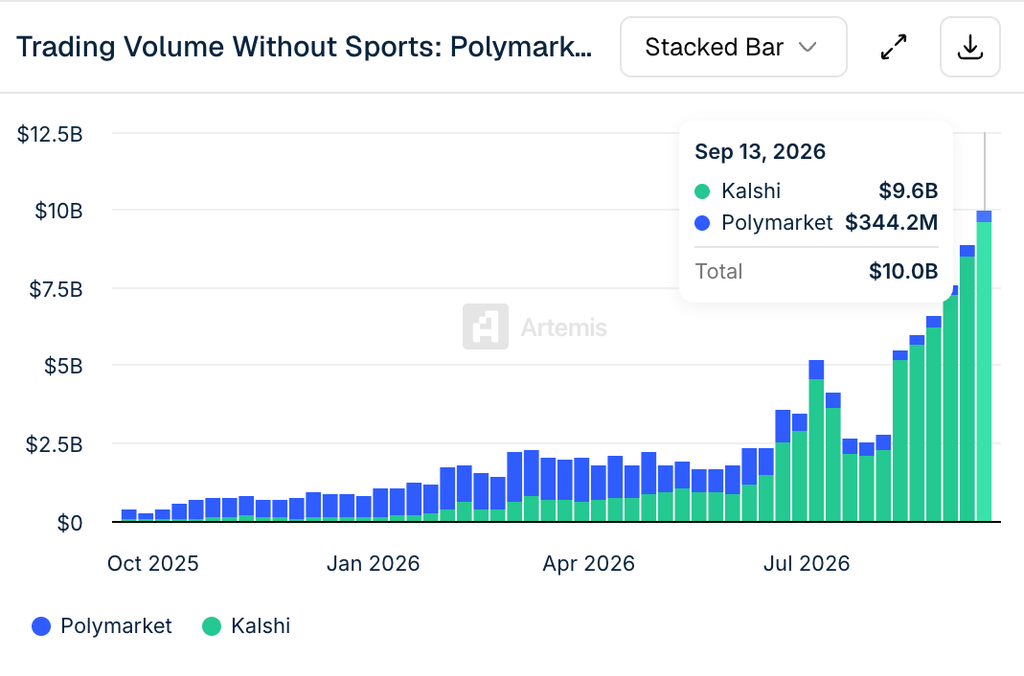
The balance looked very different only three months earlier, when weekly volumes across both platforms were much closer.
Polymarket also held the stronger position last year before Kalshi’s non-sports activity accelerated.
Kalshi’s expansion has coincided with distribution agreements across Robinhood, Coinbase, Webull and Moomoo.
Those retail platforms place Kalshi contracts before users who may never visit Kalshi directly.
The products promoted through those channels also shape the reported non-sports prediction market volume.
Webull’s prediction markets section features Kalshi-powered hourly contracts tied to major financial benchmarks and cryptocurrencies.
Those markets include the S&P 500, Nasdaq, Bitcoin, and Ethereum. Polymarket lacks comparable distribution across those mainstream retail platforms, limiting its exposure beyond crypto-focused users.
Hourly contracts and tracking rules inflate turnover differences
Short-dated contracts can generate repeated trading volume from the same pool of capital. An hourly Bitcoin contract can open and settle within 60 minutes before traders move into another contract.
The same account balance can therefore create fresh notional volume repeatedly throughout a trading day. By comparison, a Federal Reserve contract expiring in November can lock capital for weeks before settlement.
Both types still count toward reported volume, despite very different holding periods and capital turnover. Multi-leg combinations can create similar classification effects when several legs settle as one contract.
Trackers may classify the full notional under non-sports based on the contract structure rather than underlying components.
Measurement methods also complicate comparisons between Kalshi and Polymarket. Artemis tracks onchain activity, while Polymarket’s CFTC-regulated US.
venue does not settle trades through the same system. As a result, volume from that regulated venue does not appear inside the reported $344.2 million figure. Other data providers also classify crypto contracts, combinations, and exotic markets differently.
Those differences can change the estimated size of Kalshi’s lead, although trackers show the same broad direction.
Kalshi also faces potential distribution risk as some partners develop competing market infrastructure.
Robinhood has been developing Rothera with Susquehanna International Group as an exchange and clearing venture.
The project could eventually let Robinhood list event contracts without relying on an outside venue.
That matters because Robinhood reportedly accounts for roughly one-third of Kalshi’s daily trading flow.
That concentration shows how strongly distribution and contract duration now influence headline volume statistics. It also highlights why turnover requires context when comparing competing prediction markets.