MARA Digital Holdings has renewed concerns about potential Bitcoin sales after transferring more BTC to cryptocurrency exchanges.
The latest movements follow months of reserve reductions as the mining company adjusts its financial strategy.
Meanwhile, falling share prices and heavy short interest have added pressure to the company’s market outlook. Investors now face uncertainty over MARA’s Bitcoin holdings and its expansion into artificial intelligence infrastructure.
MARA transfers 1,000 BTC to Binance and Gate amid reserve reductions
MARA Digital Holdings (Nasdaq: MARA) transferred another 1,000 BTC from its public wallets to Binance and Gate exchange addresses.
On-chain data showed the company moved Bitcoin in several transactions involving 100 BTC and 500 BTC.
The transfers originated from the MARA Miner wallet, which receives Bitcoin through the company’s mining operations.
However, MARA has not confirmed whether the latest transfers resulted in sales. The movements nevertheless follow its broader reserve liquidation trend throughout 2026.
According to the reported figures, MARA has sold more than 33% of its Bitcoin reserves year-to-date.
The company previously transferred more than 800 BTC in early August. Its largest reported liquidation occurred in March 2026, followed by smaller transactions during the second half.
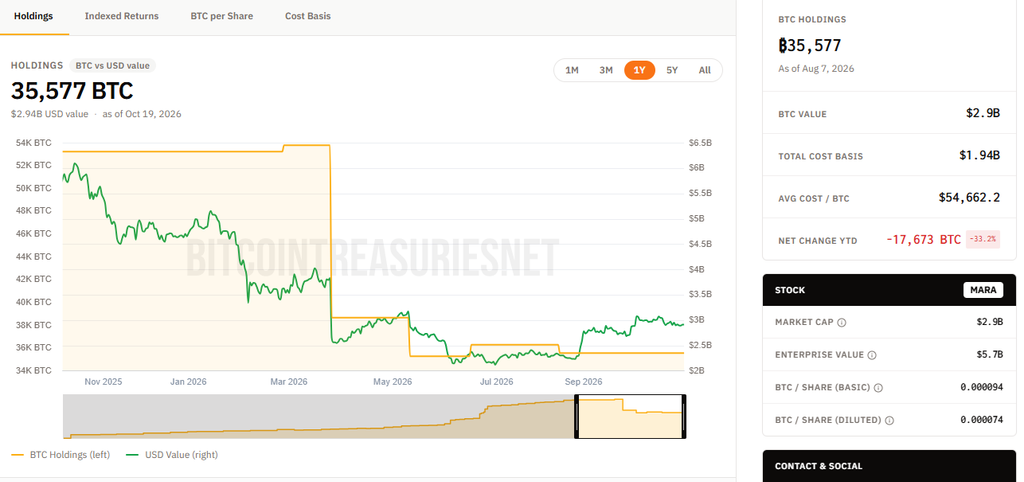
MARA’s last sale on August 6 liquidated some of the mined coins, but the company has not announced any other large cliff sales since March. | Source: Bitcoin Treasuries
Despite these reductions, MARA remains among the five largest corporate Bitcoin holders.
As of October 19, the company reportedly held approximately 35,577 BTC, supported partly by continued mining production.
MARA maintains 59 EH/s mining capacity while expanding AI infrastructure
MARA continues operating at approximately 59 exahashes per second (EH/s), maintaining mining activity near its highest levels.
Its mining pool typically produces two to three Bitcoin blocks daily, although network competition can influence production.
The company’s mining operations have expanded since 2024, supporting continued Bitcoin accumulation despite periodic reserve sales.
Meanwhile, MARA and other Bitcoin miners have increasingly sold newly mined coins rather than retaining their entire production.
Bitcoin prices above $83,000 have offered miners opportunities to secure revenue and manage operating expenses.
For MARA, Bitcoin sales could also support debt management and investments in artificial intelligence infrastructure.
The company plans to secure up to 4.8 gigawatts of energy capacity for its data center operations.
Its expansion strategy includes immersion cooling systems designed to support high-performance AI computing services.
MARA currently operates 19 mining sites, with five additional locations under development.
However, its AI infrastructure projects remain at an early stage, with significant revenue contributions potentially years away.
MARA stock falls toward yearly lows as short interest exceeds 26%
MARA shares traded near $7.53 on October 19, roughly 50% below their yearly peak.
The stock previously climbed above $14 in May following company announcements and growing interest in AI infrastructure.
However, declining miner valuations and weaker AI-related sentiment have weighed on its performance.
Reported short interest now exceeds 26% of MARA’s free float, representing approximately 100 million shares.
Shareholders have questioned the elevated short positions and requested greater transparency regarding trading activity.
Their concerns include whether investors primarily use these positions for hedging or bearish speculation.
Despite the substantial short interest, MARA has recorded no significant failures to deliver since March’s short-selling activity.
Some analysts believe MARA shares have lost the valuation premium previously associated with its AI expansion.
Consequently, Bitcoin reserves and mining performance could become more important drivers of future stock demand.