
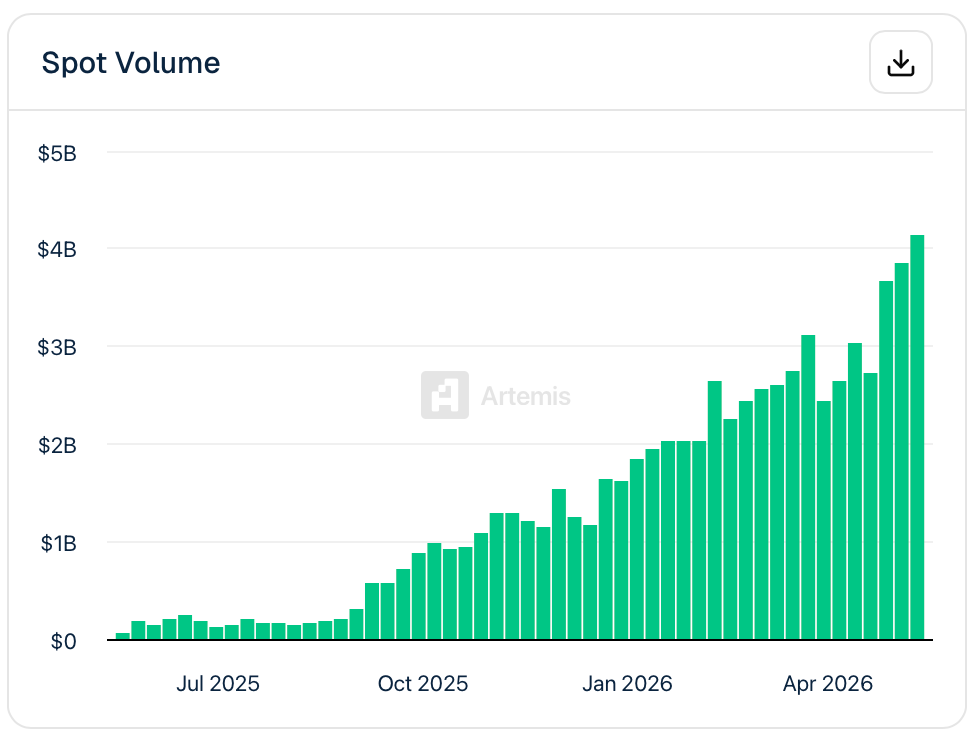
Kalshi crossed $4 billion in weekly notional volume for the first time, marking a major shift in the prediction market race.
The regulated US exchange processed about $4.1 billion during the week, compared with $54.5 million one year earlier.
That increase shows how quickly trading activity has moved toward platforms with stronger US access, deeper distribution, and cleaner market structure.
The milestone also widened Kalshi’s lead over Polymarket. Kalshi is now handling about 2.05 times Polymarket’s weekly volume, after both platforms were close to an even split in early March.
Polymarket recorded about $2 billion in the same week, which was slightly higher than the previous week but below levels seen earlier in the year.
Kalshi Gains After Polymarket Upgrade Issues
Kalshi’s volume surge came as Polymarket continued to face pressure from its April 28 V2 upgrade.
The upgrade briefly paused trading and removed open limit orders, forcing users to place them again after the new system went live.
That disruption weakened activity and hurt trader confidence during a period of rising competition.
The Block reported that Polymarket’s monthly volume fell in April after seven straight monthly records.
Source: Artemis
Trader numbers also dropped from about 733,000 in March to about 643,000 in April. Polymarket executives later acknowledged the problems, with senior figures saying the rollout disappointed users and exposed operational weaknesses.
Single Order Book Supports Liquidity
Kalshi has benefited from a simpler market structure. The platform operates as a CFTC-regulated US exchange with contracts trading through one unified order book.
That setup keeps liquidity in one place and can support tighter spreads across active markets.
Polymarket now operates two separate products.
Its global platform runs on Polygon and serves international users, while its US product runs through QCEX, the regulated venue acquired in 2025.
The two platforms do not share liquidity, which means similar markets can trade across different order books and settlement systems. That split creates friction for larger traders.
US Distribution Strengthens Kalshi’s Lead
Kalshi’s growth has also been supported by wider distribution. Its contracts reach retail users through PrizePicks, Coinbase, Robinhood, and Webull.
Clear Street also joined as the first futures commission merchant on the exchange in May, giving institutional desks another access point.
The funding backdrop has strengthened that position. Kalshi recently closed a $1 billion Series F at a $22 billion valuation, led by Coatue.
Polymarket is rebuilding its US presence after years outside the market. The current gap now reflects execution, regulation, liquidity, and distribution working in Kalshi’s favour.