
Artificial intelligence is raising fresh concerns about cryptocurrency security as industry leaders debate its ability to break blockchain cryptography.
Binance founder Changpeng Zhao and Ethereum co-founder Vitalik Buterin remain confident that Bitcoin’s underlying cryptography can withstand current AI threats.
However, researchers warn that advancing AI systems could expose weaknesses faster than developers can address them. Meanwhile, Bitcoin Core has revised its security disclosure rules to tackle growing risks from AI-assisted vulnerability detection.
CZ and Vitalik Buterin downplay AI threat to Bitcoin cryptography
Changpeng Zhao, widely known as CZ, argued Friday that artificial intelligence does not need to break Bitcoin’s cryptography to threaten users.
In an X post, the former Binance CEO expressed confidence in Bitcoin’s encryption compared with traditional financial infrastructure.
According to Zhao, Bitcoin’s cryptographic protections remain stronger than those supporting internet services and most banking systems.
However, he identified phishing and social engineering as more immediate threats, particularly when attackers exploit leaked personal information.
AI tools could strengthen such attacks without breaking the mathematical foundations protecting blockchain transactions.
Ethereum co-founder Vitalik Buterin previously expressed similar confidence in blockchain cryptography’s resilience against artificial intelligence.
Buterin also indicated that his confidence supports his decision to maintain most of his wealth in cryptocurrency.
Both industry figures consider existing cryptographic protections robust, although other researchers have questioned their long-term security.
Ethereum researcher warns AI could break crypto signatures
Ethereum Foundation researcher Justin Drake recently raised concerns about AI discovering mathematical breakthroughs capable of undermining existing cryptographic systems.
Earlier this month, Drake issued a “bunker mode” warning concerning the Elliptic Curve Digital Signature Algorithm, commonly called ECDSA.
Bitcoin and Ethereum have used ECDSA to verify transaction signatures and establish control over cryptocurrency holdings.
Drake warned that AI-assisted mathematical discoveries could potentially expose private keys within months rather than years.
His assessment challenged assumptions that quantum computing represents the primary future threat to blockchain cryptography.
However, Coinbase cryptography chief Yehuda Lindell rejected Drake’s warning and characterized it as fearmongering.
Blockstream CEO and Hashcash inventor Adam Back also dismissed the concerns, describing Drake’s assessment as unfounded fear.
Johns Hopkins cryptographer Matthew Green offered a more cautious perspective on AI’s ability to solve difficult mathematical problems.
Green suggested that researchers should not automatically assume human mathematical analysis remains beyond improvement by machines.
Bitcoin Core changes bug disclosure rules as AI threats increase
Meanwhile, Bitcoin Core developers have updated their vulnerability disclosure policy as AI tools accelerate software security research.
Developer Antoine Poinsot outlined the changes Thursday in an email to the Bitcoin Development Mailing List.
Poinsot explained that large language models can now uncover certain vulnerabilities with minimal effort.
Previously, Bitcoin Core maintained lengthy disclosure embargoes to give operators sufficient time to install security updates.
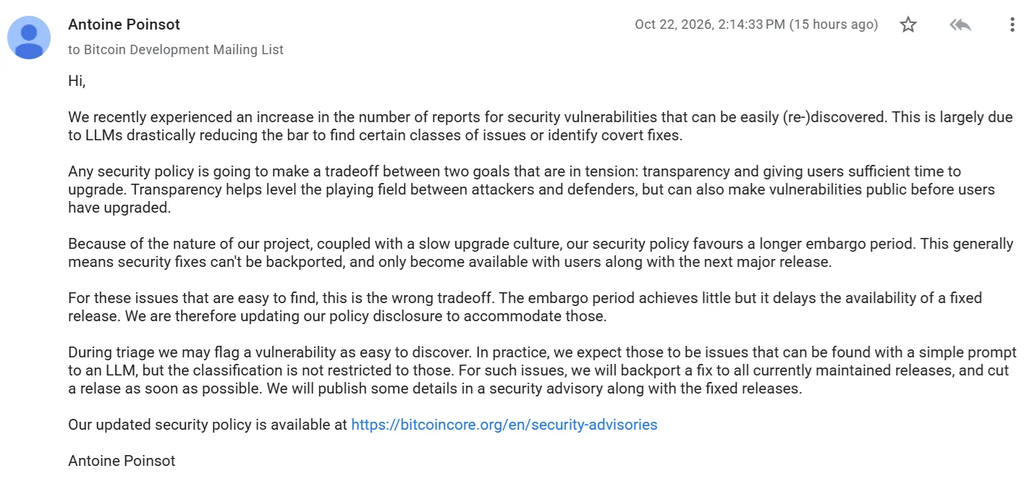
Developer Antoine Poinsot’s message to the Bitcoin Development Mailing List on Thursday. Source: Bitcoin Development Mailing List
However, those restrictions also delayed security fixes for older software versions.
Under the revised rules, developers will quickly release fixes across maintained versions for vulnerabilities they classify as easily discoverable.
They will also publish security advisories alongside those updates.
Other vulnerabilities will follow established severity-based disclosure schedules.
Low-severity issues will receive public disclosure two weeks after a major release includes the relevant fix.
Medium- and high-severity vulnerabilities will remain confidential until the final affected software version reaches its end of life.
That period generally lasts approximately one year, while critical vulnerabilities follow separate procedures.
Bitcoin Infinity Show host Luke de Wolf welcomed the policy revision despite previously disagreeing with Poinsot’s security approach.
The changes follow an August investigation involving 16 volunteer researchers from the Bitcoin Red Team.
Their AI-assisted review identified nearly 5,000 potential security issues across more than 390 projects.
Researchers classified hundreds of those findings as high or critical severity.
During the same month, Core Lightning developers urged operators to upgrade their software or disconnect vulnerable nodes.
Their warning followed a surge in AI-generated vulnerability reports, highlighting growing security pressures across cryptocurrency infrastructure.