BTC is in a high-risk, high-opportunity purchasing area since there is more market uncertainty and indications that it could be on an upturn.
The most popular cryptocurrency is offered at the boundaries of about $70,000; the risk is rather high, but the past history indicates the possible recovery levels.
AHR999 index signals rare buying conditions
The AHR999 index has fallen to its lowest point since 2023, which means there is a possible entry point for buyers.
The indicator implies that Bitcoin is underpriced compared to the past trends. Nevertheless, it also emphasizes a high level of ambiguity in the existing market conditions.
The 0.45 mark seems to be an important point of view for traders to find possible accumulation areas.
The index can be seen to hit local price bottoms when the index is lower than this. Nonetheless, this does not ensure the upward movement at once.
The index has been developed by an anonymous analyst and is concerned with timing short-term opportunities.
It has, in the past, given buy signals whenever the markets are at a low point. These indicators occurred in the 2022 bear market and other times of poor moods.
The index of 0.45 -1.2 represents a period of accumulation. As prices begin to stabilize during this phase, they usually precede any major breakout.
The existing literature indicates that Bitcoin is going through this phase once more.
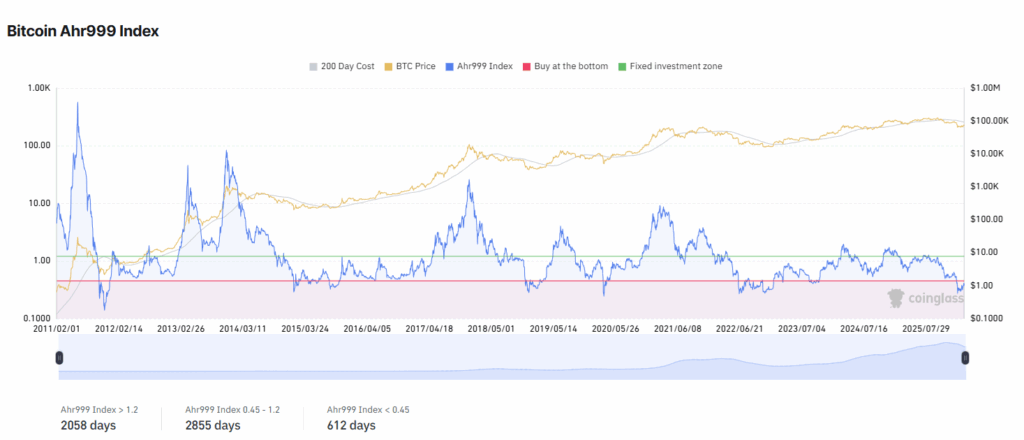
The AHR999 index points to opportunities where BTC trades with maximum uncertainty and offers a potential high-risk, high-reward opportunity. | Source: Coinglass
Market risk remains despite upside potential
Although the buy signal is in place, the risk levels are still high. Bitcoin is still undergoing unstable and imbalanced price movement.
Analysts caution that the asset can move in a sideways manner before it can recover.
Historical data indicate that the levels of such indices did not necessarily result in instant rebounds.
There are variations in the market conditions, which are caused by varying macroeconomic and geopolitical conditions. Sentiment is still affected by energy prices, world tensions, and policy changes.
Nonetheless, the historical data indicate that in most cases, Bitcoin recovers vigorously out of these areas.
Past dips have witnessed the prices increasing to over $70,000 in months since the prices dropped to approximately $28,000.
This trend contributes to the opinion that the potential upside can exceed the downside risk in the long term.
Simultaneously, the market has been changing in terms of its structure. Owning bitcoins is increasingly decentralized. Massive capitulation seems less probable in later cycles.
Retail investors lead while volatility persists
The most recent activity in the market has been significant for retail investors. Smaller buyers have been five months ahead of the institutional participation in dip buying.
This pattern is an indication of increasing confidence among individual traders.
Conversely, certain whales and institutions have become less exposed to uncertain times. Their activity implies an apprehensive attitude towards risk management.
Price stability has remained below that of the present times due to retail demand.
Volatility is at a high level at 2.19%. This puts Bitcoin in the high part of the recent volatility.
The market mood remains near the level of excessive fear, which puts traders on their heels.
As of now, Bitcoin is nearly 41.8% of its all-time high. It has even been under peak levels for more than 150 days. Nonetheless, the asset has been above the $70,000 range.
Durability holders have reduced sales. In the meantime, the market is still supported by ETF inflows and selective accumulation.
On the whole, the state of Bitcoin is the holding position because players await some understanding of the way.