
Aave liquidates hacker wallets after the KelpDAO exploit as Arbitrum governance approves the release of frozen ETH for recovery.
The decision covers 30,765.67 ETH held by the Arbitrum Security Council and supports a wider plan for affected rsETH holders.
It said more steps remain before all holders recover fully, and its lending markets continue to stabilize after withdrawals.
Arbitrum Vote Clears Frozen ETH Release
Arbitrum governance approved the release of 30,765.67 ETH that was frozen after the KelpDAO hack. The funds had remained under Arbitrum DAO control after the Security Council intercepted part of the attacker’s transactions.
Aave worked with KelpDAO, LayerZero, EtherFi, Compound, and other parties to support the recovery process. The coordinated effort aims to restore the ETH backing of rsETH and reduce losses across affected DeFi markets.
The vote received strong support, with more than 90% of participating Aave representatives backing the liquidation plan. Aave said about 1,600 addresses supported the decision, backed by roughly 190 million ARB tokens.
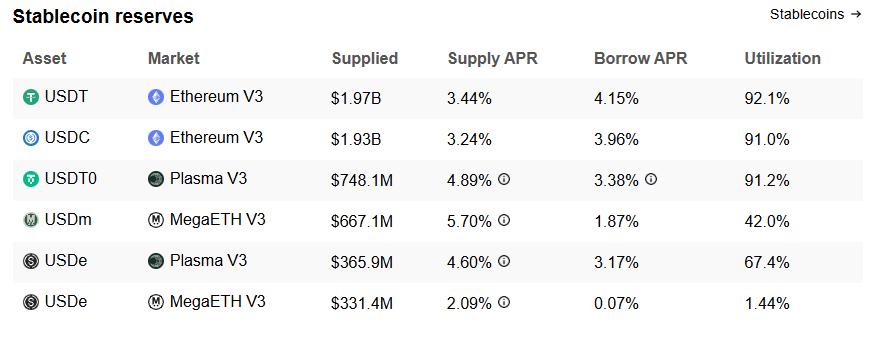
Aave stablecoin vaults have started normalizing their utilization and yield rates after the wave of withdrawals. | Source: AaveScan.
The approval has raised wider questions across DeFi. The freezing and release of stolen funds created debate over intervention, decentralization, and user compensation after major exploits.
KelpDAO Shifts Cross-Chain Infrastructure
KelpDAO has moved to change its cross-chain infrastructure after the exploit. The project migrated to Chainlink’s CCIP ecosystem after using LayerZero cross-chain tools.
KelpDAO had linked the earlier infrastructure to the conditions surrounding the $292 million exploit. The move signals a stronger focus on security controls after the rsETH incident affected several lending platforms.
Aave also used its own risk systems during the crisis. Some rsETH linked to the attacker was used in attempts to borrow more assets, but the protocol liquidated positions when risk levels exceeded its limits.
Even after those liquidations, Aave on Arbitrum estimated bad debt between $170 million and $230 million. Aave founder Stani Kulechov said further actions would follow to make the protocol whole and address remaining losses.
Aave Lending Markets Start Stabilizing
Aave has started to recover after an early liquidity shock. Its total value locked stabilized above $15 billion after around $10 billion in outflows.
Several major vaults have also returned toward healthier conditions. The WETH vault utilization remained above 93%, while USDT and USDC stood near 92% and 91%, respectively.
Those levels suggest the withdrawal pressure has slowed, although overall lending activity remains weaker. Lending fell 35% over the past 30 days, while stablecoin liquidity dropped 46.3%, based on Aavescan data.
However, lending rates have moved closer to normal levels. The average lending rate stood near 2.76%, while borrowing averaged 4.08%, with differences across individual vaults.
The AAVE token stabilized near $94 after the initial market reaction. Meanwhile, GHO supply stayed above $538 million, with no recent token burn reported.