
ZCash regained some market confidence after developers proposed a solution to address a recently disclosed counterfeit coin vulnerability that triggered a sharp selloff.
The privacy-focused cryptocurrency recovered above $435 after falling as low as $322 during a week marked by uncertainty and panic among investors.
While the network remains operational, questions about supply integrity continue to shape market sentiment.
ZEC rose by about 12% on June 7 following the announcement of the proposed Ironwood verification system.
Despite the rebound, the token remains down roughly 21% over the past seven days as traders continue to assess the long-term impact of the vulnerability.
Security Flaw Triggered Market Panic
The controversy began after security researcher Taylor Hornby identified a critical weakness within ZCash’s Orchard shielded pool.
The flaw created a possibility for unauthorized ZEC to be minted inside the privacy-focused section of the network.
Hornby reportedly used artificial intelligence tools to test the Orchard pool and later informed the ZCash Open Development Lab.
Developers patched the issue on June 2. However, the disclosure itself sparked widespread concern because the private nature of Orchard makes independent auditing difficult.
The vulnerability is believed to have existed for approximately four years. Because transactions within the Orchard pool are confidential, there is currently no definitive proof showing whether anyone successfully exploited the flaw.
This uncertainty fueled speculation about the true supply of ZEC and raised concerns that the asset could lose significant value.
Questions Remain Around Orchard Pool Activity
ZCash developers stated that the vulnerability only affected coin creation within the Orchard shielded pool and did not alter the publicly reported circulating supply. Current circulation remains at 16,755,823 ZEC according to network data.
The Orchard pool provides the highest privacy level available on the ZCash network. As a result, transaction participants and transfer details remain hidden from public view.
This design makes it difficult to determine whether counterfeit coins ever entered circulation.
Earlier in 2026, a large holder moved approximately 202,000 ZEC out of the Orchard pool in a single transaction.
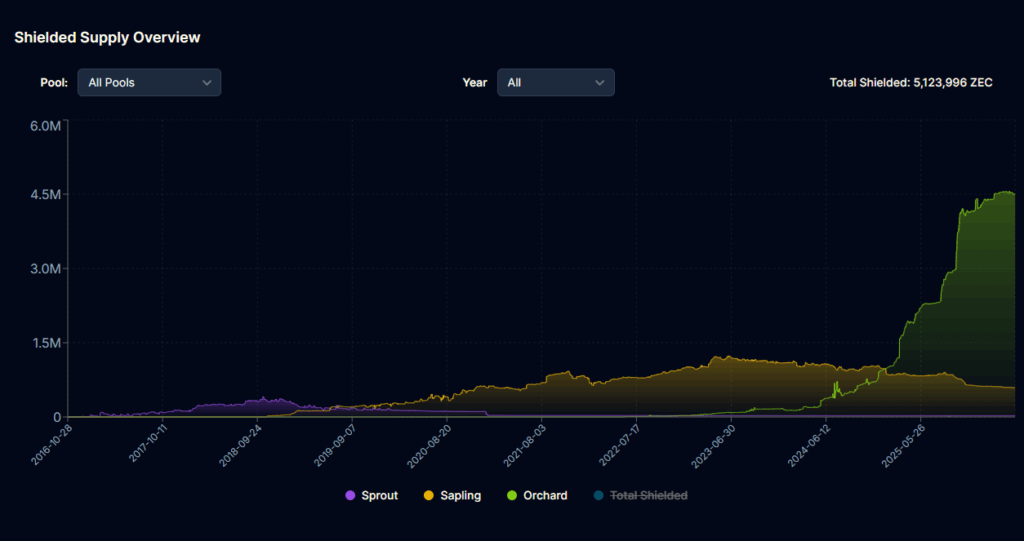
The Orchard pool doubled its ZEC supply in the past year, with only a handful of withdrawals. There is still no way to prove if counterfeit ZEC was created, as the pool shields all transactions. | Source: ZCash Info
The transfer represented around 1% of the pool’s holdings. Since Orchard activity cannot be fully traced, there is no way to verify whether all withdrawn coins originated from legitimate deposits.
Ironwood Proposal Targets Supply Verification
To address lingering concerns, the ZCash team introduced the proposed Ironwood verification system.
The upgrade would allow node operators to independently verify that the circulating supply matches the network’s expected mining schedule.
Under the proposal, the current Orchard pool would eventually be replaced with a new shielded pool using turnstile accounting.
This mechanism would require users to transfer legitimate balances into the new system while preventing any potentially counterfeit coins from crossing over.
The proposal still requires community approval. However, developers believe the approach could provide stronger assurance that ZCash’s supply remains accurate while helping rebuild trust after one of the network’s most challenging weeks.