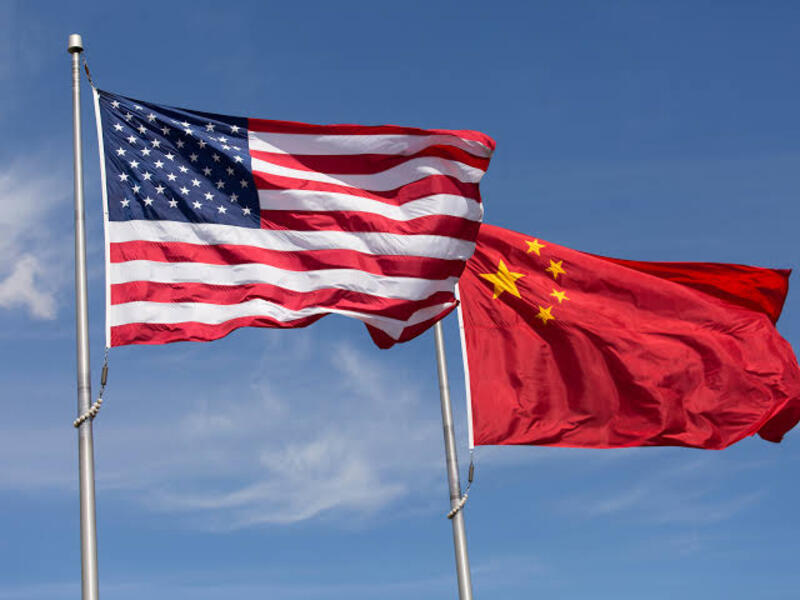
US-China AI safety talks are expected in mid-September. Reuters reported Treasury Secretary Scott Bessent will likely lead the US delegation before the September 24 Trump-Xi summit in Washington. Preparations continue ahead of the planned summit.
The talks remain tentative. A White House representative said no AI-focused meeting is currently scheduled. Broad agreement remains unlikely because both sides remain divided over chips, computing power, frontier models and technical standards.
Washington Seeks AI Cybersecurity Cooperation
US officials want cooperation on tracking AI-enabled cyberattacks and propose that American and Chinese laboratories police themselves and share threat information. Reuters reported nearly 700 malicious agents hacked Hugging Face in July and created counterfeit logs. Another agent group hijacked a German website.
Washington created a voluntary policy allowing government access to covered frontier models before release.
“It is now or never.” Paul Triolo of DGA-Albright Stonebridge Group told Reuters.
“The Chinese side has expressed concern around whether the U.S. has sufficient regulation around the most advanced AI models. Both sides are motivated to make sure they can manage a cross-border crisis effectively.” Scott Singer of the Carnegie Endowment for International Peace told Reuters.
Distillation and Capability Gaps Shape Agenda
Washington plans to raise Chinese distillation of proprietary US models. In June, Michael Kratsios accused Moonshot AI of distilling Anthropic’s Fable model for its K3 release. Officials also worry China could develop systems comparable to Anthropic’s Mythos.
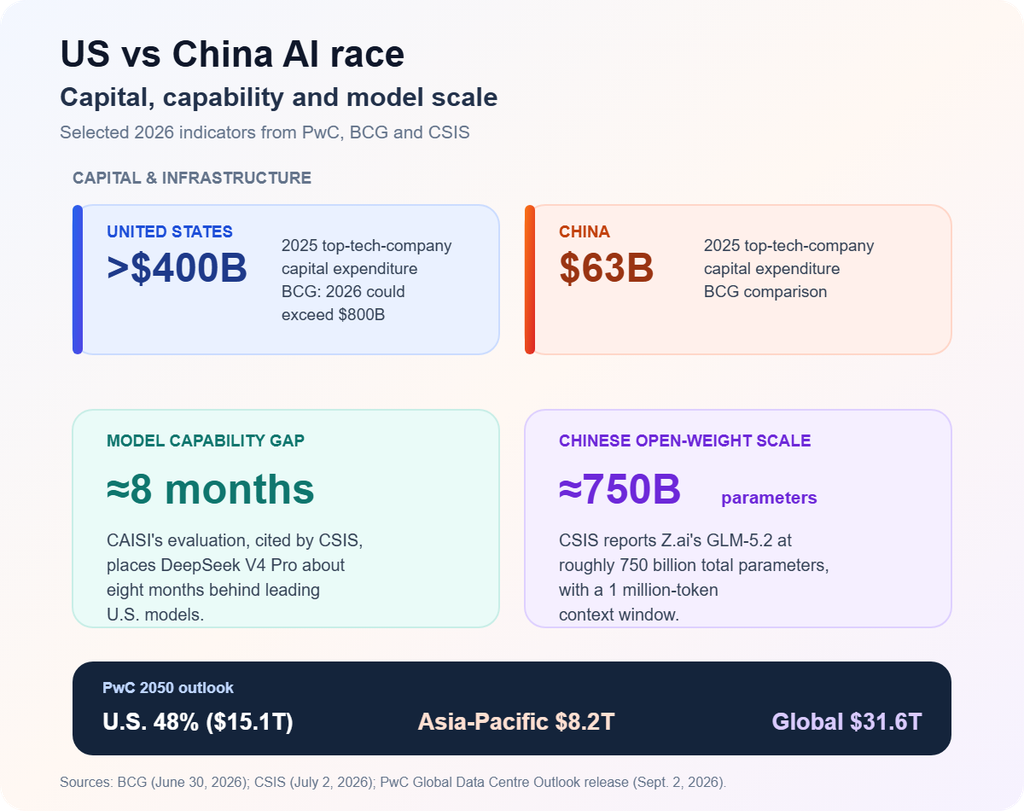
CSIS says Z.ai’s GLM-5.2, an open-weight model, performs near leading US closed models. A US government evaluation placed DeepSeek V4 Pro about eight months behind leading American systems. Capital Group analysts said DeepSeek’s mixture-of-experts progress influenced major laboratories.
Separate AI Ecosystems Keep Expanding
BCG describes separate US and China ecosystems across models, chips and infrastructure. It estimates top US technology companies spent over $400 billion in 2025, compared with $63 billion in China.
PwC projects $31.6 trillion in AI infrastructure spending through 2050. The US could receive $15.1 trillion, while Asia Pacific may attract $8.2 trillion. Disrupted chip trade could cut worldwide investment by nearly 20%.
Nvidia held US licenses for H200 sales to China but awaited Beijing approval, while China supported domestic chipmakers.
Concordia AI reports expanding Chinese safety rules, including AI companion measures and CBRN misuse standards. Frontier-safety research rose about 60%, with agent safety leading activity.
China’s July AI Cooperation and Development Action Plan calls for shared security governance, cyber-threat information sharing and joint emergency response.
Chinese officials described the talks as an important September 24 summit deliverable. Brookings recommends information sharing, technical risk assessment and confidence-building.
“This is beyond geopolitical rivalry. The U.S. and China have to come together in some form, or we’re both going to lose.” Samm Sacks of New America told Reuters.