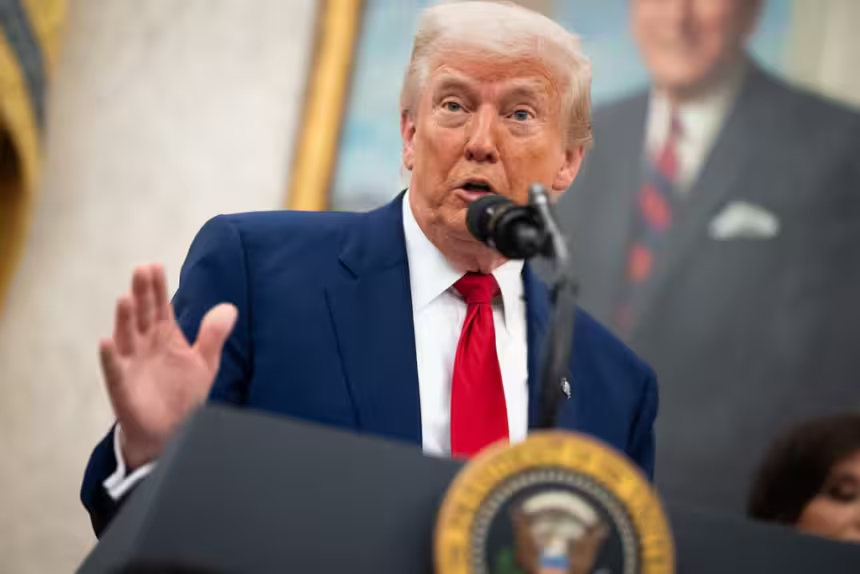
Former President Donald Trump has urged the U.S. Supreme Court to hurry up with its decision on a tariff case that could undermine the future of his tariff program.
Speaking to reporters at the White House, Trump said he was concerned by the attractiveness of a recent court ruling preventing the president from laying down specific tariffs.
Legal Battle Over Tariff Authority
The case in question has to do with a decision from the U.S. Court of Appeals for the Federal Circuit ruling that Trump exceeded his executive powers. In a 7-4 ruling, the court ruled that Congress and not the president has the constitutional authority to impose tariffs. In particular, the tariffs enacted under the authority of the International Emergency Economic Powers Act were found by the judges to be outside the realm of presidential authority.
Trump has since said he wants to ask the Supreme Court for an expedited review and a quick decision on the issue. The order is currently on hold until October 14 so that the administration can try to get the high court to intervene.
Implications for the U.S. Economy
Trump stated that if tariffs were removed, the U.S. economy would be severely damaged to the point where the country would become a “third-world country.” He recognized the danger of eliminating tariffs and said that the U.S. economic structure might collapse. The former president also intimated that the stock market had dropped because of market fears about the court’s decision.
While Trump claimed that investors hoped tariffs would stay, there was no concrete data that directly connected the court decision to market drops. Still, the dispute has cast doubt on the stability of tariffs targeting major trading partners, such as China, Mexico, and Canada.
Administration’s Legal Strategy and International Trade Concerns
The government has said it is hopeful that the Supreme Court will uphold its tariff policy. Treasury Secretary Scott Bessent admitted that the legal fight was important, but he said the White House was planning a backup plan, should the court not rule in their favor.
Apart from the tariffs, Trump also lashed out against India’s trade practices, terming the relationship between the two countries “one-sided.” Noting that India exports far more goods to the U.S. than it imports from the U.S., he said this imbalance has been in place for decades.
Now, the future of U.S. tariffs is in the hands of the Supreme Court to decide whether or not to take up the case and speed up a decision. If the lower court ruling is left in place, a large portion of tariffs would be overturned, and their impact on U.S. imports would be lessened.