As the global cryptocurrency mining industry pushes the absolute boundaries of physics and computational power, a critical question arises for modern investors: how small can a microchip get before it completely revolutionizes the game? For years, standard cloud mining pools relied heavily on generic, off-the-shelf rigs, forcing users to accept whatever basic efficiency the major hardware manufacturers dictated. But in a highly competitive 2026 landscape where every single watt of energy and every degree of thermal output directly impacts profitability, relying on standard equipment is simply no longer enough to maintain a competitive edge.
So, what happens when a forward-thinking cloud mining platform decides to stop renting old equipment and instead builds its own proprietary engine from the ground up?
How Does 5nm Technology Change Bitcoin Mining?
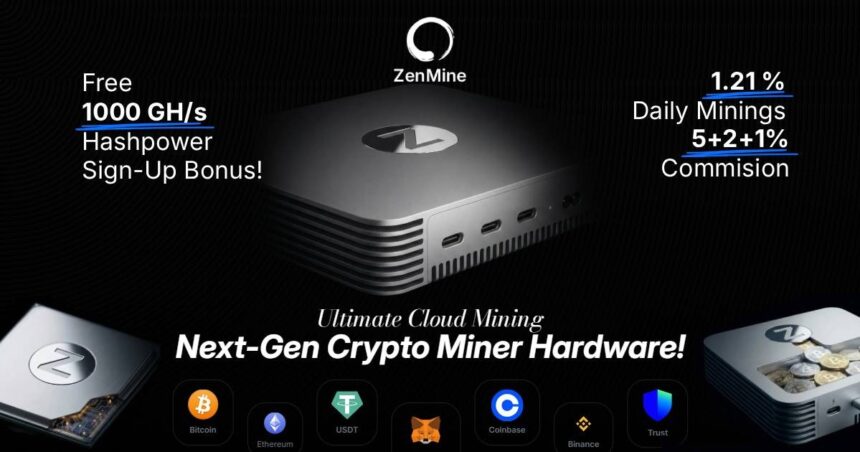
This is the exact engineering challenge that ZenMine tackled head-on with the development and deployment of the highly anticipated ZenCore Z1. At the absolute heart of this proprietary hardware ecosystem is a cutting-edge 5nm ASIC chip. To put that technical milestone into perspective for the average investor, a 5nm architecture allows for a significantly higher density of microscopic transistors within the exact same physical space compared to older, bulkier 7nm or 10nm models.
This technological leap means the hardware can process complex cryptographic algorithms exponentially faster while simultaneously drawing a mere fraction of the electrical power. The tangible result of this engineering? A staggering, verified output of 30 TH/s per individual unit, specifically optimized and calibrated for ZenMine’s internal ecosystem.
Why is Liquid Cooling Essential for Modern ASICs?
However, raw computational power almost always comes with a severe physical drawback: extreme, damaging heat. Anyone familiar with traditional Bitcoin mining farms knows the deafening roar of high-speed industrial cooling fans and the immense, costly energy they consume just to keep the machines from melting. How do you effectively mitigate this massive overhead?
ZenMine’s definitive answer is a fully integrated, state-of-the-art liquid cooling infrastructure. By completely submerging the operational core or utilizing advanced closed-loop liquid systems, the ZenCore Z1 entirely bypasses the gross inefficiencies of traditional air cooling. This proactive thermal management completely prevents thermal throttling—a common issue where a machine actively slows down its hash rate to avoid overheating—ensuring that the hardware runs at its absolute maximum 30 TH/s capacity, 24 hours a day, 7 days a week.
Can AI Really Optimize Hashpower in Real-Time?
Furthermore, in 2026, premium hardware is only as smart as the software actively driving it. The ZenCore Z1 isn’t just a physical powerhouse; it is continuously paired with ZenMine’s proprietary AI-powered mining optimization algorithms. This artificial intelligence dynamically routes hashpower based on network difficulty, micro-optimizes power consumption, and predicts necessary hardware maintenance long before actual physical failures occur.
This brilliant combination of 5nm efficiency, advanced liquid cooling, and AI oversight is exactly how the platform secures its industry-leading 99.95% guaranteed uptime. For the end-user looking to buy hashpower, it raises a highly important concluding question: why would you ever settle for renting outdated, air-cooled hardware when you can tap directly into the most advanced, liquid-cooled next-generation infrastructure currently available on the market?
About ZenMine: Hardware & Innovation
ZenMine is a New York-registered technology company at the forefront of cryptocurrency mining infrastructure. By engineering the proprietary ZenCore Z1 ASIC—featuring a 5nm architecture, 30 TH/s output, and advanced liquid cooling—ZenMine sets a new standard for computational efficiency. Coupled with AI-driven optimization, the platform allows global users to purchase high-yield hashpower directly, eliminating the need for personal hardware maintenance while ensuring a 99.95% operational uptime.
Disclaimer: The content within the Sponsored Insights and Press Release category has been provided by our partners and sponsors. The views and opinions expressed in these articles are those of the authors and do not necessarily reflect the official policy or position of our website. While our team takes care to share valuable and reliable content, we do not take responsibility for the accuracy, completeness, or validity of any claims made in these sponsored articles and Press Releases. Readers are encouraged to conduct their own research and due diligence before making any decisions based on the information provided in Sponsored Insights.