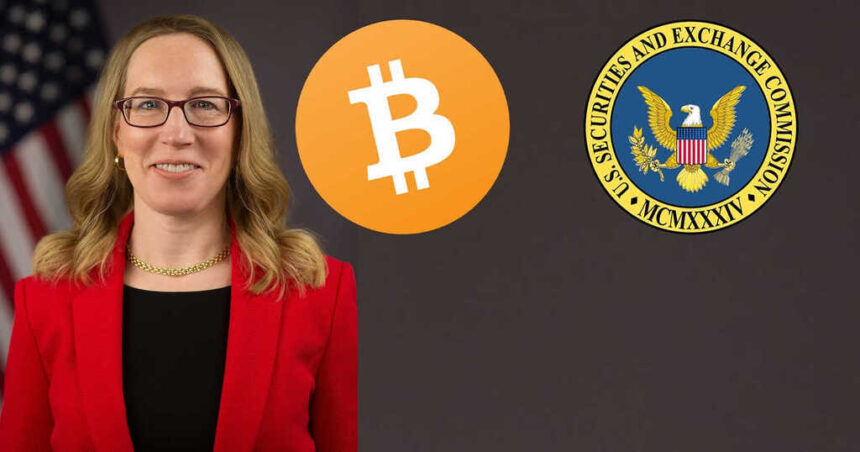
The U.S. SEC is increasingly becoming receptive to tokenized assets.
Commissioner Hester Peirce, a more pro-crypto advocate, has encouraged cryptocurrency companies to engage with the regulators early during the creation of tokenized assets.
This was a change of direction by the SEC towards cryptocurrency and blockchain-based securities.
SEC Seeks Collaboration with Crypto Firms
The crypto Mom, as she commonly goes by the name, Hester Peirce, has welcomed companies and asset managers in the crypto industry to approach the SEC and have them cooperate in new token projects.
She stressed dialogue between the agency and firms during the development process as opposed to taking action on the products once they are launched.
The stated proactive course of action is designed to guarantee adherence to regulations, as well as to promote innovations in the area of tokenized assets and exchange-traded products.
Peirce’s comments are in line with the changing attitude of the SEC towards blockchain securities.
The agency is aware that as the number of firms migrate their assets to blockchain systems increases, there will arise new challenges in regards to regulation and compliance.
According to Peirce, crypto companies should remain ready to ask hard questions about the operations, technicalities, and legal systems.
The SEC will, however, be willing to give directions and collaborate with these companies to deal with these issues.
A Tailored Innovation Exemption for Crypto Companies
The fact that a specific crypto-based innovation exemption can exist solely in the case of crypto firms specializing in tokenized securities was also discussed by Peirce.
She has admitted that these companies have a difficult time being guided by the existing securities laws and emphasized that the SEC is not making the determination as to whether a certain product is good or bad.
Instead, emphasis should be laid on the need to see to it that companies report the risks of their products.
This exemption would enable the firms to test various tokenized products and, at the same time, comply with the necessary legal requirements.
Even more, Peirce emphasized that the SEC is not against leveraged exchange-traded funds (ETFs), provided the products are legal.
The main issue that is taken into consideration by the SEC is not the quality of investment these products present, but their compliance with the required disclosure policies and protection of investors.
The Growing Interest in Tokenization
Tokenization is increasingly popular in cryptocurrency firms.
According to Peirce, numerous companies have continuously made proposals on tokenized assets, becoming more interested in this type of digital finance.
She admitted that the attitude towards blockchain technology has changed significantly, and some recognize the advantages of tokenization in such spheres as ownership tracing and the speed of settlement.
To cope with this increasing interest, the SEC has once again reiterated the significance of adhering to the traditional securities regulations.
Peirce emphasized that blockchain is not the reform of the nature of the assets but rather a present-day registry.
The tokenized securities are not governed by different laws compared to the traditional securities, and the SEC will make sure that these products possess the required level of transparency and control.
The SEC is changing its stance on tokenized assets because the regulatory body is trying to balance between innovation and investor protection.
The call by crypto companies to collaborate directly with the SEC by Peirce emanates a more open approach to tokenization, but remains subject to regulation.
As the cryptocurrency industry keeps expanding, the SEC is changing its approaches so as to support the creation of tokenized products that comply with the current regulations.
Nevertheless, companies have to continue to deal with legal intricacies and to fulfill disclosure obligations so that the market can be clean.