
Robinhood Chain is gaining attention as Robinhood Crypto SVP Johann Kerbrat emphasizes infrastructure over launching a native network token.
Kerbrat said the company’s tokenization effort is “just the beginning,” while development remains centered on technical foundations and stock tokens.
The network offers 24-hour on-chain versions of equities including Nvidia and Apple. These products provide economic exposure without granting holders a legal claim to the underlying shares. They are available across more than 120 countries but remain unavailable to U.S. persons.
Robinhood Chain Builds Without a Native Token
Robinhood Chain launched without a native token, separating its approach from many competing blockchain networks. The permissionless, EVM-compatible layer-2 uses Arbitrum technology, settles transactions on Ethereum, and requires Ether for gas fees.
Stock Tokens remain the network’s main strategic product, although trading activity currently tells a different story. OAK Research found that memecoins account for more than 99% of Robinhood Chain’s trading volume.
CASHCAT, a cat-themed token referencing Robinhood’s former mascot, rose more than 5,500% within one week. Its market capitalization approached roughly $200 million during that surge.
A July CoinDesk review found memecoin and stablecoin activity significantly exceeded tokenized real-world asset activity. Those real-world assets totaled $12.81 million, including approximately $10.68 million represented by stocks.
Robinhood CEO Vlad Tenev had told CNBC six days earlier that assets without utility “do not serve a lasting purpose.” He later posted that Robinhood Chain “works great for memes too” and followed CASHCAT’s account.
Network Activity Rises During Gas Subsidy
DefiLlama lists Robinhood Chain with about $536 million in total value locked. Its stablecoin market capitalization stands near $634 million, while 24-hour decentralized exchange volume is around $440 million.
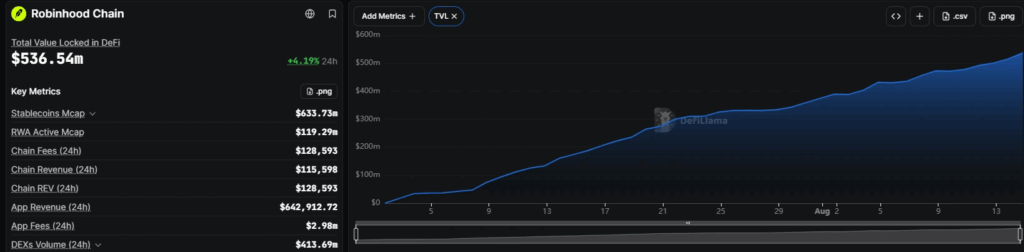
Robinhood Chain’s TVL has climbed steadily since launch. Source: DefiLlama
Ethena’s USDe increased from roughly $17 million one month earlier to about $253 million. That amount represents nearly 43% of the network’s stablecoin supply.
Growthepie data showed Robinhood Chain processing more than seven million daily transactions on July 13. That activity allowed the network to move ahead of Coinbase’s Base by that measure.
Robinhood is currently covering gas costs for eligible wallet users completing swaps, bridges, and perpetual trades. The 90-day subsidy is scheduled to end in late September.
Crypto Revenue Falls as Prediction Markets Grow
Robinhood reported $100 million in second-quarter crypto transaction revenue, representing a 38% year-over-year decline. Prediction markets generated $156 million and surpassed crypto revenue for the first time.
Despite weaker crypto transaction revenue, Robinhood’s total net revenue increased 32% to $1.31 billion. The company continues expanding tokenized stock access while its blockchain records heavier activity from memecoins and stablecoins. The contrast highlights how network usage differs from the equity-focused purpose behind Robinhood Chain’s initial design.