Moonshot AI plans to gradually expand the cybersecurity capabilities of its open-weight models while limiting potential misuse.
The Chinese startup aims to balance stronger coding performance with safeguards against advanced hacking threats.
Its latest Kimi model demonstrates substantial progress in vulnerability exploitation despite deliberate restrictions during training. The approach highlights growing challenges surrounding powerful open-weight artificial intelligence systems.
Moonshot cuts Kimi K3.1 Pro cyber performance to 81%
Beijing-based Moonshot AI said its Kimi K3.1 Pro model scored 81% on an internal cybersecurity benchmark. However, an experimental version retaining cybersecurity training data achieved 90.5% on the same test.
The company intends to “progressively raise the cyber capability available in open weights” while managing security risks. Moonshot plans to release Kimi K3.1 Pro’s complete model weights by November 4.
The model already operates through Kimi.ai and Kimi API, supporting a one-million-token context window. Moonshot also offers a high-speed version that runs two to three times faster.
Moonshot attributed the model’s exploitation capabilities to cybersecurity material within its mid-training corpus and reinforcement learning tasks. Early experiments indicated that retaining such data during either training stage substantially increased downstream hacking performance.
Consequently, developers excluded cybersecurity material from both stages while preserving general coding tasks.
Kimi outperforms predecessor in vulnerability exploitation tests
Kimi K3.1 Pro significantly surpassed its predecessor, Kimi K3, which solved just 33.3% of xdev-bench-hard tasks.
The benchmark evaluates AI agents against recently disclosed vulnerabilities involving the Linux kernel, Node.js, and Exim. Each task provides vulnerable source code, an executable binary, and a brief description of the flaw.
Agents must execute arbitrary code inside a sandbox and retrieve a secret string to demonstrate successful exploitation.
Moonshot’s comparison placed DeepSeek-V4.1-Flash at 85.7% and GLM-5.3 at 57.1%. However, both models used a different testing harness, limiting direct comparisons.
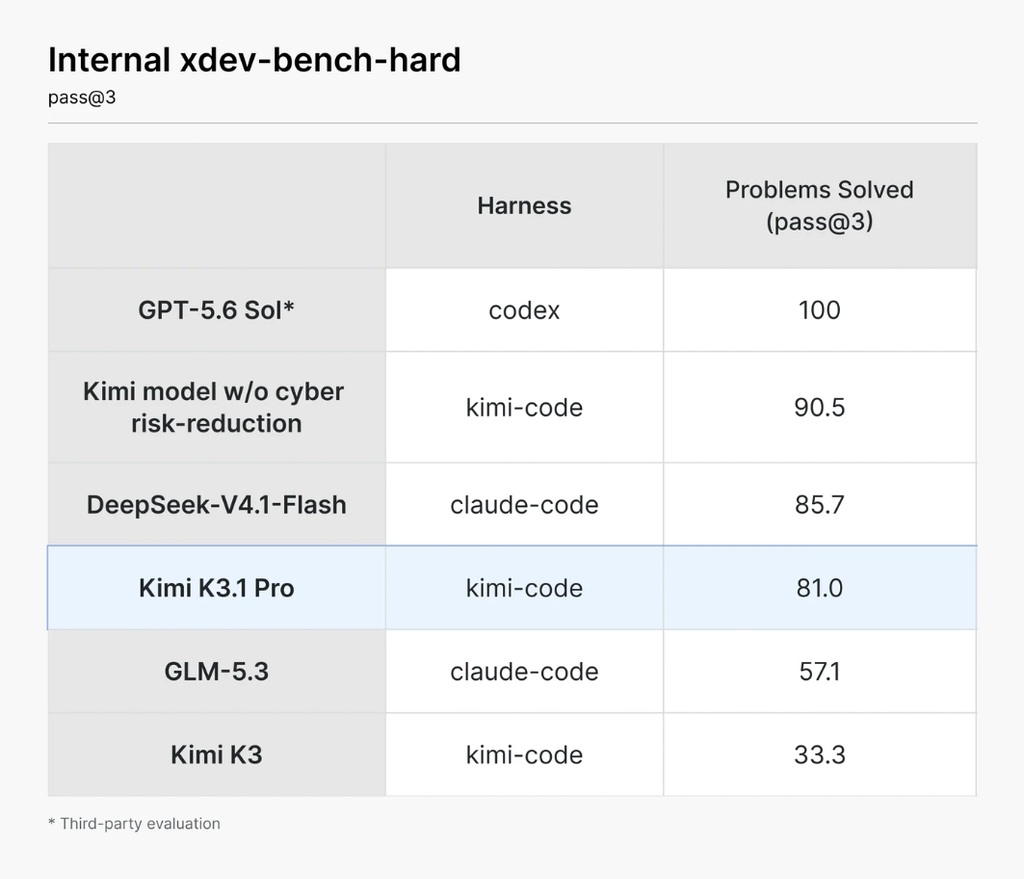
Moonshot’s xdev-bench-hard results for Kimi K3.1 Pro and rival models, from the company’s K3.1 Pro blog.
The company said Kimi K3.1 Pro trails frontier proprietary models in publicly demonstrated cybersecurity capabilities by at least three months. Independent researchers have not verified the benchmark results.
Moonshot balances open-weight access with cybersecurity risks
Moonshot said it does not intend to release open weights that extend the absolute frontier of hacking capabilities.
Instead, the company views gradual capability increases as a way to strengthen defensive cybersecurity applications. Organizations can deploy open models internally to audit proprietary software and older systems that rarely receive security reviews.
However, open-weight distribution creates oversight challenges once developers release the model files. Developers then lose substantial control over access, usage monitoring, and subsequent safeguard updates.
Meanwhile, China recently proposed export restrictions targeting AI technologies capable of generating malware or identifying software vulnerabilities. Authorities continue collecting public comments on the draft regulations.
Microsoft also linked China-associated threat group Storm-0940 to a ConnectWise breach involving ARTEX. The open-source penetration-testing framework supports integration with different AI models.
Outside cybersecurity, Moonshot reported that Kimi K3.1 Pro achieved 65.7% on Terminal-Bench 4.0. That exceeded OpenAI’s GPT-6 Astra at 58.2% but narrowly trailed Anthropic’s Claude Opus 5.5 at 66.4%.
Moonshot’s internal factual accuracy assessment also showed improvements. Kimi K3.1 Pro’s claim-level hallucination rate fell to 8.3%, compared with K3’s 23.4%.
Separately, Moonshot’s founders face an approximately $700 million arbitration claim from shareholder Recurrent AI. The dispute comes ahead of the company’s planned Hong Kong initial public offering.