HIP-3 compensates crypto slackness with an addition of up to 40% of the total amount in Hyperliquid.
The third-party market has been growing at a high rate, with the traders moving towards commodities and stock-linked perpetual futures.
This expansion is indicative of shifting market preferences and increasing demand for non-crypto exposure.
Rising volumes and expanding market share
HIP-3 remains an important part of the ecosystem of Hyperliquid. It represents as much as 21% of point of the open interest. It also adds up to 40% of the total trading volume.
Recently, the platform registered more than $19 billion in daily volume. It is a reversal to late 2024 levels. Players in the market attribute such growth to the increased availability of assets.
Stock and commodity contracts are now available in the third-party market. These tools can be used 24 hours a day. This is something that appeals to traders who want flexibility outside of the conventional markets.
The movement of activity seems to be out of other platforms. Hyperliquid is very liquid, unlike its competitors’ perpetual exchanges. The heightened involvement implies a wider migration pattern in the field of decentralized finance.
Commodities trading is also minimizing the use of altcoins. Traders are currently seeking opportunities that are related to real-life. This change is an indication of the demand for better price responsiveness and less uncertainty of volatility.
Oil futures drive trading activity
Perpetual futures that are based on oil continue to be the focus of HIP-3 activity. The trading volumes are dominated by the Brent and West Texas Intermediate contracts. These tools have been in the limelight amidst the market trends.
Brent crude has taken over WTI in the open interest. Brent hit the $286 million, and WTI fell to $215 million. This was after liquidations and the closing of positions.
There are mixed dynamics in trading volumes between the two benchmarks. Brent registered $955 million of volume. WTI has been the most active, with almost $1.25 billion.
The oil prices shot up in the early part of this year and reached a 5-year high. Brent rose to over $111 after which it relaxed to around $102 per barrel. The rally started at the levels of about $70 late in February.
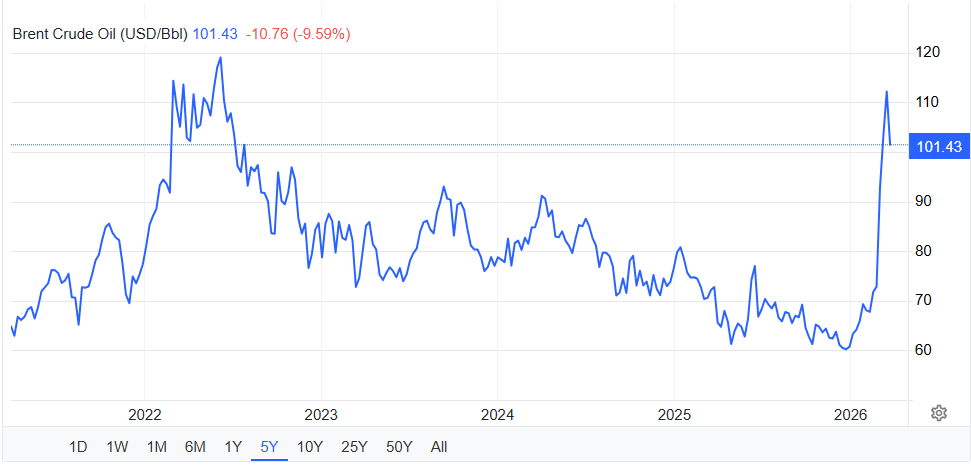
Oil prices had their steepest climb in the past five years, leading to a rush of perpetual futures trading with strong directional bets. | Source: Trading Economics.
The interest in the market also escalated following the influence of geopolitical concerns on supply expectations. The activity of traders was affected by news along the Strait of Hormuz. A lot of the participants reacted to this by placing directional bets.
On Hyperliquid, oil was selling close to $89 on March 24. The differences in pricing show the Oracle system of the platform. These distinctions generate distinctive purchasing and offering patterns.
A new category beyond traditional crypto assets
HIP-3 brings in a new trading concept in the decentralized markets. The contracts are not depictions of real commodities. They do not have anything to do with physical delivery or conventional futures.
Rather, traders transact in perpetual futures. These permit jobs that have no expiry dates. Players within the market are able to respond quickly to new trends.
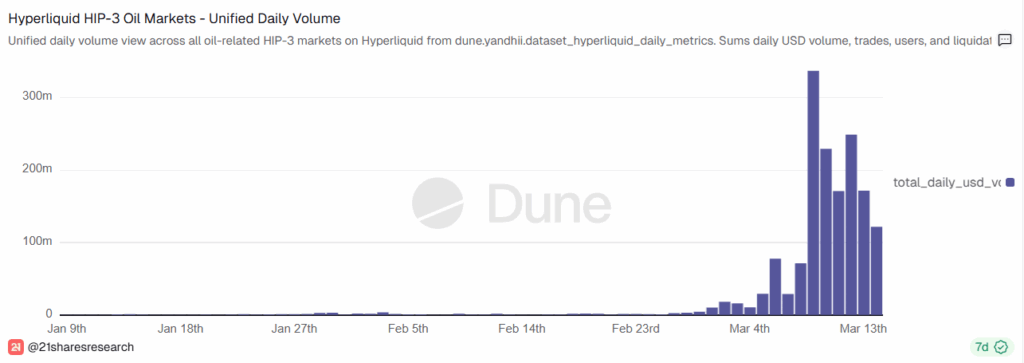
HIP-3 oil markets immediately reacted to potential oil shocks, increasing weekly trading to a higher baseline. | Source: Dune Analytics.
The system assists in quick reaction to international developments. News events are reacted to in oil markets within the platform. This elasticity appeals to both the small traders and the big investors.
Whales are engaging in these markets. Others make short positions when there is a potential fall. Some of them seek to exploit externally induced volatility.
In this environment, liquidations are still a part of it. Other big traders have incurred losses when the price is swinging. Nonetheless, other people have realized their gains and have left posts successfully.
HIP-3 is still increasing its position in Hyperliquid. Its development points to a wider trend of diversified trading. This pattern can redefine activity at decentralized exchanges within the next several months.