
Bitcoin drops down to its fourth annual loss as the market becomes weary of the asset, as on-chain data points to a continued spell of weakness.
The recession is an indication of declining dynamics as opposed to a shock-based collapse. The analysts term the move as a gradual loss of confidence in the market.
Considerable trading in the recent past indicates that Bitcoin is down 3.7% in the New York session on Monday. The decline brought the loss per year down to approximately 7%. According to data obtained by significant crypto trackers, the slide is still not that strong compared to previous years of drawdown.
Bitcoin has an uncharacteristic yearly decline
According to the indicators on-chain, Bitcoin is set to lose annual returns for the fourth consecutive year. This would be a first where there was no major scandal that would lead to the downturn. Previous annual drops were preceded by the events of the crisis that broke the belief in crypto markets.
In 2014, the Mt. Gox hack revealed the flaws in centralized exchanges. Bitcoin had been depreciating by almost 58 percent in the same year. In 2018, the burst of the ICO market plunged Bitcoin approximately 74%, its most significant decline.
The 2022 crash was preceded by collapses of companies like FTX. It was also the time when aggressive regulatory actions were developed by the Biden administration. All the incidents led to acute and immediate selloffs in the digital assets.
The existing downward trend exhibits another trend. There is increased institutional adoption and increased regulatory clarity. The investor turnout is low in spite of these changes.
ETF performance and waning risk appetite
Bitcoin is plunging after it reached almost $126,000 towards the beginning of October. Public support by some leaders, including President Donald Trump, did not change the situation. According to market data, there is no great motivation to purchase the dip.
According to SoSoValue statistics, over $5.2 billion has been pulled out of US-listed spot Bitcoin ETFs since October 10. The trading volumes are low, which is an indication of low demand. Massive acquisitions by companies such as Strategy have not helped to boost the mood.
Kaiko said the market depth has declined approximately 30% of the annual peak. Close to $19 billion of leveraged positions were sold on October 10. The incident showed a vulnerable standing below the rally.
Analysts perceive consolidation and not collapse
Maxime Seiler of STS Digital is of the opinion that there is a time correction in the current cycle. Instead of a breakdown, he anticipates a long consolidation. Bitcoin is trading at a wide scale of $70,000-100,000
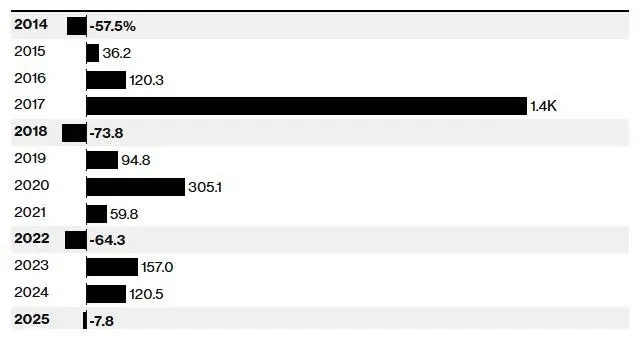
Annual returns for Bitcoin from 2014 to date. Source: Bloomberg.
Apollo Crypto Pratik Kala notes that following through following positive catalysts is weak. He observes that Bitcoin has been separated from equities. The S and P 500 has increased 16% per annum earlier this month.
Bitcoin has also been struggling with technology stocks performing well. Kala also adds that older whale holders have sold by imposing a strain on prices. The highest number of short-term holders has realized losses, which are the highest since the collapse of FTX.
The existing indicators are a warning in the market. The traders are seemingly ready to wait until the volatility subsides. To date, the fall of Bitcoin is a sign of exhaustion and not a sign of panic.