
Stablecoin growth faces increasing pressure as traditional banks compete for deposits through higher interest rates.
New research from the Bank for International Settlements (BIS) highlights how deposit pricing influences digital asset adoption.
The findings reveal differences between major stablecoins and their sensitivity to changing banking conditions. Meanwhile, regulators face growing questions about stablecoin yields and reserve requirements.
BIS research links higher deposit rates to slower stablecoin growth
A one-basis-point increase in US bank deposit rates reduces average 10-week stablecoin growth from approximately 15% to 12%, according to BIS research.
The study found that each basis-point increase reduces stablecoin growth by roughly three percentage points. However, growth remains positive despite stronger competition from traditional bank deposits.
A stricter method designed to identify causation revealed a larger impact. Under this approach, the same deposit rate increase reduces growth by approximately nine percentage points, leaving growth near 6%.
BIS economist Iñaki Aldasoro and Rashad Ahmed of the Andersen Institute for Finance and Economics authored Working Paper 1382.
The researchers published their findings on October 13, examining weekly US financial data between January 2019 and June 2025.
During this period, stablecoin market capitalization increased from under $5 billion to more than $220 billion.
USDC shows greater sensitivity than USDT to deposit rates
The BIS study identified significant differences between Circle’s USDC and Tether’s USDT.
USDC growth declined approximately 4.8 percentage points per basis-point increase in deposit rates. Meanwhile, USDT recorded a smaller reduction of 1.9 percentage points.
Researchers attributed USDC’s greater sensitivity to its stronger connections with US depositors.
The findings also showed similar effects among stablecoins supplied to decentralized finance protocols. However, the researchers found no comparable relationship among cryptocurrencies outside the stablecoin sector.
The study explained that banks generally pass limited interest rate increases to depositors when federal funds rates remain below 3%.
Above that threshold, banks compete more aggressively for deposits through higher savings rates.
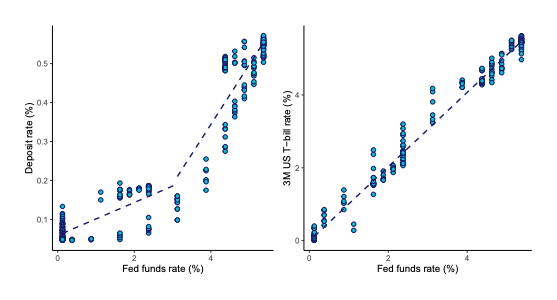
Federal funds rate against US deposit rates, left, and 3-month T-bill rates, right, January 2019 to June 2025, from Figure 2 of the BIS working paper.
Consequently, deposit accounts become more attractive than stablecoins that offer no direct interest payments.
The researchers described reserve-backed stablecoins as partial substitutes for traditional bank deposits.
BIS findings raise questions over stablecoin yield regulations
The research identified two regulatory considerations: stablecoin yield payments and requirements governing issuers’ reserve holdings.
European regulators already face disagreements over bank deposit reserve requirements under the Markets in Crypto-Assets Regulation (MiCA).
The European Central Bank and 27 EU national central banks have urged Brussels to remove existing deposit requirements.
MiCA currently requires issuers to maintain at least 30% of reserves in bank deposits, rising to 60% for significant tokens.
Meanwhile, US banking groups oppose stablecoin yield payments as the GENIUS Act approaches its January implementation.
The findings arrive as stablecoin issuers face increasing competition over reserve earnings and distribution partnerships.
Circle recently reported that distribution partners and transaction costs consumed 59% of its approximately $1.4 billion first-half 2026 revenue.
Operating expenses accounted for 34%, leaving 7% as net profit. Circle’s USDC supply stood near $72.5 billion.
Rival Open USD has also attracted attention by offering partners a greater share of reserve earnings.
However, the researchers acknowledged limitations, including their reliance on one high-interest-rate period between 2022 and 2025.
They also cautioned that their findings do not establish whether stablecoin adoption reduces bank deposits or lending.