
South Korea’s cryptocurrency industry faces renewed scrutiny over exchange security as regulators push for stronger safeguards.
Recent cyberattacks have increased pressure on trading platforms to protect customer assets. Consequently, exchanges are reviewing their security arrangements and storage practices. Gopax has now taken precautionary measures amid growing concerns about further attacks targeting the industry.
Gopax halts trading and transfers customer assets into cold storage
Gopax, the South Korean cryptocurrency exchange majority-owned by Binance, suspended all trading and transfers on Friday, November 6. The exchange announced the temporary restrictions to move 100% of customer assets under its custody into offline wallets.
According to South Korean outlets Digital Asset and Etoday, Gopax stopped processing deposits and withdrawals at 2:55 p.m. local time (05:55 UTC). It subsequently halted trading at 3:53 p.m. (06:53 UTC) and canceled all outstanding orders.
The exchange said it initiated the measures based on recommendations from financial authorities. It also clarified that the suspension did not follow any security breach or theft involving its platform.
However, Gopax has not announced when it expects to resume normal operations. Customers who need access to their tokens can contact its support team through [email protected].
The exchange warned that manual processing and approval could delay customer requests as support teams handle individual cases.
Cold storage involves keeping cryptocurrency in offline wallets, separating customer assets from internet-connected systems. This approach reduces exposure to online attacks and unauthorized access.
South Korea considers raising cold storage requirements to 99%
Gopax’s decision follows emergency discussions between South Korean financial regulators and cryptocurrency industry representatives. The Financial Services Commission (FSC) has recommended stronger security requirements following the recent Binance hack.
One proposal involves increasing the minimum percentage of customer assets held in cold storage from 80% to 99%. Regulators also recommended round-the-clock monitoring of deposits and withdrawals, alongside additional financial reserves.
However, these measures remain recommendations. South Korean authorities have not finalized or adopted the proposed requirements.
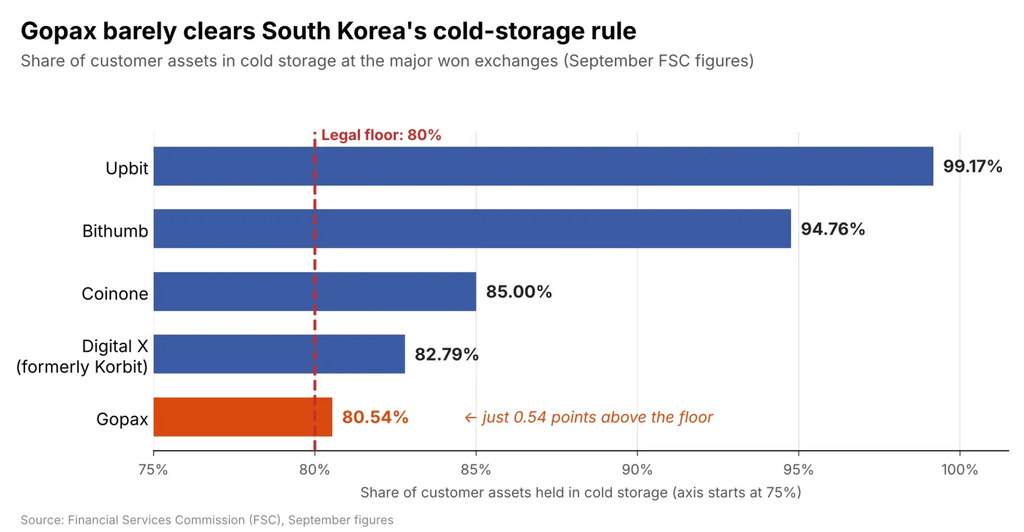
FSC figures from September show that Gopax held just 80.54% of customer assets in cold storage. That figure represented the lowest percentage among the country’s major cryptocurrency exchanges.
Upbit reported 99.17% of assets in offline storage, while Bithumb held 94.76%. Coinone recorded 85%, while Digital X, formerly Korbit, reported 82.79%.
Binance acquired its majority stake in Gopax in early 2023. The exchange purchased the stake to help customers affected by the GoFi withdrawal freeze.
Binance hack intensifies scrutiny of South Korean exchanges
The Gopax suspension comes less than a week after hackers stole approximately $6.36 billion from Binance hot wallets. TRM Labs identified the October 29 incident as the largest cryptocurrency theft on record.
According to investigators, attackers extracted the funds within approximately 20 minutes. The FBI attributed the operation to North Korea’s TraderTraitor group, although Pyongyang denied involvement.
Meanwhile, several South Korean financial institutions have experienced cybersecurity incidents. Mirae Asset Global Investments, Bithumb and Daishin Securities have all suffered breaches.
President Lee Jae Myung has consequently asked his cabinet to examine the establishment of a government-wide cybersecurity agency.
Gopax also disclosed a separate security incident last month involving leaked personal information. The breach exposed information belonging to seven customers and two current or former employees.
The intrusion began in early September but remained undetected until early October.
As South Korean authorities review exchange security standards, Gopax’s decision highlights growing pressure on cryptocurrency platforms to strengthen customer asset protection.